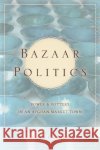
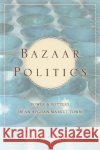
After the fall of the Taliban, instability reigned across Afghanistan. However, in the small town of Istalif, located a little over an hour north of Kabul and not far from Bagram on the Shomali Plain, local politics remained relatively violence-free. Bazaar Politics examines this seemingly paradoxical situation, exploring how the town's local politics maintained peace despite a long, violent history in a country dealing with a growing insurgency. At the heart of this story are the Istalifi potters, skilled craftsmen trained over generations. With workshops organized around extended...
After the fall of the Taliban, instability reigned across Afghanistan. However, in the small town of Istalif, located a little over an hour north of K...
After the fall of the Taliban, instability reigned across Afghanistan. However, in the small town of Istalif, located a little over an hour north of Kabul and not far from Bagram on the Shomali Plain, local politics remained relatively violence-free. Bazaar Politics examines this seemingly paradoxical situation, exploring how the town's local politics maintained peace despite a long, violent history in a country dealing with a growing insurgency. At the heart of this story are the Istalifi potters, skilled craftsmen trained over generations. With workshops organized around extended...
After the fall of the Taliban, instability reigned across Afghanistan. However, in the small town of Istalif, located a little over an hour north of K...
The decades-long resilience of Middle Eastern regimes meant that few anticipated the 2011 Arab Spring. But from the seemingly rapid leadership turnovers in Tunisia and Egypt to the protracted stalemates in Yemen and Syria, there remains a common outcome: ongoing control of the ruling regimes. While some analysts and media outlets rush to look for democratic breakthroughs, autocratic continuity--not wide-ranging political change--remains the hallmark of the region's upheaval. Contrasting Egypt and Syria, Joshua Stacher examines how executive power is structured in each country to show how...
The decades-long resilience of Middle Eastern regimes meant that few anticipated the 2011 Arab Spring. But from the seemingly rapid leadership turnove...
The decades-long resilience of Middle Eastern regimes meant that few anticipated the 2011 Arab Spring. But from the seemingly rapid leadership turnovers in Tunisia and Egypt to the protracted stalemates in Yemen and Syria, there remains a common outcome: ongoing control of the ruling regimes. While some analysts and media outlets rush to look for democratic breakthroughs, autocratic continuity--not wide-ranging political change--remains the hallmark of the region's upheaval. Contrasting Egypt and Syria, Joshua Stacher examines how executive power is structured in each country to show how...
The decades-long resilience of Middle Eastern regimes meant that few anticipated the 2011 Arab Spring. But from the seemingly rapid leadership turnove...
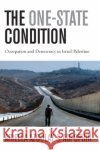
Since the start of the occupation of Palestinian territories in 1967, Israel's domination of the Palestinians has deprived an entire population of any political status or protection. But even decades on, most people speak of this rule--both in everyday political discussion and in legal and academic debates--as temporary, as a state of affairs incidental and external to the Israeli regime. In The One-State Condition, Ariella Azoulay and Adi Ophir directly challenge this belief.
Looking closely at the history and contemporary formation of the ruling apparatus--the technologies...
Since the start of the occupation of Palestinian territories in 1967, Israel's domination of the Palestinians has deprived an entire population of ...
Collusion between business communities and the state can lead to a measure of security for those in power, but this kind of interaction often limits new development. In Syria, state-business involvement through informal networks has contributed to an erratic economy. With unique access to private businessmen and select state officials during a critical period of transition, this book examines Syria's political economy from 1970 to 2005 to explain the nation's pattern of state intervention and prolonged economic stagnation.
As state income from oil sales and aid declined, collusion...
Collusion between business communities and the state can lead to a measure of security for those in power, but this kind of interaction often limit...
Before the 2011 uprisings, the Middle East and North Africa were frequently seen as a uniquely undemocratic region with little civic activism. The first edition of this volume, published at the start of the Arab Spring, challenged these views by revealing a region rich with social and political mobilizations. This fully revised second edition extends the earlier explorations of Egypt, Morocco, Lebanon, Saudi Arabia, and Turkey, and adds new case studies on the uprisings in Tunisia, Syria, and Yemen.
The case studies are inspired by social movement theory, but they also critique and...
Before the 2011 uprisings, the Middle East and North Africa were frequently seen as a uniquely undemocratic region with little civic activism. The ...
Before the 2011 uprisings, the Middle East and North Africa were frequently seen as a uniquely undemocratic region with little civic activism. The first edition of this volume, published at the start of the Arab Spring, challenged these views by revealing a region rich with social and political mobilizations. This fully revised second edition extends the earlier explorations of Egypt, Morocco, Lebanon, Saudi Arabia, and Turkey, and adds new case studies on the uprisings in Tunisia, Syria, and Yemen. The case studies are inspired by social movement theory, but they also critique and expand the...
Before the 2011 uprisings, the Middle East and North Africa were frequently seen as a uniquely undemocratic region with little civic activism. The fir...
Following the 1948 war and the creation of the state of Israel, Palestinian Arabs comprised just fifteen percent of the population but held a much larger portion of its territory. Offered immediate suffrage rights and, in time, citizenship status, they nonetheless found their movement, employment, and civil rights restricted by a draconian military government put in place to facilitate the colonization of their lands. Citizen Strangers traces how Jewish leaders struggled to advance their historic settler project while forced by new international human rights norms to share political...
Following the 1948 war and the creation of the state of Israel, Palestinian Arabs comprised just fifteen percent of the population but held a much lar...
Following the 1948 war and the creation of the state of Israel, Palestinian Arabs comprised just fifteen percent of the population but held a much larger portion of its territory. Offered immediate suffrage rights and, in time, citizenship status, they nonetheless found their movement, employment, and civil rights restricted by a draconian military government put in place to facilitate the colonization of their lands. Citizen Strangers traces how Jewish leaders struggled to advance their historic settler project while forced by new international human rights norms to share political...
Following the 1948 war and the creation of the state of Israel, Palestinian Arabs comprised just fifteen percent of the population but held a much lar...