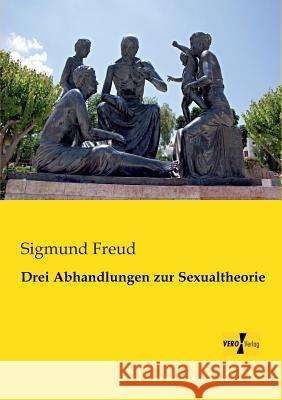
Freud's groundbreaking, troublemaking theory of sexual aberrations, adolescent sexuality, and the transformation of puberty--in the authorized A.A. Brill translation, with an introduction by James Putnam.
Freud's groundbreaking, troublemaking theory of sexual aberrations, adolescent sexuality, and the transformation of puberty--in the authorized A.A. Br...
The simple but convincing explanations of things familiar to everybody are explained here: the sudden forgetting of names, of sets of words, impressions and intentions; childhood memories; bungled actions and other errors; and all those little, significant mistakes of tongue and pen that have come to be called "Freudian slips."
The simple but convincing explanations of things familiar to everybody are explained here: the sudden forgetting of names, of sets of words, impressio...
Sigmund Freud is one of the twentieth century's greatest minds and the founder of the psychoanalytic school of psychology. His works included here are The Ego and the Id; The Theory of Sexuality, Beyond the Pleasure Principle, The Future of an Illusion, and The Psychopathology of Everyday Life.
Sigmund Freud is one of the twentieth century's greatest minds and the founder of the psychoanalytic school of psychology. His works included here are...
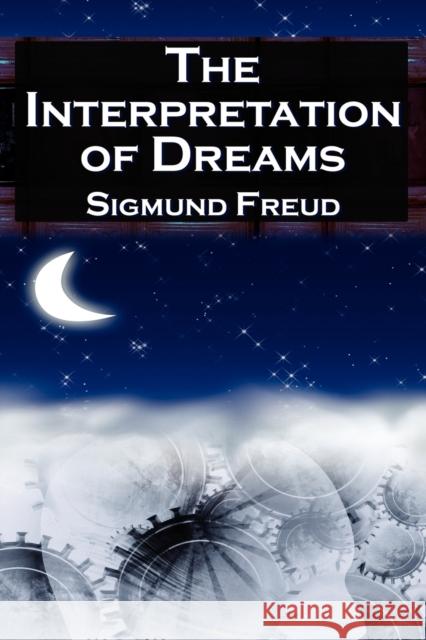
The Interpretation of Dreams, Freud's masterpiece and legendary contribution to psychiatry was originally published in 1899 and subsequently revised several times. This edition contains the benefit of the first three revisions, providing a definitive view of Freud's concepts as he refined them over time. Freudian dream analysis and the study of the unconscious are pillars of modern psychology and essential study for any student of the human mind.
The Interpretation of Dreams, Freud's masterpiece and legendary contribution to psychiatry was originally published in 1899 and subsequently revised s...
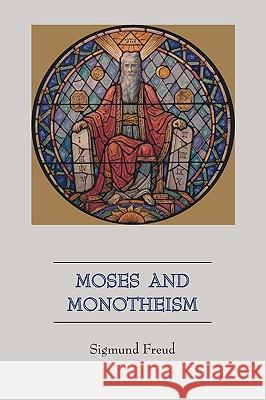
2010 Reprint of 1939 Edition. In Moses and Monotheism, Freud speculates that Moses was not Jewish, but actually born into Ancient Egyptian nobility and was perhaps a follower of Akhenaten, an ancient Egyptian monotheist. Freud further suggests that Moses led only his close followers into freedom during an unstable period in Egyptian history and that his followers subsequently killed Moses in rebellion afterward. Freud speculates that the guilt from the murder of Moses is inherited through the generations; this guilt then drives the Jews to religion to make them feel better.
2010 Reprint of 1939 Edition. In Moses and Monotheism, Freud speculates that Moses was not Jewish, but actually born into Ancient Egyptian nobility an...
Despite Freud's enormous influence on twentieth-century interpretations of the humanities, there has never before been in English a complete collection of his writings on art and literature. These fourteen essays cover the entire range of his work on these subjects, in chronological order beginning with his first published analysis of a work of literature, the 1907 -Delusion and Dreams in Jensen's Gradiva- and concluding with the 1940 posthumous publication of -Medusa's Head.- Many of the essays included in this collection have been crucial in contemporary literary and art criticism...
Despite Freud's enormous influence on twentieth-century interpretations of the humanities, there has never before been in English a complete collectio...
In what is considered one of his most prominent ideas, Austrian psychiatrist, Sigmund Freud explains the dynamic of the human psyche in terms of the roles and conflicts produced by the id, ego, and super-ego. Freud suggests that all human behaviors and traits, including personality disorders, are created by the complex conflicts and workings of these three components of human personality.
In what is considered one of his most prominent ideas, Austrian psychiatrist, Sigmund Freud explains the dynamic of the human psyche in terms of the r...
In what is considered a turning point in his theoretical approach, Austrian psychiatrist, Sigmund Freud outlines core psychoanalytic concepts, including libido, wish fulfillment, and repression. He paints a picture of the human struggle between instincts. The first set, being of creativity, harmony, and sexual connection; and the opposing set, drawing us toward repetition, aggression, and compulsion.
In what is considered a turning point in his theoretical approach, Austrian psychiatrist, Sigmund Freud outlines core psychoanalytic concepts, includi...
In what is considered one of his greatest contributions to psychology, Austrian psychiatrist, Sigmund Freud describes his perspectives on the development and origins of religion--religion as an illusion, wishes that are the "fulfillments of the oldest, strongest, and most urgent wishes of mankind." He goes on to explain and illustrate, "what is characteristic of illusions is that they are derived from human wishes.""
In what is considered one of his greatest contributions to psychology, Austrian psychiatrist, Sigmund Freud describes his perspectives on the developm...