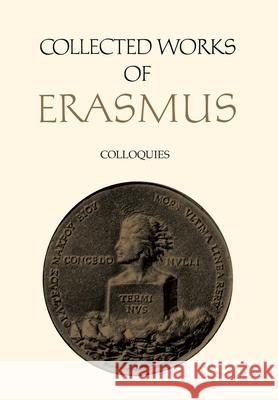
In 1520, the reading public witnessed the eruption of a simmering conflict between Erasmus, the foremost advocate of the new biblical humanism, and Edward Lee, a younger scholar at the University of Louvain and spokesman for the traditionalists in matters of biblical interpretation and church discipline. When Erasmus (perhaps unconsciously) subsumed criticisms Lee had sent to him of his 1516 Annotations on the New Testament into the second edition (1519) without properly crediting their source, Lee resorted to publication of his collection of criticisms.
Erasmus responded immediately...
In 1520, the reading public witnessed the eruption of a simmering conflict between Erasmus, the foremost advocate of the new biblical humanism, and...
Spanning the period of 1523 to 1534, the compositions in Volume 78 of the Collected Works of Erasmus detail Erasmus' theological disagreements with the Swiss and Upper German 'evangelicals' and the German Lutherans, including Luther himself. While volumes 76 and 77 of the series focus on the controversy with Luther over the "freedom of the will," the wider lens of this volume also captures the conflicts between Erasmus and contemporaries such as Hutten, Eppendorf, Oecolampadius, Capito, and Bucer.
These writings reveal the dialogue between Erasmus and those evangelicals who...
Spanning the period of 1523 to 1534, the compositions in Volume 78 of the Collected Works of Erasmus detail Erasmus' theological disagreem...
This volume contains the surviving correspondence of Erasmus for the first seven months of 1529. For nearly eight years he had lived happily and productively in Basel. In the winter of 1528-9, however, the Swiss version of the Lutheran Reformation triumphed in the city, destroying the liberal-reformist atmosphere Erasmus had found so congenial. Unwilling to live in a place where Catholic doctrine and practice were officially proscribed, Erasmus resettled in the quiet, reliably Catholic university town of Freiburg im Breisgau,
Despite the turmoil of moving, Erasmus managed to...
This volume contains the surviving correspondence of Erasmus for the first seven months of 1529. For nearly eight years he had lived happily and pr...
"Prison Sucks " will unlock the doors to the prison world. It provides you with a glimpse of what it is like to be locked down among those society has deemed to be deplorable. This book will help you understand what you can expect when you walk through the steel doors that separate you from freedom. This book will answer some of your basic questions about what goes on behind those locked steel doors and razor wire fences. Finally, this book will prepare you for the worst circumstances and the worst inmates that you have to deal with at every turn. Its contents will help you make the decision...
"Prison Sucks " will unlock the doors to the prison world. It provides you with a glimpse of what it is like to be locked down among those society has...
This additional volume offers a revised edition of Lingua, Erasmus' work on language, its possibilities and the dangers in its use, ending in a praise of the Word of God. Since it deals with the moral implications of language, Erasmus placed it in Ordo IV that comprises works on moral issues. The Latin text is presented in a critical edition, accompanied by introductions and a commentary in French, elucidating difficult passages, tracing Erasmus' sources and offering all linguistic, historical, theological and philological information needed to understand the text.
This additional volume offers a revised edition of Lingua, Erasmus' work on language, its possibilities and the dangers in its use, ending in a...
Thank you for checking out this book by Theophania Publishing. We appreciate your business and look forward to serving you soon. We have thousands of titles available, and we invite you to search for us by name, contact us via our website, or download our most recent catalogues. Colloquies is one of the many works of the "Prince of Christian Humanists," Desiderius Erasmus. Published in 1518, the pages ..".held up contemporary religious practices for examination in a more serious but still pervasively ironic tone." Christian Humanists viewed Erasmus as their leader in the early 16th century....
Thank you for checking out this book by Theophania Publishing. We appreciate your business and look forward to serving you soon. We have thousands of ...
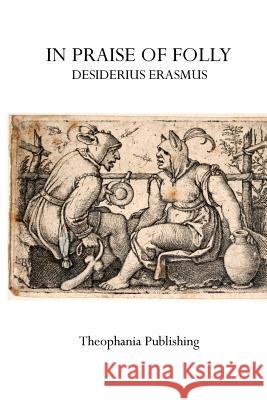
Thank you for checking out this book by Theophania Publishing. We appreciate your business and look forward to serving you soon. We have thousands of titles available, and we invite you to search for us by name, contact us via our website, or download our most recent catalogues. In Praise of Folly is an essay written in 1509 by Desiderius Erasmus of Rotterdam and first printed in 1511. The essay was inspired by De Triumpho Stultitiae, written by Italian humanist Faustino Perisauli, born at Tredozio, near Forli.Erasmus revised and extended the work, which he originally wrote in the space of a...
Thank you for checking out this book by Theophania Publishing. We appreciate your business and look forward to serving you soon. We have thousands of ...
Thank you for checking out this book by Theophania Publishing. We appreciate your business and look forward to serving you soon. We have thousands of titles available, and we invite you to search for us by name, contact us via our website, or download our most recent catalogues. THE mortal world a field is of battle Which is the cause that strife doth never fail Against man, by warring of the flesh With the devil, that always fighteth fresh The spirit to oppress by false envy; The which conflict is continually During his life, and like to lose the field. But he be armed with weapon and shield...
Thank you for checking out this book by Theophania Publishing. We appreciate your business and look forward to serving you soon. We have thousands of ...
Erasmus? Familiar Colloquies grew from a small collection of phrases, sentences, and snatches of dialogue written in Paris around 1497 to help his private pupils improve their command of Latin.
Erasmus? Familiar Colloquies grew from a small collection of phrases, sentences, and snatches of dialogue written in Paris around 1497 to help his pri...