Recipient, 2008 Guggenheim Fellowship The defining quality of Russian literature, for most critics, is its ethical seriousness expressed through formal originality. The Trace of Judaism addresses this characteristic through the thought of the Lithuanian-born Franco-Jewish philosopher Emmanuel Levinas. Steeped in the Russian classics from an early age, Levinas drew significantly from Dostoevsky in his ethical thought. One can profitably read Russian literature through Levinas, and vice versa. Vinokur links new readings of Fyodor Dostoevsky, Isaac Babel, and Osip Mandelstam to the work of...
Recipient, 2008 Guggenheim Fellowship The defining quality of Russian literature, for most critics, is its ethical seriousness expressed through f...
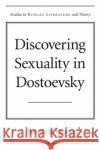
Most discussions of sexuality in the work of Dostoevsky have been framed in Freudian terms. But Dostoevsky himself wrote about sexuality from a decidedly pre-Freudian perspective. By looking at the views of human sexual development that were available in Dostoevsky's time and that he, an avid reader and observer of his own social context, absorbed and reacted to, Susanne Fusso gives us a new way of understanding a critical element in the writing of one of Russia's literary masters. Beyond discovering Dostoevsky's own views and representations of sexuality as a reflection of his culture and...
Most discussions of sexuality in the work of Dostoevsky have been framed in Freudian terms. But Dostoevsky himself wrote about sexuality from a decide...
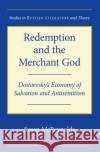
Dostoevsky s Russian chauvinism and anti-Semitism have long posed problems for his readers and critics. How could the author of "The Brothers Karamazov" also be the source of the slurs against Jews in "Diary of a Writer"? And where is the celebrated Christian humanist in the nationalist outbursts of "The Idiot"? These enigmas the coexistence of humanism and hatred, faith and doubt are linked, Susan McReynolds tells us in"Redemption and the Merchant God." Her book analyzes Dostoevsky s novels and "Diary" to show how the author s anxieties about Christianity can help solve the riddle of his...
Dostoevsky s Russian chauvinism and anti-Semitism have long posed problems for his readers and critics. How could the author of "The Brothers Karamazo...
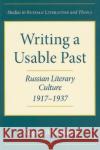
In Writing a Usable Past, Brintlinger considers the interactions of post-Revolutionary Russian and emigre culture with the genre of biography in its various permutations, arguing that in the years after the Revolution, Russian writers looked to the great literary figures of the past to help them construct a post-Revolutionary present. In detailed looks at the biographical writing of Yuri Tynianov, Vladislav Khodasevich, and Mikhail Bulgakov, Brintlinger follows each author's successful biography/ies and their failed attempts at biographies of Alexander Pushkin on the centennial...
In Writing a Usable Past, Brintlinger considers the interactions of post-Revolutionary Russian and emigre culture with the genre of biograp...
Mikhail Lermontov (1814-1841) is one of Russia's most prominent poets--and one of its most puzzling. In this radically new interpretation, David Powelstock reveals how the seeming contradictions in Lermontov's life and works can be understood as manifestations of a coherent worldview. By bringing to light Lermontov's operative version of Romantic individualism, Powelstock is able to make sense of the poet's relationship to "romantic irony," his highly modern concept of the reader (both real, and implied in the text), and his vexed passion for his predecessor Alexander Pushkin--a...
Mikhail Lermontov (1814-1841) is one of Russia's most prominent poets--and one of its most puzzling. In this radically new interpretation, David Powel...
In his original new study, Seth Graham analyzes a rich and forgotten vein of humor in an otherwise bleak environment. The late Soviet period (1961 1986) hardly seems fertile ground for humor, but Russian jokes ("anekdoty") about life in the Soviet Union were ubiquitous. The cultural and political relaxation in the decade following Stalin s death produced considerable optimism among Soviet citizens. The "anekdot" exploited and exposed what Graham calls "Soviet diglossia" (official Sovietese vs. Russian everyday language) and emphasized the distance between official myths and quotidian...
In his original new study, Seth Graham analyzes a rich and forgotten vein of humor in an otherwise bleak environment. The late Soviet period (1961 ...
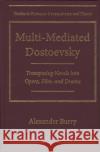
Since their publication, the works of Dostoevsky have provided rich fodder for adaptations to opera, film, and drama. While Dostoevsky gave his blessing to the idea of adapting his work to other forms, he believed that "each art form corresponds to a series of poetic thoughts, so that one idea cannot be expressed in another non-corresponding form." In Multi-Mediated Dostoevsky, Alexander Burry argues that twentieth-century adaptations (which he calls "transpositions") of four of Dostoevsky s works Sergei Prokofiev s opera The Gambler, Leos Janacek s opera From the Dead House,...
Since their publication, the works of Dostoevsky have provided rich fodder for adaptations to opera, film, and drama. While Dostoevsky gave his blessi...
Recipient, 2008 Guggenheim Fellowship The defining quality of Russian literature, for most critics, is its ethical seriousness expressed through formal originality. The Trace of Judaism addresses this characteristic through the thought of the Lithuanian-born Franco-Jewish philosopher Emmanuel Levinas. Steeped in the Russian classics from an early age, Levinas drew significantly from Dostoevsky in his ethical thought. One can profitably read Russian literature through Levinas, and vice versa.Vinokur links new readings of Fyodor Dostoevsky, Isaac Babel, and Osip Mandelstam to the work of...
Recipient, 2008 Guggenheim Fellowship The defining quality of Russian literature, for most critics, is its ethical seriousness expressed through f...
Presents an introduction to Sergei Dovlatov (1941-90) that is closely attentive to the details of his life and work, their place in the history of Soviet society and literature, and of emigre culture during this turbulent period.
Presents an introduction to Sergei Dovlatov (1941-90) that is closely attentive to the details of his life and work, their place in the history of Sov...
As cultural conflicts roil the world, the idea of a clash of civilizations has lately taken hold, with commentators from both East and West weighing the religious and political disparities that affect global unity. For all its present currency and urgency, the idea is nothing new. In various contexts V. S. Soloviev (1853 1900), the most distinguished representative of nineteenth-century Russian religious philosophy, anticipated our current global dilemma by more than a hundred years. These essays, presented together for the first time in English, consider from a number of perspectives how...
As cultural conflicts roil the world, the idea of a clash of civilizations has lately taken hold, with commentators from both East and West weighing t...