God In Us is a radical representation of the Christian faith for the 21st century. Following the example of the Old Testament prophets and the first-century Christians it overturns received ideas about God. God is not an invisible person 'out there' somewhere, but lives in the human heart and mind as 'the sum of all our values and ideals' guiding and inspiring our lives. This new updated edition includes a foreword by Bishop John Shelby Spong and an afterword from the author.
God In Us is a radical representation of the Christian faith for the 21st century. Following the example of the Old Testament prophets and the firs...
Liberal values are the hallmark of a civilised society. Yet they depend on an optimistic view of the human condition, Stripped of this essential ingredient, liberalism has become a hollowed-out abstraction. Tracing its effects through the media, politics and the public services, the author argues that hollowed-out liberalism has helped to produce our present discontent. Unless we stop boasting about our values and try to recover their essence, liberal society will be crushed in the coils of its own contradictions.
Liberal values are the hallmark of a civilised society. Yet they depend on an optimistic view of the human condition, Stripped of this essential in...
This is a different kind of book about psychedelics. Rather than describing psychedelic experiences, it presents four future-oriented ideas 'coming over the psychedelic horizon', which illustrate the potential benefits of psychedelics for humanity: # Stanislav Grof's view of our minds as a way to understand works of art (looking at Disney's Snow White). # The evidence that psychedelic-occasioned mystical experiences can boost our immune systems. # Psychedelics as a way of adding new cognitive programmes to our thinking skills. # Applying the ideas from Part 3 to learning.
This is a different kind of book about psychedelics. Rather than describing psychedelic experiences, it presents four future-oriented ideas 'coming...
This book argues that the novelist Joseph Conrad's work speaks directly to us in a way that none of his contemporaries can. Conrad's scepticism, pessimism, emphasis on the importance and fragility of community, and the difficulties of escaping our history are important tools for understanding the political world in which we live. He is prepared to face a future where progress is not inevitable, where actions have unintended consequences, and where we cannot know the contexts in which we act. Heart of Darkness uncovers the rotten core of the Eurocentric myth of imperialism as a way...
This book argues that the novelist Joseph Conrad's work speaks directly to us in a way that none of his contemporaries can. Conrad's scepticism, pe...
GAIA, named after the ancient Greek mother-goddess, is the notion that the Earth and the life on it form an active, self-maintaining whole. By its use of personification it attacks the view that the physical world is inert and lifeless. It has a scientific side, as shown by the new university departments of earth science which bring biology and geology together to study the continuity of the cycle. It also has a visionary or spiritual aspect. What the contributors to this book believe is needed is to bring these two angles together. With global warming now an accepted fact, the lessons of...
GAIA, named after the ancient Greek mother-goddess, is the notion that the Earth and the life on it form an active, self-maintaining whole. By its ...
The scientists, academics and practitioners writing this book are not 'against' complementary or alternative medicine (CAM), but they are very much 'for' evidence-based medicine and single standards. They aim to counter-balance the many uncritical books on CAM and to stimulate intelligent, well-informed public debate. TOPICS INCLUDE: What is CAM? Why is it so popular? Patient choice; Reclaiming compassion; Teaching CAM at university; Research on CAM; CAM in court; Ethics and CAM; Politics and CAM; Homeopathy in context; Concepts of holism in medicine; Placebo, deceit and CAM; Healing but...
The scientists, academics and practitioners writing this book are not 'against' complementary or alternative medicine (CAM), but they are very much...
A collection of short essays that range across philosophy, politics, general culture, morality, science, religion and art, focusing on questions of meaning, value and understanding.
ENDORSEMENT BY
- Alan Massie
"Professor Haldane's essays are serious in the way that the great writers of the Scottish Enlightenment were serious. He asks what it means to be human in the twenty-first century, and what ethical obligations our idea of humanity imposes on us. They are provocative in the best, and only useful, sense of the word: inviting the reader to consider and...
A collection of short essays that range across philosophy, politics, general culture, morality, science, religion and art, focusing on questions of...
A series of essays on the evolution of culture, dealing with topics including the city and consciousness, evolution of the afterlife, literary and mathematical archetypes, machine consciousness and the implications of 9/11, and the invasion of Iraq. The enlarged new edition contains extra essays and brings the author's comments on current affairs up to date with coverage of the election of Barak Obama as US President.
A series of essays on the evolution of culture, dealing with topics including the city and consciousness, evolution of the afterlife, literary and ...
Today, the belief that human beings are special is distinctly out of fashion. Almost every day we are presented with new revelations about how animals are so much more like us than we ever imagined. The argument is at its most powerful when it comes to our closest living relatives - the great apes. This book argues that whatever first impressions might tell us, apes are really not 'just like us'. Science has provided strong evidence that the boundaries between us and other species are vast. Unless we hold on to the belief in our exceptional abilities we will never be able to envision or...
Today, the belief that human beings are special is distinctly out of fashion. Almost every day we are presented with new revelations about how anim...
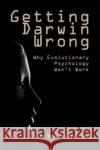
Brendan Wallace, with a background in psychology, demonstrates that the key claims of Evolutionary Psychology (EP), popularised by Steven Pinker and others, are based on the 'brain is a digital computer' argument. He then argues that as we now know this model of the brain will not work, therefore EP won't work either, since it is based on a fallacious view of the mind/brain. The book, which is written in a reader friendly but rigorous style, is a timely assault on one of the most fashionable philosophies of mind currently 'out there'.
Brendan Wallace, with a background in psychology, demonstrates that the key claims of Evolutionary Psychology (EP), popularised by Steven Pinker an...