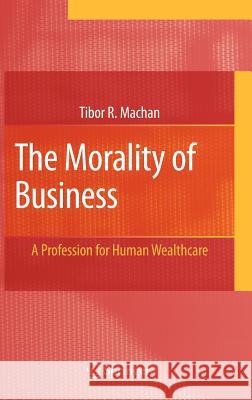
Government interference in free enterprise is growing. Should they intercede in business ethics and corporate responsibility; and if so, to what extent? The Morality of Business: A Profession for Human Wealthcare goes beyond the utilitarian case in discussing the various elements of business ethics, social policy, job security, outsourcing, government regulation, stakeholder theory, advertising and property rights.
"Professor Machan has done it again Profit seeking behavior by business is ethical and prudent, but it only can be ethical when a person is free, and that...
Government interference in free enterprise is growing. Should they intercede in business ethics and corporate responsibility; and if so, to what ex...
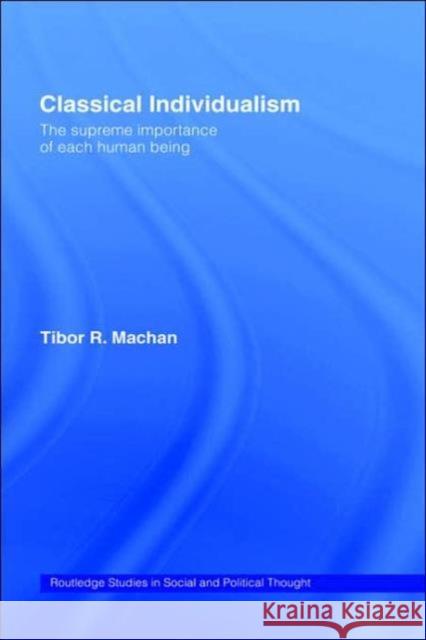
In Classical Individualism, Tibor R. Machan argues that individualism is far from being dead. Machan identifies, develops and defends what he calls classical individualism - an individualism humanised by classical philosophy, rooted in Aristotle rather than Hobbes. This book does not reject the social nature of human beings, but finds that every one has a self-directed agent who is responsible for what he or she does. Machan rejects all types of collectivism, including communitarianism, ethnic solidarity, racial unity, and gender identity. The ideas expressed here have important...
In Classical Individualism, Tibor R. Machan argues that individualism is far from being dead. Machan identifies, develops and defends what he...
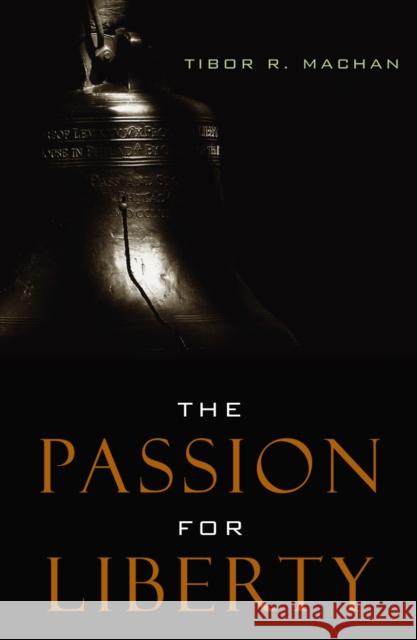
In The Passion for Liberty, Tibor R. Machan defends a libertarian conception of a free society, one in which individuals are sovereign, self-governing beings, not subject to others' will without their consent. In the tradition of John Locke, Adam Smith, Ayn Rand, and Robert Nozick, Machan argues that such a society--far from being hedonistic, licentious, or disorderly--is the best possible ideal for humans. In doing so, he addresses specific issues such as affirmative action, abortion, military intervention, and torture in light of the relationship between liberty and democracy. As freedom...
In The Passion for Liberty, Tibor R. Machan defends a libertarian conception of a free society, one in which individuals are sovereign, self-governing...
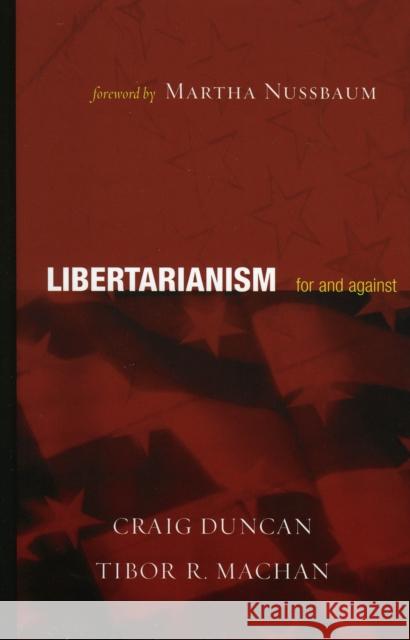
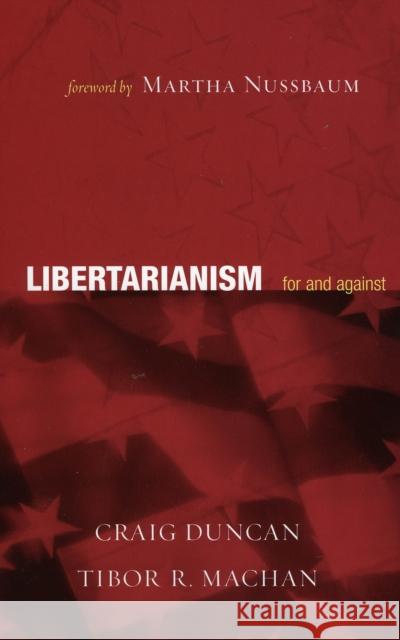
Libertarianism: For and Against offers dueling perspectives on the scope of legitimate government. Tibor R. Machan, a well-known political philosopher with libertarian convictions, argues for a minimal government devoted solely to protecting individual rights to life, liberty, and property. Stressing the sovereignty of each individual, Machan argues in favor of limiting democracy's scope and against the redistribution of wealth, or any other sort of taxation. In opposition to libertarianism, philosopher Craig Duncan defends democratic liberalism, which aims to ensure that all citizens have...
Libertarianism: For and Against offers dueling perspectives on the scope of legitimate government. Tibor R. Machan, a well-known political philosopher...
Libertarianism: For and Against offers dueling perspectives on the scope of legitimate government. Tibor R. Machan, a well-known political philosopher with libertarian convictions, argues for a minimal government devoted solely to protecting individual rights to life, liberty, and property. Stressing the sovereignty of each individual, Machan argues in favor of limiting democracy's scope and against the redistribution of wealth, or any other sort of taxation. In opposition to libertarianism, philosopher Craig Duncan defends democratic liberalism, which aims to ensure that all citizens have...
Libertarianism: For and Against offers dueling perspectives on the scope of legitimate government. Tibor R. Machan, a well-known political philosopher...
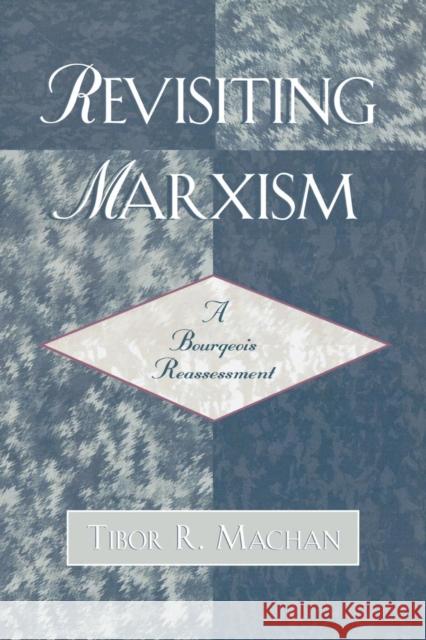
For some time there has been no direct critique of Marx's ideas from those who value the position he most harshly attacked, bourgeois capitalism. The few who did criticize Marx were economists such as Thomas Sowell, Eugen Bohm-Bawerk, and Ludwig von Mises. Others attacked Marx's ideas, but did not actually defend the concept of capitalism. In 1987, shortly before the fall of the Soviet Union, David Conway published his Farewell to Marx, which offered a philosophical critique of Marx. This work, however, developed, in part, from a position that uncritically embraces economism, or what the...
For some time there has been no direct critique of Marx's ideas from those who value the position he most harshly attacked, bourgeois capitalism. The ...
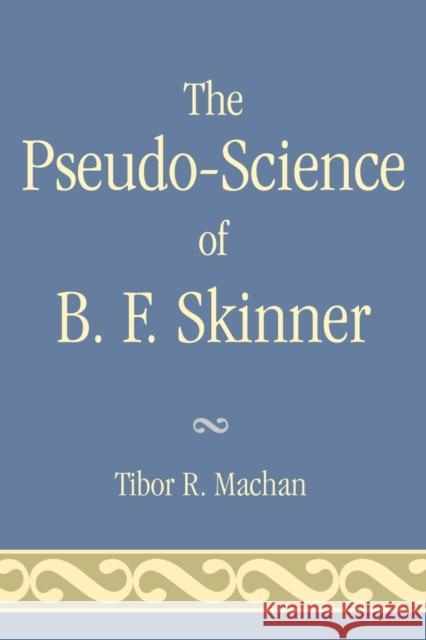
The Pseudo-Science of B.F. Skinner was Professor Tibor Machan's first book. Now, nearly forty years after its initial publication and after three dozen additional books published by Machan, it is available again through University Press of America. This study is still alive with its initial inquiry into the work of B.F. Skinner, and it is just as influential upon young students today as it was forty years ago. Was Skinner a bona fide scientist or an amateur metaphysician? Was Skinner correct to hold that only what can be observed matters when it comes to understanding ourselves? Was he...
The Pseudo-Science of B.F. Skinner was Professor Tibor Machan's first book. Now, nearly forty years after its initial publication and after three doze...
Has Marxism finally shown itself to be a bankrupt social philosophy? Why should we strive for economic democracy? Are individual human rights to be protected only so long as no one is inconvenienced? Are radical measures needed in the defense of our freedoms? Can competitive, profit-oriented free market capitalism coincide with heart-felt public concern for the social welfare of others? Why do so many people harbor anti-business attitudes? Have we become a nation of moral eunuchs who won't, or can't stand up for their own rights? Is there is right to health care? Has society really been...
Has Marxism finally shown itself to be a bankrupt social philosophy? Why should we strive for economic democracy? Are individual human rights to be pr...
This work is a classic dialogue between two philosophers, with the unusual twist that it was actually conducted, not fabricated, by two different philosophers. It presents in a conversational tone the various crucial and not so crucial aspects of the topic of political liberty and what if any value it has for us.
This work is a classic dialogue between two philosophers, with the unusual twist that it was actually conducted, not fabricated, by two different phil...