The commentary on the book of Esther by Salmon b. Yeruham represents the oldest extant Karaite commentary on "Esther" and the second-oldest Jewish commentary on the book after that of Saadia Gaon, Salmon's older contemporary. Salmon's exegesis, while grounded in the driving Karaite ethos of intense Scripturalism, reflects at the same time an even-handed openness (often downplayed in previous scholarship) to Rabbanite (including midrashic-talmudic) exegetical tradition where it both conforms to the strictures of rational analysis and serves to promote his homiletical goals. With respect to the...
The commentary on the book of Esther by Salmon b. Yeruham represents the oldest extant Karaite commentary on "Esther" and the second-oldest Jewish com...
The present volume offers the first critical edition, accompanied with English translation and commentary, of Sefer ha-Moladot, which addresses the doctrine of nativities and the system of continuous horoscopy in nativities, and of Sefer ha-Tequfah, which is devoted exclusively to continuous horoscopy in nativities. The doctrine of nativities makes predictions about the whole of an individual's subsequent life on the basis of the natal chart, and the system of continuous horoscopy in nativities is concerned with the interval between life and death and makes predictions based...
The present volume offers the first critical edition, accompanied with English translation and commentary, of Sefer ha-Moladot, which addresses...
In this book Nadia Vidro presents a critical edition and English translation of the first Karaite pedagogical grammar of Hebrew, Kitāb al-ʿUqūd fī Taṣārīf al-Luġa al-ʿIbrāniyya. Composed in Jerusalem in the 11th century, Kitāb al-ʿUqūd is a concise description of Hebrew prepared specifically to cater for the needs of students just beginning their study of the language. The critical edition is accompanied by an historical introduction, a description of manuscripts, and a glossary of grammatical terminology. This...
In this book Nadia Vidro presents a critical edition and English translation of the first Karaite pedagogical grammar of Hebrew, Kitāb al-F...
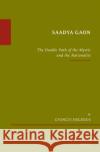
In Saadya Gaon: The Double Path of the Mystic and the Rationalist Gyongyi Hegedus offers a new perspective on the thought of the most significant medieval Jewish thinker of the pre-Maimonidean era, Saadya Gaon. Saadya's important philosophical works belong to two distinct traditions: his main work is written in the style of rationalist theology (kalam), but he is also responsible for composing a commentary in a neo-Pythagorean tone. In addition to contextualizing the two traditions and analyzing their Islamic parallels, the book makes the argument that Saadya consciously constructed...
In Saadya Gaon: The Double Path of the Mystic and the Rationalist Gyongyi Hegedus offers a new perspective on the thought of the most signifi...
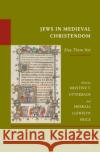
In Jews in Medieval Christendom: Slay Them Not, an international group of scholars from numerous disciplines examines the manifold ways that medieval Christians coped with the presence of Jews in their midst. The collection's touchstone comes from St. Augustine's interpretation of Psalm 59:11: "Slay them not, lest my people forget: scatter them by thy power; and bring them down," as it applied to Jews in Christendom, an interpretation that deeply affected medieval Christian strategies for dealing with Jews in Europe. This collection analyzes how medieval writers and artists, often...
In Jews in Medieval Christendom: Slay Them Not, an international group of scholars from numerous disciplines examines the manifold ways that m...
In Poetry and Memory in Karaite Prayer Joachim Yeshaya offers an edition of liturgical poems which the Karaite poet Moses Darʿī composed in twelfth-century Egypt as introductory poems for the Torah readings on each Sabbath. The Hebrew text and Judaeo-Arabic heading of each poem are provided in the original order attested in the manuscript NLR Evr. I 802, dated to the fifteenth century. Every poem comes with a commentary section consisting of English commentary essays and bilingual (Hebrew / English) line-by-line annotations. In the conclusion following this edition, Joachim...
In Poetry and Memory in Karaite Prayer Joachim Yeshaya offers an edition of liturgical poems which the Karaite poet Moses Darʿī compo...
Winner of the 2015 Bibliography Award from the Association of Jewish Libraries The AJL Judaica Bibliography Award was established to encourage the publication of outstanding Judaica bibliographies. The intellectual legacy of the ancient community of Iranian Jews rests in several large but neglected Judeo-Persian manuscript collections. The largest in the West, and the third largest collection in the world (198 manuscripts), belongs to the Library of the Jewish Theological Seminary of America, New York. Primarily a work of reference, this Catalog informs scholars in the fields of...
Winner of the 2015 Bibliography Award from the Association of Jewish Libraries The AJL Judaica Bibliography Award was established to encourage the...
Yefet ben 'Eli (fl. 960-1005) was the most prolific and influential biblical exegete in the Karaite tradition. He was possibly the earliest Jew to write a commentary on the entire Hebrew Bible, and his writings were cited and borrowed from by Karaites and Rabbanites alike, from his own time to the early modern period. Despite his importance, however, only a small percentage of his works have been published. The present volume makes available for the first time his commentary on Joshua, which includes an Arabic translation of this difficult book with full Arabic commentary. The story of...
Yefet ben 'Eli (fl. 960-1005) was the most prolific and influential biblical exegete in the Karaite tradition. He was possibly the earliest Jew to wri...
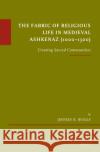
In The Fabric of Religious Life in Medieval Ashkenaz, Jeffrey R. Woolf presents the first integrated presentation of the ideals and beliefs that comprised the self-image and worldview of Ashkenazic Jews in the Central and High Middle Ages (900-1300). Through careful examination of a wide range of sources (legal, customal, liturgical, artistic), Woolf shows how religious practice played a dual role in creating and sustaining Jewish life in a hostile environment. They instilled these values, and recast religious traditions to reflect them. The author demonstrates how hitherto...
In The Fabric of Religious Life in Medieval Ashkenaz, Jeffrey R. Woolf presents the first integrated presentation of the ideals and beliefs tha...
Jewish Prayer Texts from the Cairo Genizah, which sets a new tone for future studies, consists of a selection of transcribed and translated Genizah fragments that contain some of the earliest known texts of rabbinic prayers. Reif describes in detail the physical makeup of each manuscript and assesses the manner in which the scribe has tackled the matter of recording a preferred version. He then places the prayer texts included in the manuscript within the context of Jewish liturgical history, explaining the degree to which they were innovative and whether they established precedents to...
Jewish Prayer Texts from the Cairo Genizah, which sets a new tone for future studies, consists of a selection of transcribed and translated Gen...