• Wyszukiwanie zaawansowane
  • Kategorie
  • Kategorie BISAC
  • Książki na zamówienie
  • Promocje
  • Granty
  • Książka na prezent
  • Opinie
  • Pomoc
  • Załóż konto
  • Zaloguj się

Analytical Techniques for Studying the Physical Properties of Lipid Emulsions » książka


zaloguj się | załóż konto
Logo Krainaksiazek.pl

koszyk

konto

szukaj
topmenu
Księgarnia internetowa
Szukaj
Książki na zamówienie
Promocje
Granty
Książka na prezent
Moje konto
Pomoc
 
 
Wyszukiwanie zaawansowane
Pusty koszyk
Bezpłatna dostawa dla zamówień powyżej 20 złBezpłatna dostawa dla zamówień powyżej 20 zł

Kategorie główne

• Nauka
 [2949965]
• Literatura piękna
 [1857847]

  więcej...
• Turystyka
 [70818]
• Informatyka
 [151303]
• Komiksy
 [35733]
• Encyklopedie
 [23180]
• Dziecięca
 [617748]
• Hobby
 [139972]
• AudioBooki
 [1650]
• Literatura faktu
 [228361]
• Muzyka CD
 [398]
• Słowniki
 [2862]
• Inne
 [444732]
• Kalendarze
 [1620]
• Podręczniki
 [167233]
• Poradniki
 [482388]
• Religia
 [509867]
• Czasopisma
 [533]
• Sport
 [61361]
• Sztuka
 [243125]
• CD, DVD, Video
 [3451]
• Technologie
 [219309]
• Zdrowie
 [101347]
• Książkowe Klimaty
 [123]
• Zabawki
 [2362]
• Puzzle, gry
 [3791]
• Literatura w języku ukraińskim
 [253]
• Art. papiernicze i szkolne
 [7933]
Kategorie szczegółowe BISAC

Analytical Techniques for Studying the Physical Properties of Lipid Emulsions

ISBN-13: 9781461432555 / Angielski / Miękka / 2012 / 66 str.
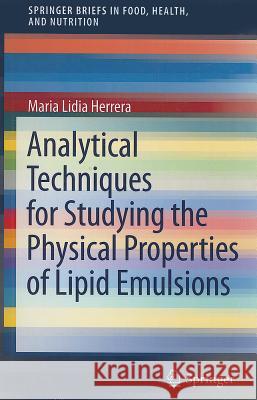
Maria Lidia Herrera
Analytical Techniques for Studying the Physical Properties of Lipid Emulsions Maria Lidia Herrera 9781461432555 Springer - książkaWidoczna okładka, to zdjęcie poglądowe, a rzeczywista szata graficzna może różnić się od prezentowanej.

Analytical Techniques for Studying the Physical Properties of Lipid Emulsions

ISBN-13: 9781461432555 / Angielski / Miękka / 2012 / 66 str.

Maria Lidia Herrera
cena 201,72
(netto: 192,11 VAT:  5%)

Najniższa cena z 30 dni: 192,74
Termin realizacji zamówienia:
ok. 22 dni roboczych
Bez gwarancji dostawy przed świętami

Darmowa dostawa!

This book will review old and new methods to study emulsion stability and structure. Examples of emulsion-based foods include ice cream, yoghurt, and mayonnaise. The physicochemical properties of emulsions play an important role in food systems, as they directly contribute to the texture, sensory and nutritional properties of foods. One of the main properties is stability, which refers to the ability of an emulsion to resist physical changes over time. The development of an effective strategy to prevent undesirable changes in the properties of a particular food emulsion depends on the dominant physicochemical mechanism(s) responsible for the changes. In practice, two or more of these mechanisms may operate in concert. It is therefore important for food scientists to identify the relative importance of each mechanism, the relationship between them, and the factors that influence them, so that effective means of controlling the stability and physicochemical properties of emulsions can be established. Several techniques are used to study the physical behavior and structure of emulsions. Each technique has its advantages and disadvantages and provides different insights into the destabilization mechanisms. Among the oldest methods used to study emulsion stability is visual observation and small deformation rheometry. More recently, other techniques, such as ultrasound profiling, microscopy, droplet size distribution, and measurement of surface concentration to characterize adsorbed protein at the interface, have also been employed. Some of these techniques, such as droplet size distribution, involve some form of dilution. However, dilution disrupts some structures that play an important role in stability. The ability to study the stability of food emulsions in their undiluted form may reveal subtle nuances about their stability. Diffusing wave spectroscopy (DWS), laser scanning confocal microscopy (LSCM), nuclear magnetic resonance (NMR), and Turbiscan are among the more powerful, non-perturbing techniques used to characterized emulsions.


Kategorie:
Technologie
Kategorie BISAC:
Technology & Engineering > Food Science - General
Science > Biochemia
Technology & Engineering > Chemical & Biochemical
Wydawca:
Springer
Seria wydawnicza:
Springer Briefs in Food, Health, and Nutrition
Język:
Angielski
ISBN-13:
9781461432555
Rok wydania:
2012
Numer serii:
000436495
Ilość stron:
66
Waga:
0.25 kg
Wymiary:
22.61 x 13.97 x 0.51
Oprawa:
Miękka
Wolumenów:
01
Dodatkowe informacje:
Bibliografia
Wydanie ilustrowane

1. Introduction.- 2. Nano and Micro Food Emulsions.- 2.1. Methods of Formulation.- 2.2. Physical Chemical Properties.- 2.3. Structuring Food Emulsions.- 3. Methods for Stability Studies.- 3.1. Visual Observation.- 3.2. Rheological Methods.- 3.3. Ultrasound Profiling.- 3.4. Electroacoustic spectroscopy: Zeta Potential.- 3.5. Measurement of Surface Concentration.- 3.6. Microscropic Analysis.- 3.7. Nuclear Magnetic Resonance (NMR) Techniques.- 3.8. Optical Methods.

Analytical Techniques for Studying the Physical Properties of Lipid Emulsions


Udostępnij

Facebook - konto krainaksiazek.pl


Opinie o Krainaksiazek.pl na Opineo.pl

Partner Mybenefit

Krainaksiazek.pl w programie rzetelna firma Krainaksiaze.pl - płatności przez paypal

Czytaj nas na:

Facebook - krainaksiazek.pl
  • książki na zamówienie
  • granty
  • książka na prezent
  • kontakt
  • pomoc
  • opinie
  • regulamin
  • polityka prywatności

Zobacz:

  • Księgarnia czeska

  • Wydawnictwo Książkowe Klimaty

1997-2025 DolnySlask.com Agencja Internetowa

© 1997-2022 krainaksiazek.pl
     
KONTAKT | REGULAMIN | POLITYKA PRYWATNOŚCI | USTAWIENIA PRYWATNOŚCI
Zobacz: Księgarnia Czeska | Wydawnictwo Książkowe Klimaty | Mapa strony | Lista autorów
KrainaKsiazek.PL - Księgarnia Internetowa

Polityka prywatnosci - link
Krainaksiazek.pl - płatnośc Przelewy24
Przechowalnia Przechowalnia





