Termin realizacji zamówienia: ok. 30 dni roboczych.
Darmowa dostawa!
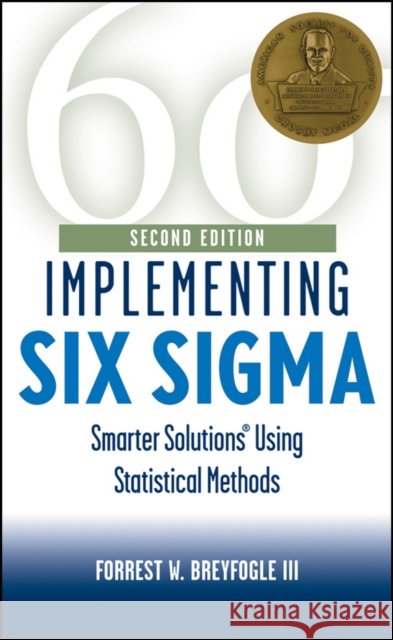
Includes new and expanded coverage of Six Sigma infrastructure building and benchmarking.
Provides plans, checklists, metrics, and pitfalls.
Widoczna okładka, to zdjęcie poglądowe, a rzeczywista szata graficzna może różnić się od prezentowanej. Nie gwarantujemy zgodności okładki z prezentowanym zdjęciem.
Bibliografia Glosariusz/słownik Wydanie ilustrowane
"The book is process oriented rather than tool oriented. This makes it refreshing and useful. This is a book every reliability engineer should own." (
Reliability Review; 12/08)
"An excellent reference book that should be on every individual involved in Six Sigma or even just quality assurance/quality improvement." (TQM Magazine)
"...a useful guide for both academia and organizations...useful source of reference for researchers...an excellent reference book..." (The TQM Magazine, Vol 15(6) 2003)
PREFACE.
PART I: S4/IEE DEPLOYMENT AND DEFINE PHASE FROM DMAIC.
1. Six Sigma Overview and S4/IEEE Implementation.
2. Voice of the Customer and the S4/IEEE Define Phase.
PART II: S4/IEE MEASURE PHASE FROM DMAIC.
3. Measurement and the S4/IEEE Measurement Phase.
4. Process Flow Charting/Process Mapping.
5. Basic Tools.
6. Probability.
7. Overview of Distributions and Statistical Processes.
8. Probability and Hazard Plotting.
9. Six Sigma Measurements.
10. Basic Control Charts.
11. Process Capability and Process Performance Metrics.
12. Measurement Systems Analysis.
13. Cause–and–Effect Matrix and Quality Function Deployment.
14. FMEA (Failure Mode and Effects Analysis).
PART III: S4/IEE ANALYZE PHASE FROM DMAIC (OR PASSIVE ANALYSIS PHASE).
45. Integrating of Theory of Constraints (TOC) in S4 /IEE.
PART VII: DFSS AND 21–STEP INTEGRATION OF THE TOOLS.
46. Manufacturing Applications and A 21–Step Integration of the Tools.
47. Service/Transactional Applications and A 21–Step Integration of the Tools.
48. DFSS Overview and Tools.
49. Product DFSS.
50. Process DFSS.
PART VIII: MANAGEMENT OF INFRASTRUCTURE AND TEAM EXECUTION.
51. Change Management.
52. Project Management and Financial Analysis.
53. Team Effectiveness.
54. Creativity.
55. Alignment of Management Initiatives and Strategies with S4/IEEE .
Appendix A. Supplemental Information.
Appendix B. Equations for the Distributions.
Appendix C. Mathematical Relationships.
Appendix D. DOE Supplement.
Appendix E. Reference Tables.
List of Symbols.
Glossary.
References.
Index.
Forrest W. Breyfogle III is the founder and President of Smarter Solutions, Inc., a company specializing in training andconsulting in Six Sigma methodologies. He is the author of Statistical Methods for Testing, Development, and Manufacturing and Implementing Six Sigma and coauthor of Managing Six Sigma, all published by Wiley.
Business Management
"No other book covers at an adequate technical level as many topics important toSix Sigma. An indispensable reference for the Six Sigma practitioner."
Ramon V. Leon
Associate Professor, Statistics Department of the University of Tennessee
Associate editor, Six Sigma Forum magazine
"Breyfogle′s book should be valuable to every Six Sigma professional."
Bill Scherkenback
Director, Samsung Quality Team
"The seamless integration of statistical methodologies . . . helps organizations execute their strategic plans and track both short– and longer–term strategic progress within their various departments and overall organizations."
Donald C. Fisher, PhD
Executive Director, MSQPC The Quality Center
"Implementing Six Sigma provides the most up–to–date material on the topic, complete with a project infrastructure roadmap and hundreds of real–life examples and exercises."
Frank Shines
Project Manager, Pilgrim Software
This new and significantly revised edition of Implementing Six Sigma goes well beyondtraditional Six Sigma methodologies, introducing an enhanced roadmap S4/IEE (Smarter Six Sigma Solutionssm/Integrated Enterprise Excellence). This cutting–edge approach offers a solution to the common problem of sustaining Six Sigma activities and downplays the traditional policy stating that Six Sigma projects must have a defined defect. A variety of plans, checklists, metrics, and warnings of potential pitfalls provide thorough preparation for anyone implementing Six Sigma strategies.
With new coverage of Six Sigma infrastructure building, benchmarking, and real–world "lessons learned," this Second Edition is the best available tool for implementing thesepowerful, profit–building strategies.