• Wyszukiwanie zaawansowane
  • Kategorie
  • Kategorie BISAC
  • Książki na zamówienie
  • Promocje
  • Granty
  • Książka na prezent
  • Opinie
  • Pomoc
  • Załóż konto
  • Zaloguj się

The Dose Makes the Poison: A Plain-Language Guide to Toxicology » książka

zaloguj się | załóż konto
Logo Krainaksiazek.pl

koszyk

konto

szukaj
topmenu
Księgarnia internetowa
Szukaj
Książki na zamówienie
Promocje
Granty
Książka na prezent
Moje konto
Pomoc
 
 
Wyszukiwanie zaawansowane
Pusty koszyk
Bezpłatna dostawa dla zamówień powyżej 20 złBezpłatna dostawa dla zamówień powyżej 20 zł

Kategorie główne

• Nauka
 [2946912]
• Literatura piękna
 [1852311]

  więcej...
• Turystyka
 [71421]
• Informatyka
 [150889]
• Komiksy
 [35717]
• Encyklopedie
 [23177]
• Dziecięca
 [617324]
• Hobby
 [138808]
• AudioBooki
 [1671]
• Literatura faktu
 [228371]
• Muzyka CD
 [400]
• Słowniki
 [2841]
• Inne
 [445428]
• Kalendarze
 [1545]
• Podręczniki
 [166819]
• Poradniki
 [480180]
• Religia
 [510412]
• Czasopisma
 [525]
• Sport
 [61271]
• Sztuka
 [242929]
• CD, DVD, Video
 [3371]
• Technologie
 [219258]
• Zdrowie
 [100961]
• Książkowe Klimaty
 [124]
• Zabawki
 [2341]
• Puzzle, gry
 [3766]
• Literatura w języku ukraińskim
 [255]
• Art. papiernicze i szkolne
 [7810]
Kategorie szczegółowe BISAC

The Dose Makes the Poison: A Plain-Language Guide to Toxicology

ISBN-13: 9780470381120 / Angielski / Miękka / 2011 / 284 str.
Frank
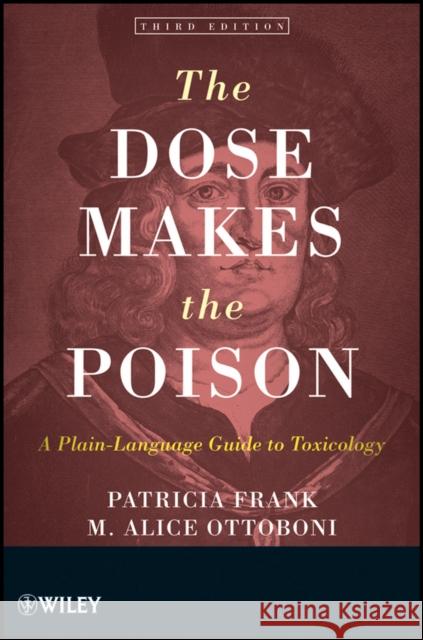
The Dose Makes the Poison: A Plain-Language Guide to Toxicology Ottoboni, M. Alice 9780470381120  - książkaWidoczna okładka, to zdjęcie poglądowe, a rzeczywista szata graficzna może różnić się od prezentowanej.

The Dose Makes the Poison: A Plain-Language Guide to Toxicology

ISBN-13: 9780470381120 / Angielski / Miękka / 2011 / 284 str.

Frank
cena 135,50
(netto: 129,05 VAT:  5%)

Najniższa cena z 30 dni: 134,94
Termin realizacji zamówienia:
ok. 30 dni roboczych
Bez gwarancji dostawy przed świętami

Darmowa dostawa!

This new edition of a widely-read and highly-acclaimed book broadens the scope of its predecessors from a heavy focus on industrial chemicals as toxicants to include drugs, food additives, cosmetics and other types of compounds that people are exposed to daily. Also new to the 3rd edition are newer issues-of-the-day such as nanoparticulate toxicants, second hand smoke, food contamination, lead in toys, and others. As such, the book provides the basics of toxicology in easy-to-understand language as well as a fuller understanding of the daily insults to which our bodies are subjected.


Kategorie:
Nauka, Chemia
Kategorie BISAC:
Science > Chemistry - Industrial & Technical
Medical > Toxicology
Science > Chemistry - Toxicology
Język:
Angielski
ISBN-13:
9780470381120
Rok wydania:
2011
Wydanie:
Revised
Ilość stron:
284
Waga:
0.45 kg
Wymiary:
22.81 x 15.93 x 1.78
Oprawa:
Miękka
Wolumenów:
01
Dodatkowe informacje:
Bibliografia
Glosariusz/słownik
Wydanie ilustrowane

"This is a refreshing, invigorating as well as eye–opening text, which is reading like an exciting novel – even to a seasoned toxicologist ... An appendix to clarify quantities of pollutants plus an index concludes this most valuable introduction into the science of toxicology for a broad readership." (Toxicology, 2011)

"I recommend this book to anyone who has ever listened to the evening news and wondered how much of the "chemical scare du jour" is hype and how much of it is fact – and to those who might want to understand basic concepts in toxicology and the related areas of study without having to trudge through a gaggle of 1000–page textbooks." (International Journal of Toxicology, 2011)

"Overall, this is a well–written work with wisely chosen and relevant topics. It will be a perfect addition to any science enthusiast′s library. Summing Up: Highly recommended. Lower–level undergraduates through professionals/practitioners; general readers." (Choice, 1 September 2011)

"The Dose Makes the Poison is more than just an introduction to toxicology. It is an enjoyable read with lots of interesting stories and one I can thoroughly recommend." (Chemistry & Industry, 25 July 2011)

"There is much to be applauded in this book from its straightforward layout and honesty to its accessibility . . . Many good, and contemporary, examples are provided to deliver greater context for the reader." (The British Toxicology Society Journal, 1 May 2011) 

Introduction to the Third Edition xi

Preface to the Second Edition xv

1 WHAT ARE CHEMICALS? 1

Atoms and Molecules 1

Natural Chemicals 2

Synthetic Chemicals 3

Chemical Categories 6

Chemicals: “Good” and “Bad” 8

Why the “Good–Bad” Dichotomy? 10

Man–made Chemicals Are Made by Humans 11

Man–made Chemicals May Not Be Biodegradable 12

Man–made Chemicals May Be Very Complex 16

2 WHAT HARM DO CHEMICALS CAUSE? 19

Harmful Properties of Chemicals 19

Explosiveness and Reactivity 19

Flammability and Combustibility 20

Radioactivity 21

Corrosiveness 23

Irritation 23

Sensitization and Photosensitization 24

Toxicity 26

Multiple Harmful Properties 27

Definition of Poison 28

Defi nition of Hazard 28

3 WHAT IS TOXICOLOGY? 31

Empirical Toxicology 31

Paracelsus and Ramazzini 32

A Brief History of Toxicology 34

Toxicology Today 40

What Do Toxicologists Do? 44

4 WHAT FACTORS INFLUENCE THE TOXIC EFFECTS OF CHEMICALS? 47

Acute versus Chronic Toxicity 47

Significance of Divided Doses 53

Routes of Exposure 54

Dermal Exposure 54

Inhalation Exposure 55

Oral Exposure 58

Other Routes of Exposure 59

Combinations 60

Influence of Route on Toxicity 60

Metabolism 64

Routes of Elimination (Excretion) 65

Other Factors that Infl uence Toxicity 66

Species 66

Sex 70

Age 71

Nutrition 73

State of Health 73

Biochemical Individuality (Genetic Diversity) 74

Presence of Other Chemicals 75

Adaptation 77

Light 79

5 HOW IS TOXICOLOGY STUDIED? 81

Experimental Methods 82

Acute Toxicity 83

Irritant and Corrosive Effects 85

Sensitization and Photosensitization 86

Chronic Toxicity 87

Mutagenesis 90

Carcinogenesis 91

Developmental and Reproductive Toxicity 94

Units of Trace Quantities 95

Analytical Methods 96

Animal Rights 99

6 GENERAL TOXICOLOGY 103

Acute Toxicity 103

LD50 and LC50 Values 103

Signifi cance of LDs for Humans 104

Poison Prevention 109

Antidotes 112

Chronic Toxicity 114

No–Effect Levels and Thresholds 116

Margins of Safety 117

Sufficient Challenge 119

Bioaccumulation 121

7 MUTAGENESIS AND CARCINOGENESIS 129

Mutagenesis 129

Genetic Code 129

Mutations 130

Significance of Mutations 132

Mutation and Cancer 135

Carcinogenesis 138

What Is Cancer? 138

Causes of Cancer 140

Role of Mutation 141

Incidence of Cancer 142

Categories and Characteristics of Carcinogens 143

Induction Periods 146

Thresholds 147

Practical Thresholds 149

The Real World 150

Benzo[a]pyrene 150

Cancerophobia 151

8 DEVELOPMENTAL AND REPRODUCTIVE TOXICITY 153

Male and Female Reproductive Systems 154

Prepuberty Systems 154

Adult Systems 155

The Developing Individual 156

9 CASE STUDIES IN TOXICOLOGY 163

Environmental Contaminations 164

Dioxins: Seveso, Italy 164

PCBs and Dibenzofurans: Yusho Disease 169

Bophal, India 173

Minamata Disease 174

DDT 174

Consumer Products 177

Metals 177

Lead and Cadmium 178

Zinc 178

Plastics 179

Bisphenyl A 180

Indoor Air Pollution 181

Water Pollution 185

Pharmaceuticals 186

Fen–Phen 187

Vioxx 188

Thalidomide 189

10 EPIDEMIOLOGY 191

Origins of Modern Epidemiology 191

Epidemiology of Noninfectious Diseases 193

Koch’s Postulates 195

Study Design: Precepts and Pitfalls 197

Unreasonable Expectations 201

Proximate Event Approach in Assigning Cause 202

Distrust of Science and Scientists 204

11 THE STUDY OF RISK 211

Public Health Statistics 211

Inherent Risk 213

Risk Assessment 215

Perceived Risk 218

Acceptable Risk 220

Risk Benefit and Cost Benefit 222

Risk Communication 225

Risk Management 227

Bibliography 229

Abbreviations 233

Glossary 235

Appendix A 245

Index 247

Patricia Frank is President of Patricia Frank & Associates, Inc., a consulting firm founded in 1993 that assists companies in the development and registration of human and veterinary pharmaceutical agents. She is a past president of both the American College of Toxicology and the Roundtable of Toxicology Consultants.

M. Alice Ottoboni lectures, writes, and consults in the field of toxicology. As Staff Toxicologist with the California State Department of Public Health for over twenty years, she originated, designed, and performed numerous toxicological studies of environmental factors of importance to public health. She is the author of the previous editions of The Dose Makes the Poison.

An introductory guide to the history, concepts, and practice of toxicology

With the advent of serious industrialization in non–Western economies such as China and India, the integrity of our food supply is once again in question and the safety of various consumer products and medicines at risk. Every day, people are exposed to a wide array of chemicals and other potential toxicants—from industrial emissions, the natural environment, drugs, and consumer products. Using broadly accessible language and clear examples, the Third Edition of The Dose Makes the Poison updates its highly acclaimed predecessors and explains the basics and practice of toxicology in easy–to–understand language.

This new edition broadens its scope from a heavy focus on industrial chemicals as toxicants to include drugs, food additives, cosmetics, and other types of compounds that people are exposed to daily. Also new to the Third Edition are recent issues–of–the–day such as bisphenol A, secondhand smoke, food contamination, lead in toys, melamine toxicity to children and pets, and drug recalls. Basic principles of how doses and routes of administration alter toxicity, testing paradigms for drugs and chemicals, and newer technology such as nanoparticles are all addressed and explained. In addition, the book:

  • Presents case studies of historical and current interest to illustrate various aspects of toxicology

  • Deals with all types of chemicals that we confront every day, including drugs, food additives, vitamins, and others

  • Includes an introduction to how chemicals cause harm, the factors that influence toxicity, and the ways that chemicals and drugs are tested to determine their safety


Udostępnij

Facebook - konto krainaksiazek.pl


Opinie o Krainaksiazek.pl na Opineo.pl

Partner Mybenefit

Krainaksiazek.pl w programie rzetelna firma Krainaksiaze.pl - płatności przez paypal

Czytaj nas na:

Facebook - krainaksiazek.pl
  • książki na zamówienie
  • granty
  • książka na prezent
  • kontakt
  • pomoc
  • opinie
  • regulamin
  • polityka prywatności

Zobacz:

  • Księgarnia czeska

  • Wydawnictwo Książkowe Klimaty

1997-2025 DolnySlask.com Agencja Internetowa

© 1997-2022 krainaksiazek.pl
     
KONTAKT | REGULAMIN | POLITYKA PRYWATNOŚCI | USTAWIENIA PRYWATNOŚCI
Zobacz: Księgarnia Czeska | Wydawnictwo Książkowe Klimaty | Mapa strony | Lista autorów
KrainaKsiazek.PL - Księgarnia Internetowa

Polityka prywatnosci - link
Krainaksiazek.pl - płatnośc Przelewy24
Przechowalnia Przechowalnia







