• Wyszukiwanie zaawansowane
  • Kategorie
  • Kategorie BISAC
  • Książki na zamówienie
  • Promocje
  • Granty
  • Książka na prezent
  • Opinie
  • Pomoc
  • Załóż konto
  • Zaloguj się

Haptics for Virtual Reality and Teleoperation » książka


zaloguj się | załóż konto
Logo Krainaksiazek.pl

koszyk

konto

szukaj
topmenu
Księgarnia internetowa
Szukaj
Książki na zamówienie
Promocje
Granty
Książka na prezent
Moje konto
Pomoc
 
 
Wyszukiwanie zaawansowane
Pusty koszyk
Bezpłatna dostawa dla zamówień powyżej 20 złBezpłatna dostawa dla zamówień powyżej 20 zł

Kategorie główne

• Nauka
 [2946912]
• Literatura piękna
 [1852311]

  więcej...
• Turystyka
 [71421]
• Informatyka
 [150889]
• Komiksy
 [35717]
• Encyklopedie
 [23177]
• Dziecięca
 [617324]
• Hobby
 [138808]
• AudioBooki
 [1671]
• Literatura faktu
 [228371]
• Muzyka CD
 [400]
• Słowniki
 [2841]
• Inne
 [445428]
• Kalendarze
 [1545]
• Podręczniki
 [166819]
• Poradniki
 [480180]
• Religia
 [510412]
• Czasopisma
 [525]
• Sport
 [61271]
• Sztuka
 [242929]
• CD, DVD, Video
 [3371]
• Technologie
 [219258]
• Zdrowie
 [100961]
• Książkowe Klimaty
 [124]
• Zabawki
 [2341]
• Puzzle, gry
 [3766]
• Literatura w języku ukraińskim
 [255]
• Art. papiernicze i szkolne
 [7810]
Kategorie szczegółowe BISAC

Haptics for Virtual Reality and Teleoperation

ISBN-13: 9789400757172 / Angielski / Twarda / 2012 / 216 str.
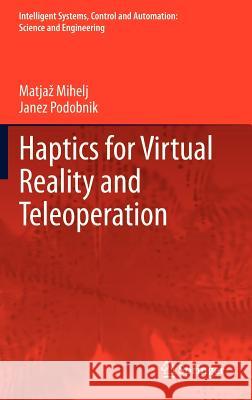
Matjaž Mihelj;Janez Podobnik
Haptics for Virtual Reality and Teleoperation Matjaž Mihelj, Janez Podobnik 9789400757172 Springer - książkaWidoczna okładka, to zdjęcie poglądowe, a rzeczywista szata graficzna może różnić się od prezentowanej.

Haptics for Virtual Reality and Teleoperation

ISBN-13: 9789400757172 / Angielski / Twarda / 2012 / 216 str.

Matjaž Mihelj;Janez Podobnik
cena 401,58
(netto: 382,46 VAT:  5%)

Najniższa cena z 30 dni: 385,52
Termin realizacji zamówienia:
ok. 22 dni roboczych
Dostawa w 2026 r.

Darmowa dostawa!
inne wydania

This book covers all topics relevant for the design of haptic interfaces and teleoperation systems. The book provides the basic knowledge required for understanding more complex approaches and more importantly it introduces all issues that must be considered for designing efficient and safe haptic interfaces. Topics covered in this book provide insight into all relevant components of a haptic system.
The reader is guided from understanding the virtual reality concept to the final goal of being able to design haptic interfaces for specific tasks such as nanomanipulation.
The introduction chapter positions the haptic interfaces within the virtual reality context. In order to design haptic interfaces that will comply with human capabilities at least basic understanding of human sensors-motor system is required. An overview of this topic is provided in the chapter related to human haptics. The book does not try to introduce the state-of-the-art haptic interface solutions because these tend to change quickly. Only a careful selection of different kinematic configurations is shown to introduce the reader into this field.
Mathematical models of virtual environment, collision detection and force rendering topics are strongly interrelated and are described in the next two chapters. The interaction with the virtual environment is simulated with a haptic interface. Impedance and admittance based approaches to haptic robot control are presented. Stability issues of haptic interaction are analyzed in details and solutions are proposed for guaranteeing stable and safe operation. Finally, haptic interaction is extended to teleoperation systems. Virtual fixtures which improve the teleoperation and human-robot cooperation in complex environments are covered next and the last chapter presents nanomanipulation as one specific example of teleoperation."


Kategorie:
Technologie
Kategorie BISAC:
Technology & Engineering > Robotics
Computers > Artificial Intelligence - General
Computers > User Interfaces
Wydawca:
Springer
Seria wydawnicza:
Intelligent Systems, Control and Automation: Science and Eng
Język:
Angielski
ISBN-13:
9789400757172
Rok wydania:
2012
Dostępne języki:
Angielski
Wydanie:
2012
Ilość stron:
216
Waga:
0.51 kg
Wymiary:
23.523.5 x 15.5
Oprawa:
Twarda
Wolumenów:
01
Dodatkowe informacje:
Wydanie ilustrowane

1 Introduction to virtual reality

2 Introduction to haptics

3 Human haptic system

4 Haptic displays

5 Collision detection

6 Haptic rendering

7 Control of haptic interfaces

8 Stability analysis of haptic interfaces

9 Teleoperation

10 Virtual fixtures

11 Micro/nanomanipulation

Index

Matjaz Mihelj graduated from the Faculty of Electrical Engineering, University of Ljubljana, Slovenia in 1996. In October 1997 he became a research staff member and in October 1998 a teaching assistant for robotic courses in the Laboratory of Biomedical Engineering and Robotics at the Faculty of Electrical Engineering in Ljubljana. He received M.Sc. and D.Sc. degrees in biomedical engineering from the Faculty of Electrical Engineering, University of Ljubljana in 1999 and 2002, respectively. For his diploma thesis he was awarded by the Slovenian Ministry of Science and Technology and ISKRA Holding with the Bedjani award. In 2001 he was a visiting researcher at Tohoku University, Sendai, Japan. From May 2005 till April 2006 he spent one year as a visiting researcher at the Automatic Control Laboratory of the Swiss Federal Institute of Technology (ETH Zurich). The research on the rehabilitation robotics performed at ETH Zurich was awarded with the Swiss Technology Award. Since 2009 he has been affiliated as an associate professor. He gives fifth year control system lectures on the man/machine interaction topic with the main focus on multimodal systems based on haptic devices. His current research interests are in man/machine interaction, haptic interfaces as well as modeling and control of biological systems with the main focus on restoration of lost functions in people with disabilities. Dr. Mihelj is a member of IFMBE and IFESS. Janez Podobnik received the B.Sc. and D.Sc. degrees in electrical engineering from the University of Ljubljana, Slovenia in 2004 and 2009, respectively. He was born in 1980 in Ljubljana, Slovenia. He attended Faculty of Electrical Engineering, University of Ljubljana, Slovenia, where he obtained the B.Sc. degree in Electrical Engineering in 2004. His B.Sc. thesis covered stability of haptic interface. He received a Ph.D. degree from the Faculty of Electrical Engineering, University of Ljubljana in 2009. He is currently a teaching assistant in the Laboratory of Biomedical Engineering and Robotics, at the same faculty. His research interests include various applications of haptic interface.

This book covers all topics relevant for the design of haptic interfaces and teleoperation systems. The book provides the basic knowledge required for understanding more complex approaches and more importantly it introduces all issues that must be considered for designing efficient and safe haptic interfaces. Topics covered in this book provide insight into all relevant components of a haptic system.
The reader is guided from understanding the virtual reality concept to the final goal of being able to design haptic interfaces for specific tasks such as nanomanipulation. 

The introduction chapter positions the haptic interfaces within the virtual reality context. In order to design haptic interfaces that will comply with human capabilities at least basic understanding of human sensors-motor system is required. An overview of this topic is provided in the chapter related to human haptics. The book does not try to introduce the state-of-the-art haptic interface solutions because these tend to change quickly. Only a careful selection of different kinematic configurations is shown to introduce the reader into this field.

Mathematical models of virtual environment, collision detection and force rendering topics are strongly interrelated and are described in the next two chapters. The interaction with the virtual environment is simulated with a haptic interface. Impedance and admittance based approaches to haptic robot control are presented. Stability issues of haptic interaction are analyzed in details and solutions are proposed for guaranteeing stable and safe operation. Finally, haptic interaction is extended to teleoperation systems. Virtual fixtures which improve the teleoperation and human-robot cooperation in complex environments are covered next and the last chapter presents nanomanipulation as one specific example of teleoperation.


Udostępnij

Facebook - konto krainaksiazek.pl


Opinie o Krainaksiazek.pl na Opineo.pl

Partner Mybenefit

Krainaksiazek.pl w programie rzetelna firma Krainaksiaze.pl - płatności przez paypal

Czytaj nas na:

Facebook - krainaksiazek.pl
  • książki na zamówienie
  • granty
  • książka na prezent
  • kontakt
  • pomoc
  • opinie
  • regulamin
  • polityka prywatności

Zobacz:

  • Księgarnia czeska

  • Wydawnictwo Książkowe Klimaty

1997-2025 DolnySlask.com Agencja Internetowa

© 1997-2022 krainaksiazek.pl
     
KONTAKT | REGULAMIN | POLITYKA PRYWATNOŚCI | USTAWIENIA PRYWATNOŚCI
Zobacz: Księgarnia Czeska | Wydawnictwo Książkowe Klimaty | Mapa strony | Lista autorów
KrainaKsiazek.PL - Księgarnia Internetowa

Polityka prywatnosci - link
Krainaksiazek.pl - płatnośc Przelewy24
Przechowalnia Przechowalnia





