• Wyszukiwanie zaawansowane
  • Kategorie
  • Kategorie BISAC
  • Książki na zamówienie
  • Promocje
  • Granty
  • Książka na prezent
  • Opinie
  • Pomoc
  • Załóż konto
  • Zaloguj się

Fortschritte Der Chemie Organischer Naturstoffe / Progress in the Chemistry of Organic Natural Products / Progrès Dans La Chimie Des Substances Organi » książka


zaloguj się | załóż konto
Logo Krainaksiazek.pl

koszyk

konto

szukaj
topmenu
Księgarnia internetowa
Szukaj
Książki na zamówienie
Promocje
Granty
Książka na prezent
Moje konto
Pomoc
 
 
Wyszukiwanie zaawansowane
Pusty koszyk
Bezpłatna dostawa dla zamówień powyżej 20 złBezpłatna dostawa dla zamówień powyżej 20 zł

Kategorie główne

• Nauka
 [2946912]
• Literatura piękna
 [1852311]

  więcej...
• Turystyka
 [71421]
• Informatyka
 [150889]
• Komiksy
 [35717]
• Encyklopedie
 [23177]
• Dziecięca
 [617324]
• Hobby
 [138808]
• AudioBooki
 [1671]
• Literatura faktu
 [228371]
• Muzyka CD
 [400]
• Słowniki
 [2841]
• Inne
 [445428]
• Kalendarze
 [1545]
• Podręczniki
 [166819]
• Poradniki
 [480180]
• Religia
 [510412]
• Czasopisma
 [525]
• Sport
 [61271]
• Sztuka
 [242929]
• CD, DVD, Video
 [3371]
• Technologie
 [219258]
• Zdrowie
 [100961]
• Książkowe Klimaty
 [124]
• Zabawki
 [2341]
• Puzzle, gry
 [3766]
• Literatura w języku ukraińskim
 [255]
• Art. papiernicze i szkolne
 [7810]
Kategorie szczegółowe BISAC

Fortschritte Der Chemie Organischer Naturstoffe / Progress in the Chemistry of Organic Natural Products / Progrès Dans La Chimie Des Substances Organi

ISBN-13: 9783709171417 / Angielski / Miękka / 2012 / 408 str.
JR. J. Engel; W. Grassmann; K. Hannig
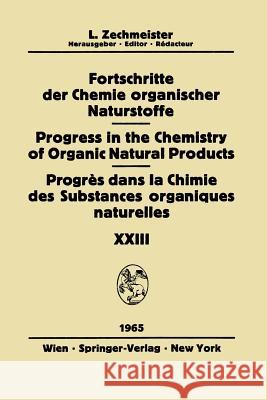
Fortschritte Der Chemie Organischer Naturstoffe / Progress in the Chemistry of Organic Natural Products / Progrès Dans La Chimie Des Substances Organi Engel, J. 9783709171417 Springer - książkaWidoczna okładka, to zdjęcie poglądowe, a rzeczywista szata graficzna może różnić się od prezentowanej.

Fortschritte Der Chemie Organischer Naturstoffe / Progress in the Chemistry of Organic Natural Products / Progrès Dans La Chimie Des Substances Organi

ISBN-13: 9783709171417 / Angielski / Miękka / 2012 / 408 str.

JR. J. Engel; W. Grassmann; K. Hannig
cena 201,24
(netto: 191,66 VAT:  5%)

Najniższa cena z 30 dni: 192,74
Termin realizacji zamówienia:
ok. 22 dni roboczych
Bez gwarancji dostawy przed świętami

Darmowa dostawa!

Sulfonium compounds have been known to the organic chemist for almost 90 years. During most of this period they remained curiosities, well suited for didactic purposes to illustrate certain similarities to ether adducts and to organic ammonium compounds. Their exploration remained largely in the academic realm, because no unusual practical applications were found in spite of a steady increase in the attention paid to them. An event that occasionally puts a class of compounds into the center of interest is the recognition of its occurrence in nature and of special biological significance. The first natural sulfonium compound was discovered less than 20 years ago, somewhat by chance rather than as the climax of some coveted biochemical problem. Gradually, however, the unique role of sulfonium compounds, especially of S-adenosyl methionine, in enzymatic group transfer reactions such as trans methylation was recognized, and the recent upsurge of interest has been exceptional. The present review is directed toward an interpretation of the properties and functions of biological sulfonium compounds with frequent reference to their structural chemistry. The data presented here may suggest novel or improved analytical techniques and new interpretations of the mechanism of group transfer. Furthermore, a stimulus may be derived for the design of sulfonium compound analogues. The availability of competitive analogues of biochemical key compounds has aided in the understanding of the function of virtually all metabolic intermediates, prosthetic groups of enzymes, vitamins, amino acids, and other compounds. The pattern will be similar in sulfonium biochemistry.


Kategorie:
Nauka, Chemia
Kategorie BISAC:
Science > Chemia - Organiczna
Science > Biochemia
Medical > Farmakologia
Wydawca:
Springer
Seria wydawnicza:
Fortschritte Der Chemie Organischer Naturstoffe Progress in
Język:
Angielski
ISBN-13:
9783709171417
Rok wydania:
2012
Wydanie:
Softcover Repri
Numer serii:
000401901
Ilość stron:
408
Waga:
0.64 kg
Wymiary:
23.5 x 15.5
Oprawa:
Miękka
Wolumenów:
01
Dodatkowe informacje:
Wydanie ilustrowane

— Table des matières.- Polysaccharides of Marine Algae.- I. Introduction.- II. Skeletal Polysaccharides of the Algal Cell-Wall.- 1. Cellulose in Algae.- 2. Mannans.- 3. Xylans.- 4. Conclusions.- III. Food Reserve Polysaccharides.- 1. Starch (Green Algae).- 2. Floridean Starch (Red Algae).- 3. Laminarin (Brown Algae).- 4. Conclusions.- IV. Polysaccharides Containing Sulphate Esters.- 1. Fucoidin (Brown Algae).- 2. Galactan Sulphates of Red Algae.- (a) Agarose Type.- (i) Agar.- (ii) Funori.- (iii) Porphyran.- (b) x-Carrageenan Type.- (i) Carrageenan.- (ii) Furcellaran.- (iii) Other Carrageenan Types.- (c) Miscellaneous.- (i) The Mucilage of Dilsea edulis.- (ii) Polysiphonia fastigiata.- 3. Polysaccharide Sulphates of Green Algae.- (a) Heteropolysaccharides Containing Sulphated Arabogalactans.- (i) Cladophora rupestris.- (ii) Caulerpa filiformis.- (iii) Codium fragile.- (b) Heteropolysaccharides Containing Glucuronic Acid.- (i) Ulva lactuca.- (ii) Acrosiphonia centralis.- (iii) Enteromorpha compressa.- 4. Conclusions.- V. Alginic Acid.- References.- Der Kohlenhydratstoffwechsel in Gerste, Hafer und Rispenhirse.- I. Die löslichen Kohlenhydrate in der Gerste und ihre Konstitution.- II. Die löslichen Kohlenhydrate im Hafer und ihre Konstitution.- III. Die löslichen Kohlenhydrate in der Rispenhirse und ihre Konstitution.- IV. Die enzymatische Steuerung des Kohlenhydratstoffwechsels in den Getreidearten.- V. Zur Geschichte der Kultur der Getreidearten.- The Chemistry of Biological Sulfonium Compounds..- I. Introduction.- II. The Discovery of Sulfonium Compounds.- III. The Chemistry of Sulfonium Compounds.- 1. Formation and Structure.- 2. Mechanisms of Decomposition and Rearrangement.- 3. Stereoisomerism of the Sulfonium Group.- IV. In vitro Synthesis and Properties of Biological Sulfonium Compounds.- 1. Dimethyl-?-propiothetin.- 2. S-Methylsulfonium Salt of Methionine (S-Methylmethionine).- 3. S-Adenosylmethionine and Related Compounds.- a. In vitro Synthesis of S-Adenosylmethionine.- b. S-Adenosyl-3-methylmercaptopropylamine.- c. Hydrolysis of S-Adenosylmethionine.- d. Effect of Alkali on S-Adenosylmethionine and Related Compounds.- e. Diastereoisomers of S-Adenosylmethionine.- V. Origin and Metabolism of Biological Sulfonium Compounds.- 1. Dimethyl-?-propiothetin.- 2. S-Methylsulfonium Salt of Methionine (S-Methylmethionine).- 3. S-Adenosylmethionine.- VI. Metabolic Functions of Biological Sulfonium Compounds.- 1. Transmethylations.- a. General Considerations.- b. The Diversity of Methyl Acceptors.- c. Analytical Techniques.- d. Attempts to Explain the Mechanism of Transmethylation.- 2. Biosynthesis of Spermidine and Spermine.- 3. Formation of Homoserine Lactone and Homoserine from S-Adenosylmethionine.- VII. Derivatives and Analogues of Biological Sulfonium Compounds.- 1. Analogues for Metabolic Studies.- 2. Sulfonium Derivatives of Protein-bound Methionine.- References.- Some Aspects of the Chemistry and Function of Human and Animal Hemoglobins..- I. Introduction.- II. Nomenclature.- III. The Amino Acid Sequence of Human Hemoglobins A and F.- 1. Hemoglobin A.- a. The Amino Acid Sequence of the ?AChain.- b. The Amino Acid Sequence of the ?AChain.- 2. Hemoglobin F.- a. The Amino Acid Sequence of the ?F Chain.- b. The Amino Acid Sequence of the ?F Chain.- 3. A Comparison of Hemoglobins A and F.- 4. A Comparison of the ? and ? Chains.- IV. Other Hemoglobins in the Normal Human Individual.- 1. The Hemoglobin Components of the New-born Infant.- 2. The Hemoglobin Components of the Adult.- V. The Abnormal Human Hemoglobins.- 1. Methods.- 2. Nomenclature.- 3. Some General Genetic Considerations.- 4. Hemoglobins with Abnormalities in the ? Chain.- 5. Hemoglobins with Abnormalities in the ? Chain.- 6. Hemoglobins with Abnormalities in the ? Chain.- 7. Hemoglobins with Abnormalities in the ? Chain.- 8. Hemoglobins with Other Abnormalities.- 9. General Remarks.- VI Animal Hemoglobins.- 1. Gross Structure of Animal Hemoglobins.- 2. Adult and Fetal Forms.- 3. Nomenclature of the Animal Hemoglobins.- 4. Sequences in the Animal Hemoglobins.- a. ? Chains.- b. ? Chains.- c. ? Chains.- VII. Hemoglobin in Three Dimensions.- 1. Introduction.- 2. The Relationship between Hemoglobin and Myoglobin.- 3. Pertinent Aspects of the Structure of Myoglobin.- 4. The ? and ? Chains — Secondary and Tertiary Structure.- 5. The Quaternary Structure.- 6. The Three-dimensional Structure of Hemoglobins from Different Species.- 7. Oxygenation and Structural Alterations.- VIII. Chemical Modifications of Hemoglobin.- 1. Introduction.- 2. Reactions of the Heme Group.- 3. Titration Curves and their Interpretation.- 4. Reactions of the Sulfhydryl Group.- 5. Other Reactions.- 6. Conclusions.- IX. Reversible Dissociation and Subunit Hybridization of Hemoglobin.- 1. Introduction.- 2. Possible Modes of Dissociation.- 3. Evidence for Dissociation.- 4. Mechanism of Dissociation and Subunit Hybridization.- 5. Other Factors which Influence Dissociation and Subunit Hybridization.- 6. Comments on Dissociation and Hybridization.- X. The Biosynthesis of Hemoglobin.- 1. Introduction.- 2. Genetic Control of Hemoglobin Structure.- 3. Biosynthesis of the Polypeptide Chains of Globin.- a. The Activation of Amino Acids for Protein Biosynthesis.- b. DNA and the Role of m-RNA.- c. The Function of the Ribosomes.- d. The Assembling of the Polypeptide Chain.- e. The Final Release of the Protein.- 4. Biosynthesis of Heme.- 5. The Attachment of Heme to Globin Chains.- 6. Assembly of Chains into the Whole Hemoglobin Molecule.- References.- Kollagen.- I. Einleitung.- II. Übersicht.- III. Aminosäurezusammensetzung.- 1. Kollagene der Wirbeltiere.- 2. Kollagene im niederen Tierreich.- IV. Primärstruktur.- 1. Aminosäuresequenzen des Kollagens.- a. Partielle Säure- und Alkali-Hydrolyse.- b. Enzymatische Methoden.- ?) Abbau des denaturierten Kollagens mit Trypsin.- ?) Kollagenase — der Schlüssel für die apolaren Bereiche.- ?) Isolierung der apolaren Bereiche.- ?) Isolierung der polaren Bereiche.- 2 Alkali- und Hydroxylamin-empfindliche Bindungen, Endgruppen und Acetylgruppen.- 3. Quervernetzungen.- V. Sekundär- und Tertiärstruktur.- 1. Ergebnisse der Röntgenstruktur-Untersuchung.- 2. Physikalische Eigenschaften des nativen Kollagenmoleküls.- 3. Denaturiertes lösliches Kollagen.- VI. Zerfall und Rückbildung der Sekundär- und Tertiärstruktur (De- und Renaturierung).- 1. Denaturierung in Lösung.- 2. Denaturierung im festen Zustand (Schrumpfung).- 3. Renaturierung in Lösung.- 4. Der De- und Renaturierung des Kollagens analoge Umwandlungen von (Pro · Gly · Pro)n in Lösung.- VII. Bau und Bildung der Fibrillen und Segmente (Quartärstrukturen).- 1. Die nativen Fibrillen.- a. Das Querstreifungsmuster.- b. Die Ursache der Querstreifung.- 2. Der molekulare Bau der verschiedenen Kollagenstrukturen.- a. Das Querstreifungsmuster der Long-spacing-Segmente (SLS).- b. Die Anordnung der Kollagenmoleküle in den Fibrillen des nativen Typs.- c. Die Anordnung der Moleküle in den Long-spacing-Fibrillen (FLS).- d. Die End-an-End-Zusammenlagerung der Kollagenmoleküle.- 3. Die Fibrillenbildung.- 4. Die Beeinflussung der Fibrillenbildung in vitro.- VIII. Stoffwechsel des Kollagens.- 1. Biosynthese.- 2. Reifung und Alterung.- 3. Abbau im Körper.- 4. Mineralisierung.- 5. Kollagenosen.- Some Applications of Nuclear Magnetic Resonance Spectroscopy in Natural Product Chemistry.- I. Introduction.- II. Principles of Application.- 1. Determination of Empirical Formulae.- 2. Determination of the Classes of Protons in a Molecule. The Chemical Shift.- 3. The Number of Protons in a Given Class. Intensities.- 4. The Sequence of Groups in Molecules. Electron Coupled Spin-Spin Interaction.- 5. An Example of Application to Structure Determination.- 6. Applications to the Elucidation of Relative Stereochemistry and Conformation.- III. Examples in Natural Product Chemistry.- 1. Steroids.- 2. Carbohydrates.- 3. Carotenoids and Acyclic Terpenes.- 4. Flavonoids and Related Compounds.- 5. Alkaloids.- References.- Namenverzeichnis. Index of Names. Index des Auteurs.- Sachverzeichnis. Index of Subjects. Index des Matières.


Udostępnij

Facebook - konto krainaksiazek.pl


Opinie o Krainaksiazek.pl na Opineo.pl

Partner Mybenefit

Krainaksiazek.pl w programie rzetelna firma Krainaksiaze.pl - płatności przez paypal

Czytaj nas na:

Facebook - krainaksiazek.pl
  • książki na zamówienie
  • granty
  • książka na prezent
  • kontakt
  • pomoc
  • opinie
  • regulamin
  • polityka prywatności

Zobacz:

  • Księgarnia czeska

  • Wydawnictwo Książkowe Klimaty

1997-2025 DolnySlask.com Agencja Internetowa

© 1997-2022 krainaksiazek.pl
     
KONTAKT | REGULAMIN | POLITYKA PRYWATNOŚCI | USTAWIENIA PRYWATNOŚCI
Zobacz: Księgarnia Czeska | Wydawnictwo Książkowe Klimaty | Mapa strony | Lista autorów
KrainaKsiazek.PL - Księgarnia Internetowa

Polityka prywatnosci - link
Krainaksiazek.pl - płatnośc Przelewy24
Przechowalnia Przechowalnia






