• Wyszukiwanie zaawansowane
  • Kategorie
  • Kategorie BISAC
  • Książki na zamówienie
  • Promocje
  • Granty
  • Książka na prezent
  • Opinie
  • Pomoc
  • Załóż konto
  • Zaloguj się

Computer Algebra Recipes: A Gourmet's Guide to the Mathematical Models of Science » książka


zaloguj się | załóż konto
Logo Krainaksiazek.pl

koszyk

konto

szukaj
topmenu
Księgarnia internetowa
Szukaj
Książki na zamówienie
Promocje
Granty
Książka na prezent
Moje konto
Pomoc
 
 
Wyszukiwanie zaawansowane
Pusty koszyk
Bezpłatna dostawa dla zamówień powyżej 20 złBezpłatna dostawa dla zamówień powyżej 20 zł

Kategorie główne

• Nauka
 [2946600]
• Literatura piękna
 [1856966]

  więcej...
• Turystyka
 [72221]
• Informatyka
 [151456]
• Komiksy
 [35826]
• Encyklopedie
 [23190]
• Dziecięca
 [619653]
• Hobby
 [140543]
• AudioBooki
 [1577]
• Literatura faktu
 [228355]
• Muzyka CD
 [410]
• Słowniki
 [2874]
• Inne
 [445822]
• Kalendarze
 [1744]
• Podręczniki
 [167141]
• Poradniki
 [482898]
• Religia
 [510455]
• Czasopisma
 [526]
• Sport
 [61590]
• Sztuka
 [243598]
• CD, DVD, Video
 [3423]
• Technologie
 [219201]
• Zdrowie
 [101638]
• Książkowe Klimaty
 [124]
• Zabawki
 [2473]
• Puzzle, gry
 [3898]
• Literatura w języku ukraińskim
 [254]
• Art. papiernicze i szkolne
 [8170]
Kategorie szczegółowe BISAC

Computer Algebra Recipes: A Gourmet's Guide to the Mathematical Models of Science

ISBN-13: 9780387951485 / Angielski / Twarda / 2001 / 796 str.
Richard H. Enns; R. Enns; G. McGuire
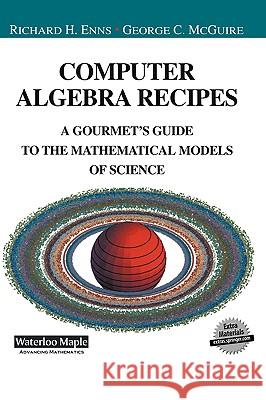
Computer Algebra Recipes: A Gourmet's Guide to the Mathematical Models of Science Enns, Richard 9780387951485 Springer - książkaWidoczna okładka, to zdjęcie poglądowe, a rzeczywista szata graficzna może różnić się od prezentowanej.

Computer Algebra Recipes: A Gourmet's Guide to the Mathematical Models of Science

ISBN-13: 9780387951485 / Angielski / Twarda / 2001 / 796 str.

Richard H. Enns; R. Enns; G. McGuire
cena 403,47 zł
(netto: 384,26 VAT:  5%)

Najniższa cena z 30 dni: 385,52 zł
Termin realizacji zamówienia:
ok. 22 dni roboczych
Bez gwarancji dostawy przed świętami

Darmowa dostawa!

Computer algebra systems have the potential to revolutionize the teaching of and learning of science. Not only can students work thorough mathematical models much more efficiently and with fewer errors than with pencil and paper, they can also work with much more complex and computationally intensive models. Thus, for example, in studying the flight of a golf ball, students can begin with the simple parabolic trajectory, but then add the effects of lift and drag, of winds, and of spin. Not only can the program provide analytic solutions in some cases, it can also produce numerical solutions and graphic displays.
Aimed at undergraduates in their second or third year, this book is filled with examples from a wide variety of disciplines, including biology, economics, medicine, engineering, game theory, physics, chemistry. The text is organized along a spiral, revisiting general topics such as graphics, symbolic computation, and numerical simulation in greater detail and more depth at each turn of the spiral.
The heart of the text is a large number of computer algebra recipes. These have been designed not only to provide tools for problem solving, but also to stimulate the reader's imagination. Associated with each recipe is a scientific model or method and a story that leads the reader through steps of the recipe.Each section of recipes is followed by a set of problems that readers can use to check their understanding or to develop the topic further."


Kategorie:
Informatyka, Bazy danych
Kategorie BISAC:
Mathematics > Algebra - General
Computers > Data Science - General
Mathematics > Matematyka dyskretna
Wydawca:
Springer
Seria wydawnicza:
Undergraduate Texts in Contemporary Physics
Język:
Angielski
ISBN-13:
9780387951485
Rok wydania:
2001
Numer serii:
000038941
Ilość stron:
796
Waga:
1.49 kg
Wymiary:
24.13 x 18.54 x 4.24
Oprawa:
Twarda
Wolumenów:
01
Dodatkowe informacje:
Wydanie ilustrowane

From the reviews:

"In the book, the authors are showing the reader what they can do with Maple 6, and they can do a lot. Simply flipping the pages of the book, the reader might get very inspired by the formulas and pictures. ... Most of the text I covered up to now contains useful and exciting examples ... . the book is definitely very useful for educators ... ." (L. Kocbach, Computer Physics Communications, Vol. 144, 2002)

"This book captures the essence of the CAS approach and it is the best book of its kind that I am aware of. The level of mathematics, the eclectic, abundant and carefully selected problem set, the friendly and expansive text and the clear demonstration of the power of the CAS approach all add up to a first rate book. ... I highly recommend that you get your library to order a copy." (B.I. Henry, The Physicist, Vol. 39 (2), 2002)

"This book is a readable introduction to Maple, a computer algebra system. The authors present real life situations, describe them in the language of mathematics, and then use Maple to find or deduce conclusions, predictions and classifications of each of these situations." (Václav Koubek, Zentralblatt MATH, Vol. 976, 2002)

Preface.- A Computer Algebra Systems.- B The Spiral Staircase to Learning.- C How to Climb the Spiral Staircase.- I The Appetizers.- 1 The Pictures of Science.- 1.1 Introduction.- 1.2 Data and Function Plots.- 1.2.1 Correcting for Inflation.- 1.2.2 The Plummeting Badminton Bird.- 1.2.3 Minimizing the Travel Time.- 1.3 Log-Log (Power Law) Plots.- 1.3.1 Chimpanzee Brain Size.- 1.3.2 Scaling Arguments and Gulliver’s Travels.- 1.4 Contour and Gradient Plots.- 1.4.1 The Secret Message.- 1.4.2 Designing a Ski Hill.- 1.5 Animated Plots.- 1.5.1 Waves Are Dynamic.- 1.5.2 The Sands of Time.- 2 Deriving Model Equations.- 2.1 Introduction.- 2.2 Linear Correlation.- 2.2.1 What Is Linear Correlation?.- 2.2.2 The Corn Palace.- 2.3 Least Squares Derivations.- 2.3.1 Regression Analysis.- 2.3.2 Will You Be Better Off Than Your Parents?.- 2.3.3 What Was the Heart Rate of a Brachiosaurus?.- 2.3.4 Senate Renewal.- 2.3.5 Bikini Sales and the Logistic Curve.- 2.3.6 Following the Dow Jones Index.- 2.3.7 Variation of “g” with Latitude.- 2.3.8 Finding Romeo a Juhet.- 2.4 Multiple Regression Equations.- 2.4.1 Real Estate Appraisals.- 2.4.2 And the Winner Is?.- 3 Algebraic Models.- 3.1 Introduction.- 3.2 Algebraic Examples.- 3.2.1 Bombs Versus Schools.- 3.2.2 Kirchhoff Rules the Electrical World.- 3.2.3 The Window Washer’s Secret.- 3.2.4 The Science Student’s Summer Job Interview.- 3.2.5 Envelope of Safety.- 3.2.6 Rainbow County.- 3.3 Integral Examples.- 3.3.1 The Great Pyramid of Cheops.- 3.3.2 Noah’s Ark.- 3.4 Vector Examples.- 3.4.1 Vectoria’s Mathematical Heritage.- 3.4.2 Ain’t She Sweet.- 3.4.3 Born Curl Free.- 3.4.4 Of Flux and Circulation and Coordinates Too.- 4 Monte Carlo Methods.- 4.1 Introduction.- 4.2 Random Walks.- 4.2.1 The Concept.- 4.2.2 The Soccer Fan’s Drunken Walk.- 4.2.3 Blowin’ in the Wind.- 4.2.4 Flight of Penelope Jitter Bug.- 4.2.5 That Meandering Perfume Molecule.- 4.3 Monte Carlo Integration.- 4.3.1 Standard Numerical Integration Algorithms.- 4.3.2 Monte Carlo Integration.- 4.3.3 Wait and Buy Later!.- 4.3.4 Wait and Buy Later! The Sequel.- 4.3.5 Estimating ?.- 4.3.6 Chariot of Fire and Destruction.- 4.4 Probability Distributions.- 4.4.1 Of Nuts and Bolts and Hospital Beds Too.- 4.4.2 The Ice Wines of Rainbow County.- 4.5 Monte Carlo Statistical Distributions.- 4.5.1 Estimating e.- 4.5.2 Vapor Deposition.- II The Entrees.- 5 Phase-Plane Portraits.- 5.1 Introduction.- 5.2 Phase-Plane Portraits.- 5.2.1 Stationary or Singular Points.- 5.3 Linear ODE Models.- 5.3.1 Tenure Policy at Erehwon University.- 5.3.2 Vectoria Investigates the RLC Circuit.- 5.4 Nonlinear ODE Models.- 5.4.1 Classification of Stationary Points.- 5.4.2 Rabbits and Foxes.- 5.4.3 The Mona Lisa of Nonlinear Science.- 5.4.4 Mike Creates a Higher-Order Singular Point.- 5.4.5 The Gnus and Sung of Erehwon.- 5.5 Nonautonomous ODEs.- 5.5.1 Can an Unstable Spring Find Stability?.- 5.5.2 The Period Doubling Route to Chaos.- 6 Linear ODE Models.- 6.1 Introduction.- 6.2 Solving Linear ODEs with Maple.- 6.3 First-Order ODE Models.- 6.3.1 There Goes Louie’s Alibi.- 6.3.2 The Water Skier.- 6.4 Second-Order ODE Models.- 6.4.1 Shrinking the Safety Envelope.- 6.4.2 Halley’s Comet.- 6.4.3 Frank N Stein Is Not Heartless.- 6.4.4 Vectoria Feels the Force and Hits the Bottle.- 6.5 Bessel and Legendre ODE Models.- 6.5.1 Introduction to Special Functions.- 6.5.2 The Vibrating Bungee Cord.- 6.5.3 Wheel of misFortune.- 6.5.4 TheWeedeater.- 7 Nonlinear ODE Models.- 7.1 Introduction.- 7.2 First-Order Models.- 7.2.1 The Nonlinear Diode.- 7.2.2 The Bad Bird Equation.- 7.2.3 The Struggle for Existence.- 7.3 Second-Order Models.- 7.3.1 Pirates of the Caribbean.- 7.3.2 Oh What Sounds We Hear!.- 7.3.3 Those Lennard-Jones Vibrational Blues.- 7.3.4 Golf Is Such an “Uplifting” Experience.- 7.3.5 This Would Be a Great Amusement Park Ride.- 7.4 Limit Cycles.- 7.4.1 The Bizarre World of the Tunnel Diode Oscillator.- 7.4.2 Follow That Rabbit.- 8 Difference Equation Models.- 8.1 Introduction.- 8.2 Linear Difference Equation Models.- 8.3 First-Order Linear Models.- 8.3.1 Those Dratted Gnats.- 8.3.2 Gone Fishing.- 8.4 Second-Order Linear Models.- 8.4.1 Fibonacci’s Adam and Eve Rabbit.- 8.4.2 How Red Is Your Blood?.- 8.4.3 Fermi-Pasta-Ulam Is Not a Spaghetti Western.- 8.5 Nonlinear Difference Equation Models.- 8.6 First-Order Nonhnear Models.- 8.6.1 Competition for Available Resources.- 8.6.2 The Logistic Map and Cobweb Diagrams.- 8.7 Second-Order Nonhnear Models.- 8.7.1 The Bouncing Ball Art Gallery.- 8.7.2 Onset of Chaos: A Model for the Outbreak of War.- 8.8 Numerically Solving ODEs.- 8.8.1 Finite Difference Approximations to Derivatives.- 8.8.2 Rabbits and Foxes: The Sequel.- 8.8.3 Glycolytic Oscillator.- 9 Some Analytic Approaches.- 9.1 Introduction.- 9.2 Checking Solutions.- 9.2.1 The Palace of the Governors.- 9.2.2 Play It, Sam.- 9.2.3 The Tliree-Piece String.- 9.3 Calculus of Variations.- 9.3.1 Dress Design, The Erehwonese Way.- 9.3.2 Queen Dido’s Problem.- 9.3.3 The Human Fly Plans His Escape Route.- 9.4 Fourier Series.- 9.4.1 Hi C Is Not Always a Drink.- 9.4.2 Play It, Sam: A New Perspective.- 9.4.3 Vectoria Sums a Series.- 10 Fractal Patterns.- 10.1 Introduction.- 10.2 Difference Equation Patterns.- 10.2.1 Wallpaper for the Mind.- 10.2.2 Sierpinski’s Fractal Gasket.- 10.2.3 Barnsley’s Fern.- 10.2.4 Douadv’s Rabbit and Other Fauna and Flora.- 10.2.5 The Rings of Saturn.- 10.3 ODE Patterns.- 10.3.1 The Butterfly Attractor.- 10.3.2 Rössler’s Strange Attractor.- 10.4 Cellular Automata Patterns.- 10.4.1 A Navaho Rug Design.- 10.4.2 The One Out of Eight Rule.- III The Desserts.- 11 Diagnostic Tools for Nonlinear Dynamics.- 11.1 Introduction.- 11.2 The Poincaré Section.- 11.2.1 The Concept.- 11.2.2 A Rattler Signals Chaos.- 11.3 The Power Spectrum.- 11.3.1 The Concept.- 11.3.2 The Rattler Returns.- 11.4 The Bifurcation Diagram.- 11.4.1 The Concept.- 11.4.2 Pitchforks and Other Bifurcations.- 11.5 The Lyapunov Exponent.- 11.5.1 The Concept.- 11.5.2 Mr Lyapunov Agrees.- 11.6 Reconstructing an Attractor.- 11.6.1 The Concept.- 11.6.2 Chaos Versus Noise.- 12 Linear PDE Models.- 12.1 Introduction.- 12.1.1 The Linear PDEs of Mathematical Physics.- 12.1.2 Separation of Variables.- 12.2 Diffusion and Laplace’s Equation Models.- 12.2.1 Freeing Excalibur.- 12.2.2 Aussie Barbecue.- 12.2.3 Erehwon Institute of Technology.- 12.2.4 Hugo and the Atomic Bomb.- 12.2.5 Hugo Prepares for his Job Interview.- 12.3 Wave Equation Models.- 12.3.1 Vectoria Encounters Simon Legree.- 12.3.2 Homer’s Jiggle Test.- 12.3.3 Vectoria’s Second Problem.- 12.4 Semi-Infinite and Infinite Domains.- 12.4.1 Vectoria’s Third Problem.- 12.4.2 Assignment Complete!.- 12.4.3 Radioactive Contamination.- 12.4.4 “Play It Sara” Revisited.- 13 Nonlinear PDE Models: Soliton Solutions.- 13.1 Introduction.- 13.2 Solitary Waves.- 13.3 The Graphical Hunt for Solitons.- 13.3.1 Of Kinks and Antikinks.- 13.3.2 In Search of Bright Solitons.- 13.3.3 Can Three Solitary Waves Live Together?.- 13.4 Analytic Soliton Solutions.- 13.4.1 Follow That Wave!.- 13.4.2 Looking for a Kinky Solution.- 14 Simulating PDE Models.- 14.1 Introduction.- 14.2 Diffusion and Wave Equation Models.- 14.2.1 Freeing Excalibur the Numerical Way.- 14.2.2 Vectoria Secret.- 14.2.3 Enjoy the Klein-Gordon Vibes.- 14.3 Soliton Colhsions.- 14.3.1 To Be or Not to Be a Soliton.- 14.3.2 Are Diamonds a Kink’s Best Friend?.- Epilogue.


Udostępnij

Facebook - konto krainaksiazek.pl


Opinie o Krainaksiazek.pl na Opineo.pl

Partner Mybenefit

Krainaksiazek.pl w programie rzetelna firma Krainaksiaze.pl - płatności przez paypal

Czytaj nas na:

Facebook - krainaksiazek.pl
  • książki na zamówienie
  • granty
  • książka na prezent
  • kontakt
  • pomoc
  • opinie
  • regulamin
  • polityka prywatności

Zobacz:

  • Księgarnia czeska

  • Wydawnictwo Książkowe Klimaty

1997-2025 DolnySlask.com Agencja Internetowa

© 1997-2022 krainaksiazek.pl
     
KONTAKT | REGULAMIN | POLITYKA PRYWATNOŚCI | USTAWIENIA PRYWATNOŚCI
Zobacz: Księgarnia Czeska | Wydawnictwo Książkowe Klimaty | Mapa strony | Lista autorów
KrainaKsiazek.PL - Księgarnia Internetowa

Polityka prywatnosci - link
Krainaksiazek.pl - płatnośc Przelewy24
Przechowalnia Przechowalnia





