• Wyszukiwanie zaawansowane
  • Kategorie
  • Kategorie BISAC
  • Książki na zamówienie
  • Promocje
  • Granty
  • Książka na prezent
  • Opinie
  • Pomoc
  • Załóż konto
  • Zaloguj się

Additive Manufacturing Advantage » książka


zaloguj się | załóż konto
Logo Krainaksiazek.pl

koszyk

konto

szukaj
topmenu
Księgarnia internetowa
Szukaj
Książki na zamówienie
Promocje
Granty
Książka na prezent
Moje konto
Pomoc
 
 
Wyszukiwanie zaawansowane
Pusty koszyk
Bezpłatna dostawa dla zamówień powyżej 20 złBezpłatna dostawa dla zamówień powyżej 20 zł

Kategorie główne

• Nauka
 [2946600]
• Literatura piękna
 [1856966]

  więcej...
• Turystyka
 [72221]
• Informatyka
 [151456]
• Komiksy
 [35826]
• Encyklopedie
 [23190]
• Dziecięca
 [619653]
• Hobby
 [140543]
• AudioBooki
 [1577]
• Literatura faktu
 [228355]
• Muzyka CD
 [410]
• Słowniki
 [2874]
• Inne
 [445822]
• Kalendarze
 [1744]
• Podręczniki
 [167141]
• Poradniki
 [482898]
• Religia
 [510455]
• Czasopisma
 [526]
• Sport
 [61590]
• Sztuka
 [243598]
• CD, DVD, Video
 [3423]
• Technologie
 [219201]
• Zdrowie
 [101638]
• Książkowe Klimaty
 [124]
• Zabawki
 [2473]
• Puzzle, gry
 [3898]
• Literatura w języku ukraińskim
 [254]
• Art. papiernicze i szkolne
 [8170]
Kategorie szczegółowe BISAC

Additive Manufacturing Advantage

ISBN-13: 9783031345623 / Angielski
Sanjay Kumar
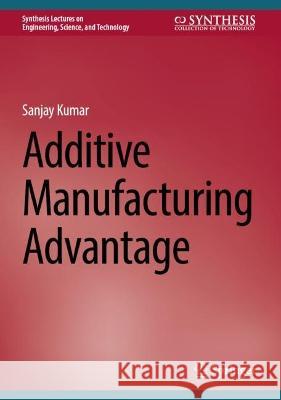
Additive Manufacturing Advantage Sanjay Kumar   9783031345623 Springer International Publishing AG - książkaWidoczna okładka, to zdjęcie poglądowe, a rzeczywista szata graficzna może różnić się od prezentowanej.

Additive Manufacturing Advantage

ISBN-13: 9783031345623 / Angielski

Sanjay Kumar
cena 242,07 zł
(netto: 230,54 VAT:  5%)

Najniższa cena z 30 dni: 212,02 zł
Termin realizacji zamówienia:
ok. 22 dni roboczych
Bez gwarancji dostawy przed świętami

Darmowa dostawa!
inne wydania

This book provides a concise introduction to additive manufacturing, accessible to anyone with a basic background in engineering and materials science. The author explains additive manufacturing (AM) in terms of advantages and disadvantages and gives a concise list of advantages and disadvantages, enabling readers to understand AM in relation to other techniques. Additionally, this book clarifies various contradictions with the help of numerous examples. This book: Offers readers a unique, accelerated learning tool, revealing the subtleties of Additive Manufacturing Describes a concept for refabrication in the context of additive manufacturing, providing new insight into repair and refurbishment Discusses additive manufacturing not only as a design tool, but also a production tool in the context of mass-production


Kategorie:
Technologie
Kategorie BISAC:
Technology & Engineering > Electronics - General
Technology & Engineering > Materials Science - Electronic Materials
Science > Physics - Condensed Matter
Wydawca:
Springer International Publishing AG
Język:
Angielski
ISBN-13:
9783031345623

1.       Advantage and disadvantage

Abstract

Keywords

1.1.    Advantages

1.1.1. Freedom to design and freedom to move

1.1.2. Freedoms to save material and make multi-material part

1.1.3. Freedoms to save energy and material

1.2.    Fast process and freedom to design

1.2.1. Why independent

1.2.2. Why fast process

1.2.3. Effect of shape and size on speed

1.2.4. Requirement for comparing speed

1.2.5. Geometrical complexity and problem

1.2.6. Perspective of machining

1.2.7. Perspective of AM

1.2.8. Advanced: AM or machining?

1.2.9. Complexity and technique

1.3.    Freedom to design

1.3.1. Not always better

1.3.2. In injection molding (IM)

1.3.3. In machining

1.3.4. In AM

1.3.5. Not enough

1.3.6. Restriction as advantage

1.3.7.  Side surface

1.3.8. Multi-tool AM

1.3.8.1.              Wall

1.3.8.2.              Cavity

1.3.9. Build directions

1.4.    Freedom to save material

1.4.1. Amount

1.4.2. Better than machining

1.4.3. By multi-material part

1.4.4. How to save

1.4.5. How wasted

1.4.6. Wasting and manufacturing

1.4.7. Wasting and complexity

1.5.    Freedom to make multi-material part

1.5.1. Deposition process

1.5.2. Bed process

1.5.3. Changing parameter

1.5.4. High cooling rate

1.6.    Freedom to save energy

1.6.1. Repair

1.6.2. Efficient part

1.6.3. Light-weighting

1.6.4. Assembly

1.6.5. Creating energy

1.7.    Freedom to move

1.7.1. Industrial implication

1.7.2. Limitation

1.8.    Not independent advantage

1.8.1. Rapid prototyping

1.8.2. Rapid manufacturing

1.8.3. On-demand production

1.8.4. Accelerated time to market

1.8.5. Mass customization

1.8.6. Production volume flexibility

1.8.7. Parts consolidation into assembly

1.8.8. Modular product

1.8.9. Innovative product

1.8.10.                   Cost effective

1.8.11.                   Material waste reduction

1.8.12.                   Customized repair, customized composition

1.8.13.                   Energy saving

1.8.14.                   Distributed manufacturing

1.8.15.                   Supply chain improvement

1.9.    Disadvantages

1.10.                        Energy-intensive process

1.10.1.                   No shortcut

1.10.2.                   Not always demerit

1.10.3.                   Energy sharing

1.11.                        Lack of processable materials

1.11.1.                   What if number increases

1.12.                        Lack of repeatability

1.12.1.                   Difference between two sizes

1.12.2.                   Process resolution

1.12.3.                   Accuracy of consolidation

1.12.4.                   Specification for machine

1.12.5.                   Accuracy and repeatability

1.12.6.                   Meaning of lack of repeatability

1.12.7.                   Comparison

1.12.7.1.           With mold-based process

1.12.7.2.           With machining

1.13.                        Slow process

1.13.1.                   Slow due to processing difference

1.13.2.                   Slow due to support structure

1.13.2.1.           Changing orientation

1.13.2.2.           Self-support structure

1.13.2.3.           Reusable support

1.13.2.4.           Difficulty in bed process

1.13.2.5.           Various types

1.14.                        Need of post-processing

1.14.1.                   Process and post-process stage

1.14.1.1.           Post-processing type action

1.14.2.                   Parameter types

1.14.2.1.           Optimization

1.14.3.                   In AM

1.14.4.                   Not a fundamental disadvantage

1.15.                        Paradox of AM being both slow and fast

1.16.                        AM saves or wastes energy?

1.17.                        About the book

References

2.       Examples

Abstract

Keywords

2.1.    Composite

2.1.1. Multi-material part and composite

2.1.2. Categorization of advantages

2.1.3. Perspective of advantage

2.1.4. What is composite

2.1.5. Extension of concept

2.1.6. Composite-1 and composite-2

2.1.7. Composite structure

2.1.8. Composite material part

2.1.8.1.              Composite feedstock

2.1.9. Deposition process

2.1.9.1.              Fibre-reinforced composite

2.1.9.2.              Metal composite

2.2.    Conformal cooling channel

2.2.1. Disadvantage of drilling

2.2.2. Disadvantage of casting

2.2.3. By LPBF

2.3.    Pattern and mold

2.3.1. Permanent mold

2.3.2. Temporary mold

2.3.3. Temporary pattern

2.3.4. Permanent pattern to make mold

2.3.5. Permanent pattern to make temporary pattern

References

3.       A concept for refabrication

Abstract

Keywords

3.1.    Repair and refurbishment

3.2.    Examples of refurbishment

3.3.    Bed process and deposition process

3.4.    Top surface and side surface

3.5.    Laser cladding and laser DP

3.6.    Localization of repair

3.7.    Concept for standardized repair

3.8.    Marking for repair a necessity

3.9.    Design and repair

3.10.                        How part should break

3.11.                        Why weak component

3.12.                        Weak component helps repair

3.13.                        Restriction of process

3.14.                        In bed process

3.15.                        Bed process and system

3.16.                        Customized bed

3.17.                        Problem with planar bed

References

4.       A Concept for mass production

Abstract

Keywords

4.1.    Advantage or disadvantage

4.2.    Introduction

4.3.    Requirement for uniform property

4.4.    Failure of mass production as mass customization

4.5.    Property in AM and IM

4.6.    Methods

4.7.    Serial and non-serial production

4.8.    Fast serial production

4.9.    Non-serial production

4.10.                        Number of parts

4.11.                        Many parts and big part

4.11.1.                   Why big part

4.11.2.                   Why deposition process

4.11.3.                   Why wire

4.12.                        Processing space and machine space

4.13.                        Advantage of AM over IM

4.14.                        Machine time

4.15.                        Effect of machine space

4.16.                        Million parts

4.17.                        Window of time

4.18.                        Another option for continuous production

4.19.                        Metal and polymer systems

4.20.                        Processing metal and polymer

4.21.                        Comparison with CM

References

Dr Sanjay Kumar did his Ph. D. in additive manufacturing from Catholic University Leuven, Belgium in 2008. Before that, he did B. Sc. (Hons), M. Sc. (Physics) and M. Tech. (Surface Engineering) from India. He did post-doctoral research in additive manufacturing at following places: Utah State University, USA; National Laser Centre, Pretoria, South Africa; Shanghai Jiao Tong University, Shanghai, China; York University, Toronto, Canada. He has published several research papers in additive manufacturing (h-index-18). Dr. Kumar is the author of Additive Manufacturing Processes, 2020, Additive Manufacturing Solutions, 2022, and Additive Manufacturing Classification, 2022, Springer, Cham.

This book provides a concise introduction to additive manufacturing, accessible to anyone with a basic background in engineering and materials science. The author explains additive manufacturing (AM) in terms of advantages and disadvantages and gives a concise list of advantages and disadvantages, enabling readers to understand AM in relation to other techniques. Additionally, this book clarifies various contradictions with the help of numerous examples.

This book:

  • Offers readers a unique, accelerated learning tool, revealing the subtleties of Additive Manufacturing
  • Describes a concept for refabrication in the context of additive manufacturing, providing new insight into repair and refurbishment
  • Discusses additive manufacturing not only as a design tool, but also a production tool in the context of mass-production

Udostępnij

Facebook - konto krainaksiazek.pl


Opinie o Krainaksiazek.pl na Opineo.pl

Partner Mybenefit

Krainaksiazek.pl w programie rzetelna firma Krainaksiaze.pl - płatności przez paypal

Czytaj nas na:

Facebook - krainaksiazek.pl
  • książki na zamówienie
  • granty
  • książka na prezent
  • kontakt
  • pomoc
  • opinie
  • regulamin
  • polityka prywatności

Zobacz:

  • Księgarnia czeska

  • Wydawnictwo Książkowe Klimaty

1997-2025 DolnySlask.com Agencja Internetowa

© 1997-2022 krainaksiazek.pl
     
KONTAKT | REGULAMIN | POLITYKA PRYWATNOŚCI | USTAWIENIA PRYWATNOŚCI
Zobacz: Księgarnia Czeska | Wydawnictwo Książkowe Klimaty | Mapa strony | Lista autorów
KrainaKsiazek.PL - Księgarnia Internetowa

Polityka prywatnosci - link
Krainaksiazek.pl - płatnośc Przelewy24
Przechowalnia Przechowalnia





