In History's Grip concentrates on the literature of Philip Roth, one of America's greatest writers, and in particular on American Pastoral, I Married a Communist, and The Human Stain. Each of these novels from the 1990s uses Newark, New Jersey, to explore American history and character. Each features a protagonist who grows up in and then leaves Newark, after which he is undone by a historically generated crisis. The city's twentieth-century decline from immigrant metropolis to postindustrial disaster completes the motif of history and its terrifying power over...
In History's Grip concentrates on the literature of Philip Roth, one of America's greatest writers, and in particular on American Pastoral
With great immediacy, the diaries of Willy Cohn, a Jew and a Social Democrat, show how the process of marginalization under the Nazis unfolded within the vibrant Jewish community of Breslau--until that community was destroyed in 1941. Cohn documents how difficult it was to understand precisely what was happening, even as people were harassed, beaten, and taken off to concentration camps. He chronicles the efforts of the community to maintain some semblance of normal life at the same time as many made plans to emigrate or to get their children out. Cohn and his wife Gertrud were able to get...
With great immediacy, the diaries of Willy Cohn, a Jew and a Social Democrat, show how the process of marginalization under the Nazis unfolded within ...
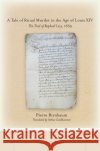
In the late seventeenth century, France prided itself for its rationality and scientific achievements. Yet it was then that Raphael Levy, a French Jew, was convicted, tortured, and executed for an act he did not commit, a fiction deriving from medieval anti-Jewish myth: the ritual murder of a Christian boy to obtain blood for satanic rituals. When Levy was accused of the ritual murder, it was the first accusation of blood libel for a century. Levy's trial, however, became a forum for anti-Jewish accusations, and although the Holy Roman Emperor and a representative of King Louis XIV both tried...
In the late seventeenth century, France prided itself for its rationality and scientific achievements. Yet it was then that Raphael Levy, a French Jew...
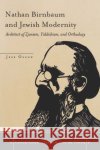
This book explores the life and thought of one of the most important but least known figures in early Zionism, Nathan Birnbaum. Now remembered mainly for his coinage of the word "Zionism," Birnbaum was a towering figure in early Jewish nationalism. Because of his unusual intellectual trajectory, however, he has been written out of Jewish history. In the middle of his life, in the depth of World War I, Birnbaum left his venerable position as a secular Jewish nationalist for religious Orthodoxy, an unheard of decision in his time. To the dismay of his former colleagues, he adopted a life of...
This book explores the life and thought of one of the most important but least known figures in early Zionism, Nathan Birnbaum. Now remembered mainly ...
This book explores the unique phenomenon of Christian engagement with Yiddish language and literature from the beginning of the sixteenth century to the late eighteenth century. By exploring the motivations for Christian interest in Yiddish, and the differing ways in which Yiddish was discussed and treated in Christian texts, A Goy Who Speaks Yiddish addresses a wide array of issues, most notably Christian Hebraism, Protestant theology, early modern Yiddish culture, and the social and cultural history of language in early modern Europe. Elyada's analysis of a wide range of philological...
This book explores the unique phenomenon of Christian engagement with Yiddish language and literature from the beginning of the sixteenth century to t...
Recent scholarship has brought to light the existence of a dynamic world of specifically Jewish forms of literature in the nineteenth century--fiction by Jews, about Jews, and often designed largely for Jews. This volume makes this material accessible to English speakers for the first time, offering a selection of Jewish fiction from France, Great Britain, and the German-speaking world. The stories are remarkably varied, ranging from historical fiction to sentimental romance, to social satire, but they all engage with key dilemmas including assimilation, national allegiance, and the...
Recent scholarship has brought to light the existence of a dynamic world of specifically Jewish forms of literature in the nineteenth century--fict...
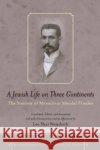
This remarkable memoir by Menachem Mendel Frieden illuminates Jewish experience in all three of the most significant centers of Jewish life during the late nineteenth and early twentieth centuries. It chronicles Frieden's early years in Eastern Europe, his subsequent migration to the United States, and, finally, his settlement in Palestine in 1921. The memoir appears here translated from its original Hebrew, edited and annotated by Frieden's grandson, the historian Lee Shai Weissbach. Frieden's story provides a window onto Jewish life in an era that saw the encroachment of modern ideas into a...
This remarkable memoir by Menachem Mendel Frieden illuminates Jewish experience in all three of the most significant centers of Jewish life during the...
This book presents for the first time the complete text of the earliest known Ladino-language memoir, transliterated from the original script, translated into English, and introduced and explicated by the editors. The memoirist, Sa'adi Besalel a-Levi (1820-1903), wrote about Ottoman Jews' daily life at a time when the finely wrought fabric of Ottoman society was just beginning to unravel. His vivid portrayal of life in Salonica, a major port in the Ottoman Levant with a majority Jewish population, thus provides a unique window into a way of life before it disappeared as a result of profound...
This book presents for the first time the complete text of the earliest known Ladino-language memoir, transliterated from the original script, transla...
This book traces the mixing of musical forms and practices in Istanbul to illuminate multiethnic music-making and its transformations across the twentieth and twenty-first centuries. It focuses on the Jewish religious repertoire known as the Maftirim, which developed in parallel with "secular" Ottoman court music. Through memoirs, personal interviews, and new archival sources, the book explores areas often left out of those histories of the region that focus primarily on Jewish communities in isolation, political events and actors, or nationalizing narratives. Maureen Jackson foregrounds...
This book traces the mixing of musical forms and practices in Istanbul to illuminate multiethnic music-making and its transformations across the tw...
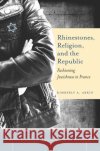
During the course of her fieldwork in Paris, anthropologist Kimberly Arkin heard what she thought was a surprising admission. A French-born, North African Jewish (Sephardi) teenage girl laughingly told Arkin she was a racist. When asked what she meant by that, the girl responded, -It means I hate Arabs.- This girl was not unique. She and other Sephardi youth in Paris insisted, again and again, that they were not French, though born in France, and that they could not imagine their Jewish future in France. Fueled by her candid and compelling informants, Arkin's analysis delves into the...
During the course of her fieldwork in Paris, anthropologist Kimberly Arkin heard what she thought was a surprising admission. A French-born, North Afr...