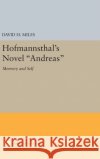
Although Hofmannsthal never completed his only novel Andreas, its theme--the quest for self through memory--haunted the Viennese writer and recurs again and again in his poems, libretti, and essays. Analyzing the fragment, David Miles discusses Hofmannsthal's understanding of memory and myth, Andreas' pivotal role in his work, and its place within the tradition of such novels as Goethe's Wilhelm Meister and Rilke's Malte.
Originally published in 1972.
The Princeton Legacy Library uses the latest print-on-demand technology to again make...
Although Hofmannsthal never completed his only novel Andreas, its theme--the quest for self through memory--haunted the Viennese writer and ...
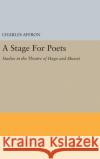
In the nineteenth century, the French lyric poets imposed their diction on the theatrical genre and thus illuminated the essence of both poetry and theatre. Ten plays by Victor Hugo, the standard-bearer of the French romantic theatre, and Alfred de Musset, the romantic playwright most frequently performed in France today, are analyzed by Charles Affron to answer the question, "Can the dialetic form of the theatre accommodate the solitary elan of the lyric poet?"
As a functional point of departure, he considers those characteristics of lyric poetry--time, voice, and metaphor--which...
In the nineteenth century, the French lyric poets imposed their diction on the theatrical genre and thus illuminated the essence of both poetry and...
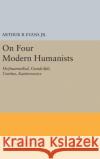
Five experts present their viewpoints on four of the most important figures in recent intellectual and cultural history. Professor Egon Schwarz evaluates Hofmannsthal as a critic; Professors C. V. Bock and Lother Helbing combine forces in an analysis of Gundolf; Professor Yakov Malkiel has provided an evocative, ornately styled document luimain on Kantorowicz; Professor Evans presents the first substantial study of Curtius. The combined insight of the authors gives us a new and better understanding of these cultural figures, their associations with and influences on each other, and...
Five experts present their viewpoints on four of the most important figures in recent intellectual and cultural history. Professor Egon Schwarz eva...
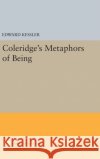
In an original and provocative demonstration that Coleridge's later poetry took on a powerful metaphysical conception, Edward Kessler emphasizes Coleridge's struggle with language as a means of both expressing and creating Being. While many of Coleridge's late poems are generally viewed as fragments that constitute an aesthetic failure, Professor Kessler contends that what at first may appear to reflect Coleridge's inability to finish a poem can otherwise be seen as a deliberate rejection of what the poet came to see as a confining form.
Originally published in 1979.
The...
In an original and provocative demonstration that Coleridge's later poetry took on a powerful metaphysical conception, Edward Kessler emphasizes Co...