10 lectures, various cities, Jan.-Dec. 1913 (CW 150)
"By cultivating spiritual thoughts here on Earth we can provide nourishment for the dead.... When fields lie fallow, they produce no crops to feed humanity, and people may die of starvation. The dead cannot die of starvation, of course; all they can do is suffer when spiritual life lies fallow on Earth." --Rudolf Steiner
The founding of the Anthroposophical Society in 1913 marked a major change in Rudolf Steiner's work. Although Steiner had always been an independent spiritual researcher, the break...
10 lectures, various cities, Jan.-Dec. 1913 (CW 150)
"By cultivating spiritual thoughts here on Earth we can provide nourishment for...
Rudolf Steiner's teachings of Christ--and in particular what he calls the "Christ impulse"--are unique. Christ, he says, is an objective universal force that exists independently of Christian churches and creeds, working for all humanity. The impulse that Christ brought to Earth acts to advance all people, irrespective of religion, creed, or race. Speaking in Berlin while still a representative of the largely Eastern-oriented Theosophical Society, Steiner presents multifaceted perspectives on the Christ impulse based on his independent spiritual research--from the vast cycles of time that...
Rudolf Steiner's teachings of Christ--and in particular what he calls the "Christ impulse"--are unique. Christ, he says, is an objective universal for...
Taking a truly holistic approach, Steiner tackles an eclectic series of subjects throughout these sixteen lectures, all united by the common theme of rediscovering how spirit pervades life. In addition to a focus on education in several lectures, he discusses experiences during sleep; the human spirit and soul between death and a new birth; how spirit "sculpts" the human organism; Christ from the perspective of Anthroposophy; the battle between luciferic and ahrimanic beings for human nature; karma and the creation of conditions for our return to a new life on Earth; human experience of the...
Taking a truly holistic approach, Steiner tackles an eclectic series of subjects throughout these sixteen lectures, all united by the common theme of ...
Steiner describes polarities of illness and derives courses of treatment from a comprehensive analysis. He considers many individual cases in detail and gives indications on therapeutic exercises, diet, and medicine. The "I," he states, relates directly to the physical body, and the spirit and soul need to be considered when making diagnoses. Throughout the lectures, Steiner offers valuable advice for the self-development of educators, emphasizing the need for enthusiasm, humor, and courage. As with Steiner's lectures on agriculture, this course has had a huge international impact, inspiring...
Steiner describes polarities of illness and derives courses of treatment from a comprehensive analysis. He considers many individual cases in detail a...
During 1924, Rudolf Steiner gave more than eighty lectures on the subject of karma to members of the Anthroposophical Society. These profoundly esoteric commentaries examine the underlying laws of reincarnation and karma and explore in detail the incarnations of specific historical figures. In Steiner's words, the study of karma is "a matter of penetrating the most profound mysteries of existence, for within the sphere of karma and the course it takes lie those processes that are the basis of the other phenomena of world existence." In this eighth and final volume of the series, Steiner...
During 1924, Rudolf Steiner gave more than eighty lectures on the subject of karma to members of the Anthroposophical Society. These profoundly esoter...
Although these nine lectures were given to an audience that had been studying anthroposophy, or spiritual science, for many years, they were nevertheless described by Rudolf Steiner as an 'introductory course'. Given shortly after the Christmas Foundation Meeting, in which Rudolf Steiner refounded and renewed the Anthroposophical Society, these lectures reformulate the content of spiritual science from a condensed, personal, experiential point of view. What Steiner presented in his fundamental work Theosophy in a descriptive, systematic way, is complemented here with great intensity,...
Although these nine lectures were given to an audience that had been studying anthroposophy, or spiritual science, for many years, they were neverthel...
Like pearls in the oyster, pearls of thought are easily overlooked. Lying hidden in texts, they keep their light under a bushel, serving the greater framework and context. But if we draw them out they begin to shine, revealing their translucent facets and intrinsic harmony. In this meditative treasure, the editor has harvested and threaded together such pearls from Rudolf Steiner's books, creating new textures and striking panoramas. Dynamic constellations of thought arise, allowing us unusual and surprising access to Steiner's spiritual and philosophical thinking. In contrast to the...
Like pearls in the oyster, pearls of thought are easily overlooked. Lying hidden in texts, they keep their light under a bushel, serving the greater f...
During 1924, before his last address in September, Rudolf Steiner gave over eighty lectures on the subject of karma to members of the Anthroposophical Society. These profoundly esoteric lectures examine the underlying laws of reincarnation and karma, and explore in detail the incarnations of certain named historical figures. In Rudolf Steiner's words, the study of karma is 'a matter of penetrating into the most profound mysteries of existence, for within the sphere of karma and the course it takes lie those processes which are the basis of the other phenomena of world-existence.' In this...
During 1924, before his last address in September, Rudolf Steiner gave over eighty lectures on the subject of karma to members of the Anthroposophical...
By "mantric sayings," Rudolf Steiner means content given by the spiritual world to be absorbed and experienced in meditation. Thus the volume contains intuitive insights received "from the spiritual world" and, as such, the vehicle to return us to it. The meditations were often given personally to others for general use, as well as for specific situations or needs such as healing and strengthening, in relation to those who had died, or for anthroposophic work. In other words, these short texts are to be performed--to be experienced. In this sense, they are directive--enjoining us to "Do this...
By "mantric sayings," Rudolf Steiner means content given by the spiritual world to be absorbed and experienced in meditation. Thus the volume contains...
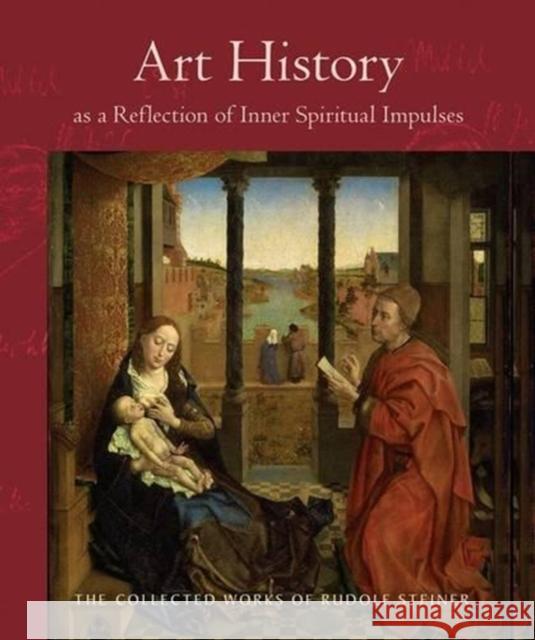
Rudolf Steiner understood that the history of art is a field in which the evolution of consciousness is symptomatically and transparently revealed. This informal sequence of thirteen lectures was given during the darkest hours of World War I. It was a moment when the negative consequences of what he called the age of the consciousness soul, which began around 1417, were made most terribly apparent. In these lectures he sought to provide an antidote to pessimism. After describing the movement of consciousness from Greece into Rome, coupled with influences from the Orthodox East, he showed how...
Rudolf Steiner understood that the history of art is a field in which the evolution of consciousness is symptomatically and transparently revealed. Th...