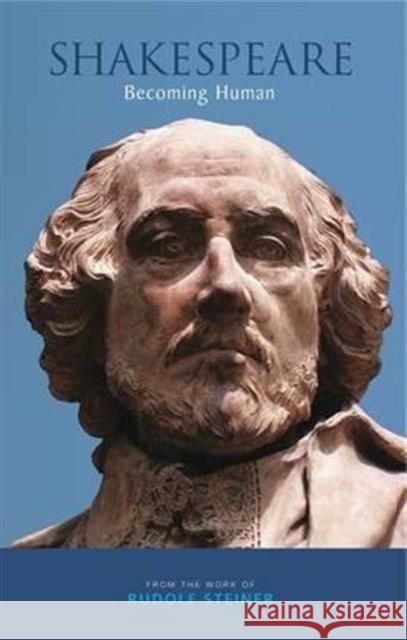
"Like so much of Renaissance art, Shakespeare's work bears an open secret. The esoteric spiritual content is undisguised, though it may be unexpected and not always immediately recognized. Like all the great artistic achievements, this work remains incomplete until we recognize and respond to its open invitation that we become active participants." (from the introduction)
Shakespeare's core themes explore the challenges of the human condition while celebrating the human potential to achieve and develop in earthly life. But what is it that enables Shakespeare's characters to...
"Like so much of Renaissance art, Shakespeare's work bears an open secret. The esoteric spiritual content is undisguised, though it may be unexpect...
"Our neurosensory system is inwardly configured music, and we experience music as an artistic quality to the degree that a piece of music is in tune with the mystery of our own musical structure." - Rudolf Steiner
What is music? Steiner regards the essence of music as spiritual and inaudible to the senses. The world of tones, carried on vibrations of air, is not the essence. "The true nature of music, the spiritual element in music," he says, "is found between the tones, in the intervals as an inaudible quality."
Rudolf Steiner spoke repeatedly of music as...
"Our neurosensory system is inwardly configured music, and we experience music as an artistic quality to the degree that a piece of music is in tun...
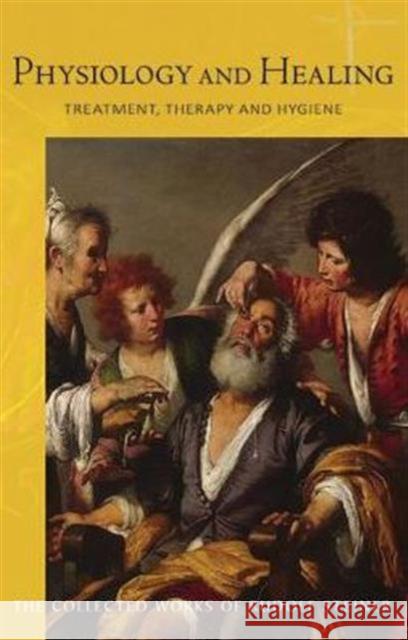
Following his first major lecture course for medical practitioners, Steiner elaborated and deepened his "extension" of conventional healing through a spiritual-scientific perspective. In this collection of addresses, discussions, question-and-answer sessions, and lectures--which paralleled his major medical courses--Steiner comments on contemporary medical emphasis on experimental, materially based research and its lack of attention to therapy. Steiner's intention is not to detract from developments in medical...
According to Rudolf Steiner, illness comes to expression in the physical body, but mostly does not originate in it. Thus, a key to the physician's work is gaining insight into the whole nature--the essential core being--of an individual. Throughout this lecture course, Steiner draws our attention to the greater scope of the smallest phenomena--even a seemingly insignificant headache. He sheds light on things we normally take for granted, such as the human capacity to laugh or cry. In the process, he broadens our vision of human...
18 lectures, Berlin, 1908-1909 (CW 107)
According to Rudolf Steiner, illness comes to expression in the physical body, but mostly do...
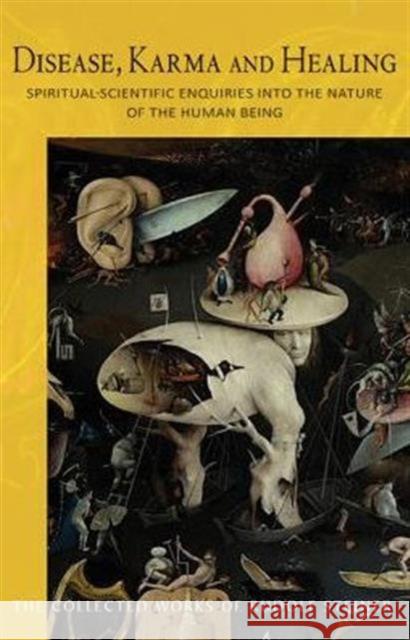
In a series of nine lectures to doctors, pharmacists and students, Steiner presents a wealth of medical ideas with numerous therapeutic and diagnostic insights. As with his first series of lectures on medicine a year earlier (Introducing Anthroposophical Medicine), the range, depth and scope of Steiner's subject matter is breathtaking.
Steiner begins by describing the interplay of physical and metaphysical aspects of the human being, presenting a paradigm in which the four bodies--physical, etheric, astral,...
9 lectures, Dornach, April 11-18, 1921 (CW 313)
In a series of nine lectures to doctors, pharmacists and students, Steiner presents ...
"When we consider the plant world in all its greenery, or the stars with their golden glory; when we look at all this without forming any judgment from within ourselves but instead permit the things to reveal themselves to us... then all things are transformed from what they were in the world of the senses into something entirely different--something for which no word exists other than one which is taken from our very life of soul." --Rudolf Steiner
One of Rudolf Steiner's most fundamental objectives was...
"We learn gradually to raise our eyes not only to material existence; instead we discover spiritual entities and their actions wherever we look in the universe... We get to know the deeds of these spirits. We are alive and active and we are within the spiritual entities and their activities." --Rudolf Steiner
This classic series of lectures presents systematic knowledge on many different spiritual entities, ranging from the higher hierarchies of angels down to hindering demons. Basing his presentation on...
13 lectures, Berlin, Jan.-Jun. 1908 (CW 102)
"We learn gradually to raise our eyes not only to material existence; instead we discov...
16 lectures, various cities, Nov.-Dec. 1920 (CW 202) "Our contemporaries--who wish to keep to a narrow-minded and superficial outlook, are annoyed to find that spiritual science continually seeks the whole picture--that it has to create a bridge between the body and the soul, and truly explores how the psyche becomes corporeal and the body becomes psychological." How do the soul and the spirit live in human physical bodies? In our materialistic age, in which the very existence of the metaphysical is widely rejected, such questions are rarely posed let alone addressed. In this...
16 lectures, various cities, Nov.-Dec. 1920 (CW 202) "Our contemporaries--who wish to keep to a narrow-minded and superficial outlook, are ...
An authorized translation of this classic work, re-edited, beautifully typeset and designed, from a professional publisher dedicated to high-quality editions of Rudolf Steiner's books and lectures.
The Anthroposophy of Rudolf Steiner is not a theoretical system, but the results of research based on direct observation. As Steiner's research was so vast and conducted over such a long period of time, no single book can be said to contain the whole of his spiritual teaching. However, of all his books Occult Science comes closest. Steiner even referred to it as "an epitome of...
An authorized translation of this classic work, re-edited, beautifully typeset and designed, from a professional publisher dedicated to high-quality e...
"The whole world stands facing the human soul--dark, unknown as the blue of the sky. But what is unknown comes. The human soul must feel this coming as its own extinguishing. Sensing this self-extinguishing is followed by the right to re-create oneself anew from the outer world that has been absorbed.... "I am 'I.'"
Rudolf Steiner made it his task to teach nothing that he had not experienced himself and always encouraged others to make individual spiritual-meditative research the basis of their spiritual lives. Therefore he...
Soul Exercises, 1903-1924 (CW 267)
"The whole world stands facing the human soul--dark, unknown as the blue of the sky. But what is ...