In this sequel to The History of Sexuality, Volume I: An Introduction, the brilliantly original French thinker who died in 1984 gives an analysis of how the ancient Greeks perceived sexuality. Throughout The Uses of Pleasure Foucault analyzes an irresistible array of ancient Greek texts on eroticism as he tries to answer basic questions: How in the West did sexual experience become a moral issue? And why were other appetites of the body, such as hunger, and collective concerns, such as civic duty, not subjected to the numberless rules and regulations and judgments that have defined, if...
In this sequel to The History of Sexuality, Volume I: An Introduction, the brilliantly original French thinker who died in 1984 gives an analysis of h...
In this remarkable book Michel Foucault, one of the most influential thinkers of recent times, calls us to look critically at specific historical events in order to uncover new layers of significance. In doing so, he challenges our assumptions not only about history, but also about the nature of language and reason, even of truth. The scope of such an undertaking is vast, but by means of his uniquely engaging narrative style, Foucault's penetrating gaze is skilfully able to confront our own. After reading his words our perceptions are never quite the same again.
In this remarkable book Michel Foucault, one of the most influential thinkers of recent times, calls us to look critically at specific historical e...
In this classic account of madness, Michel Foucault shows once and for all why he is one of the most distinguished European philosophers since the end of World War II. Madness and Civilization, Foucault's first book and his finest accomplishment, will change the way in which you think about society. Evoking shock, pity and fascination, it might also make you question the way you think about yourself.
In this classic account of madness, Michel Foucault shows once and for all why he is one of the most distinguished European philosophers since the end...
When one defines "order" as a sorting of priorities, it becomes beautifully clear as to what Foucault is doing here. With virtuoso showmanship, he weaves an intensely complex history of thought. He dips into literature, art, economics and even biology in The Order of Things, possibly one of the most significant, yet most overlooked, works of the twentieth century. Eclipsed by his later work on power and discourse, nonetheless it was The Order of Things that established Foucault's reputation as an intellectual giant. Pirouetting around the outer edge of language, Foucault...
When one defines "order" as a sorting of priorities, it becomes beautifully clear as to what Foucault is doing here. With virtuoso showmanship, he wea...
In France, a country that awards its intellectuals the status other countries give their rock stars, Michel Foucault was part of a glittering generation of thinkers, one which also included Sartre, de Beauvoir and Deleuze. One of the great intellectual heroes of the twentieth century, Foucault was a man whose passion and reason were at the service of nearly every progressive cause of his time. From law and order, to mental health, to power and knowledge, he spearheaded public awareness of the dynamics that hold us all in thrall to a few powerful ideologies and interests. Arguably his finest...
In France, a country that awards its intellectuals the status other countries give their rock stars, Michel Foucault was part of a glittering generati...
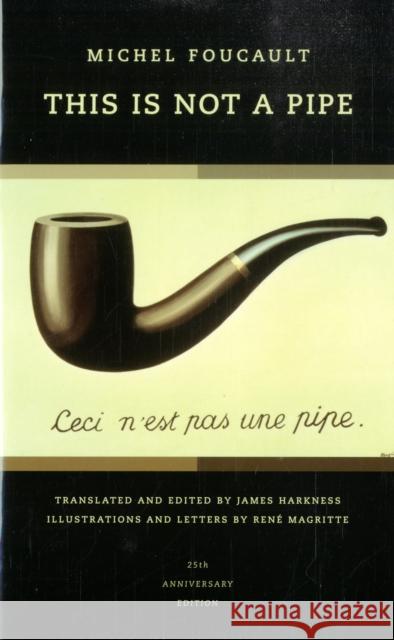
What does it mean to write "This is not a pipe" across a bluntly literal painting of a pipe? Rene Magritte's famous canvas provides the starting point for a delightful homage by French philosopher and historian Michel Foucault. Much better known for his incisive and mordant explorations of power and social exclusion, Foucault here assumes a more playful stance. By exploring the nuances and ambiguities of Magritte's visual critique of language, he finds the painter less removed than previously thought from the pioneers of modern abstraction.
What does it mean to write "This is not a pipe" across a bluntly literal painting of a pipe? Rene Magritte's famous canvas provides the starting point...
Introduction to Kant's Anthropology From a Pragmatic Point of View Michel Foucaulttranslated and with an introduction by Arianna BoveThis introduction and commentary to Kant's least discussed work, Anthropology from a Pragmatic Point of View, is the dissertation that Michel Foucault presented in 1961 as his doctoral thesis. It has remained unpublished, in any language, until now. In his exegesis and critical interpretation of Kant's Anthropology, Foucault raises the question of the relation between psychology and anthropology, and how they are affected by time. Though a Kantian -critique...
Introduction to Kant's Anthropology From a Pragmatic Point of View Michel Foucaulttranslated and with an introduction by Arianna BoveThis introduct...