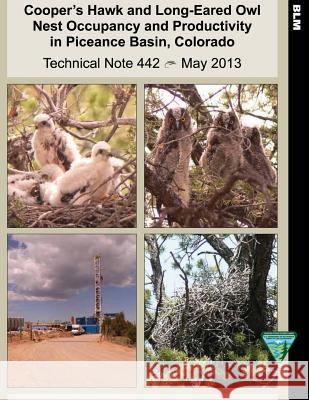
The purpose of this publication is to convey research findings to the Bureau of Land Management and other federal and state agencies to expand the current unding of Cooper's hawk and long eared owl nest occupancy and productivity information in areas affected by oil and gas development.
The purpose of this publication is to convey research findings to the Bureau of Land Management and other federal and state agencies to expand the cur...
Stabilization and improvement of degraded and damaged vegetation, wildlife habitats, soils, and range croplands have been a concern of foresters, farmers, ranchers, and agency staff for many decades. However, it has only been in approximately the last 30 years that restoration ecology has begun to emerge as a serious science.
Stabilization and improvement of degraded and damaged vegetation, wildlife habitats, soils, and range croplands have been a concern of foresters, farm...
The "Regional Mitigation Strategy for the Dry Lake Solar Energy Zone" presents a strategy for compensating for the unavoidable impacts that are expected from the development of the Dry Lake Solar Energy Zone in southern Nevada. This strategy responds to a call for the development of solar regional mitigation strategies for each of the SEZs
The "Regional Mitigation Strategy for the Dry Lake Solar Energy Zone" presents a strategy for compensating for the unavoidable impacts that are expect...
Prior to beginning an inventory, an interdisciplinary team develops the inventory plan. The team sets forth in writing the extent and intensity of the inventory studies needed. The ecological site inventory of present and potential vegetation on BLM rangelands for use in all programs that require information on vegetation
Prior to beginning an inventory, an interdisciplinary team develops the inventory plan. The team sets forth in writing the extent and intensity of the...
The Montana/Dakotas National Landscape Conservation System (NLCS) Strategy will implement the BLM's National Landscape Conservation System 15-Year Strategy 2010-2025 for designated public lands in Montana and the Dakotas over the next four years. It will also provide a starting point for discussion with partners, stakeholders, and members of the public on how they can support the management of these special places.
The Montana/Dakotas National Landscape Conservation System (NLCS) Strategy will implement the BLM's National Landscape Conservation System 15-Year Str...
Congress has provided the Bureau of Land Management the privilege of protecting many special places for a myriad of uses. Of these lands and waters, those of the national Landscape Conservation System have been set aside specifically for conservation, preservation, and restoration.
Congress has provided the Bureau of Land Management the privilege of protecting many special places for a myriad of uses. Of these lands and waters, t...
Nevada is a beautiful state that off ers endless panoramic vistas that stretch as far as the eye can see, and countless experiences and opportunities for those seeking unique outdoor adventures. Endowed with approximately 48 million acres of nationally signifi cant resources, the Bureau of Land Management (BLM) Nevada has many special designations which are part of the National Landscape Conservation System (NLCS), also referred to as BLM's "National Conservation Lands."
Nevada is a beautiful state that off ers endless panoramic vistas that stretch as far as the eye can see, and countless experiences and opportunities ...
Since the release of Technical Reference (TR) 1737-5, Riparian and Wetland Classification Review, in 1990, the use of classification in riparian and wetland disciplines has been refined. Some of the previously described classification techniques have become increasingly popular, and new systems have emerged to fill the gaps identified by land managers, wetland regulators, and wetland scientists. While TR 1737-5 focused on vegetation classification methods, this Technical Reference presents a general discussion of several areas of classification related to riparian and wetland management and...
Since the release of Technical Reference (TR) 1737-5, Riparian and Wetland Classification Review, in 1990, the use of classification in riparian and w...