The Little Data Book on Climate Change is based on World Development Indicators 2011, the World Bank s premier data publication. It provides a broad overview of climate change data and includes a diverse set of indicators selected from both the global economic and scientific communities. These indicators reflect recognition of the intrinsic relationship between climate change and development, and attempt to synthesize important aspects of current and projected climate conditions, exposure to climate impacts, resilience, greenhouse gas emissions, and the state of efforts to take action. This...
The Little Data Book on Climate Change is based on World Development Indicators 2011, the World Bank s premier data publication. It provides a broad o...
Does what economies export matter for development? If so, can industrial policies improve on the export basket generated by the market? This book approaches these questions from a variety of conceptual and policy viewpoints. Reviewing the theoretical arguments in favor of industrial policies, the authors first ask whether existing indicators allow policy makers to identify growth-promoting sectors with confidence. To this end, they assess, and ultimately cast doubt upon, the reliability of many popular indicators advocated by proponents of industrial policy. Second, and central to their...
Does what economies export matter for development? If so, can industrial policies improve on the export basket generated by the market? This book appr...
Billions in corrupt assets, complex money trails, strings of shell companies and other spurious legal structures. These form the complex web of subterfuge in corruption cases, behind which hides the benefi cial owner--the puppet master and benefi ciary of it all. Linking the benefi cial owner to the proceeds of corruption is notoriously hard. With sizable wealth and resources on their side, they exploit transnational constructions that are hard to penetrate and stay aggressively ahead of the game. Nearly all cases of grand corruption have one thing in common. They rely on corporate vehicles...
Billions in corrupt assets, complex money trails, strings of shell companies and other spurious legal structures. These form the complex web of subter...
Les politiques d'integration mondiale de la Tunisie ont permis une augmentation significative des flux d'IDE, et une hausse des exportations de textiles et vetements et des composantes mecaniques et electriques ce, grace a la participation aux reseaux de production de l'UE. Les secteurs les plus integres au marche mondial ont pu augmenter leur productivite, creer des emplois et contribue sensiblement a la croissance du pays. Ces evolutions ont grandement contribue a la croissance de 5 pourcent qu a connu la Tunisie au cours de ces 20 dernieres annees, performance le placant parmi les pays...
Les politiques d'integration mondiale de la Tunisie ont permis une augmentation significative des flux d'IDE, et une hausse des exportations de textil...
For years, Brazil has had a system of higher education, which has not adequately met the needs of the Brazilian companies or prospective students. In comparison to other countries in the region, Brazilian universities have enrolled a significantly smaller percentage of the eligible students, have not produced an adequately trained work force and have been cost prohibitive for lower income students. Both economic and societal pressures are now forcing changes upon the educational system. Together with the Minister for Education, members of the National Education Council, and others, World Bank...
For years, Brazil has had a system of higher education, which has not adequately met the needs of the Brazilian companies or prospective students. In ...
The Little Green Data Book is a pocket-sized ready reference on key environmental data for over 200 countries. Key indicators are organized under the headings of agriculture, forestry, biodiversity, oceans, energy, emission and pollution, and water and sanitation. For the second year, The Little Green Data Book presents a new set of ocean-related indicators, highlighting the role of oceans in economic development.
The Little Green Data Book is a pocket-sized ready reference on key environmental data for over 200 countries. Key indicators are organized under the ...
A two-volume set containing Doing Business in 2005: Removing Obstacles to Growth and Doing Business in 2006: Creating Jobs . Doing Business is a series of annual reports investigating regulations that ease doing business and those that constrain it.
A two-volume set containing Doing Business in 2005: Removing Obstacles to Growth and Doing Business in 2006: Creating Jobs . Doing Business is a serie...
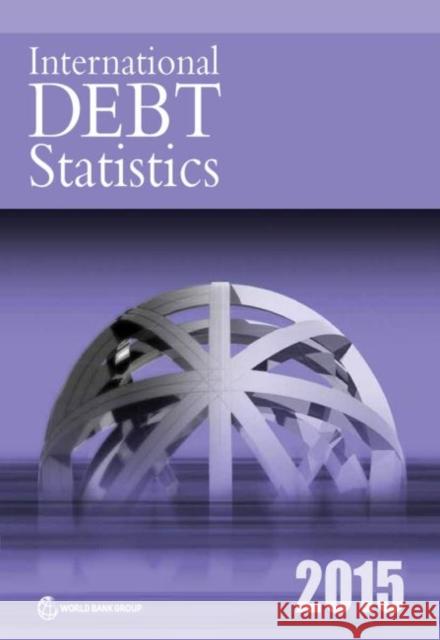
International Debt Statistics (IDS) 2015 (formerly Global Development Finance) provides statistical tables showing the external debt of 128 developing countries that report public and publicly guaranteed external debt to the World Bank's Debtor Reporting System (DRS). It also includes tables of key debt ratios for individual reporting countries and the composition of external debt stocks and flows for individual reporting countries and regional and income groups, along with some graphical presentations. IDS 2015 draws on a database maintained by the World Bank External Debt (WBXD) system....
International Debt Statistics (IDS) 2015 (formerly Global Development Finance) provides statistical tables showing the external debt of 128 developing...
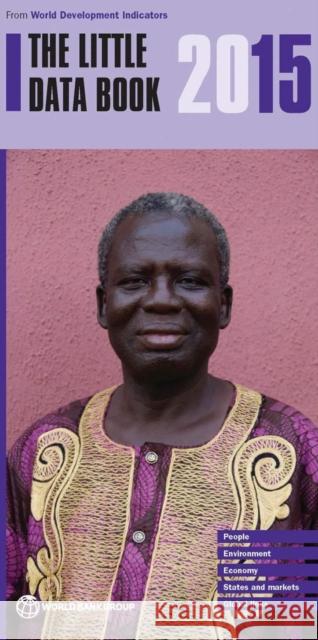
The Little Data Book 2015 is a pocket edition of World Development Indicators 2015. It is intended as a quick reference for users of the World Development Indicators database, book, and mobile app. The database covers more than 1,200 indicators and spans more than 50 years. The 214 country tables present the latest available data for World Bank member countries and other economies with populations of more than 30,000. The 14 summary tables cover regional and income group aggregates.
The Little Data Book 2015 is a pocket edition of World Development Indicators 2015. It is intended as a quick reference for users of the World Develop...
The Kurdistan region of Iraq is facing an economic and humanitarian crisis as a result of the influx of Syrian refugees which began in 2012 and internally displaced persons (IDPs) in 2014. The region's population increased by 28 percent over a short period, placing strains on the local economy, host community, and access to public services. This book provides national and regional policy makers with a technical assessment of the impact and stabilization costs needed for 2015 associated with the influx of refugees and IDPs. The stabilization cost for 2015 is estimated at US$1.4 billion in...
The Kurdistan region of Iraq is facing an economic and humanitarian crisis as a result of the influx of Syrian refugees which began in 2012 and intern...