Virtually from its redaction about the sixth century A.D., the Babylonian Talmud became the rabbinic document par excellence. Through its lens almost all previous canonical rabbinic tradition was refracted. Study and mastery of the Talmud marked one as a rabbi, a "master." This book examines the character, use and social meaning of the formalized rhetoric which pervades the Babylonian Talmud. It explores, first, how the editors of the Talmud employ a consistent and highly laconic code of formalized linguistic terms and literary patterns to create the Talmud's (renowned) dialectical,...
Virtually from its redaction about the sixth century A.D., the Babylonian Talmud became the rabbinic document par excellence. Through its lens alm...
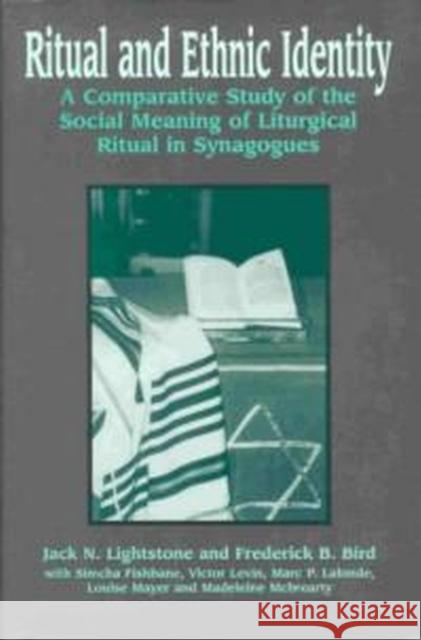
In this innovative and comprehensive collection of essays Jack Lightstone and Frederick Bird document and interpret ritual practice among contemporary Canadian Jews. They particularly focus on the character and meaning of the public performance of the Sabbath liturgy in six urban Canadian synagogues, ranging from Orthodox to Reform, and from large congregations to a small house synagogue-yeshiva (rabbinic academy). Their examination of synagogue ritual is complemented with accounts of the ritual life of contemporary Canadian Jews outside the synagogue -- amongst their families, within...
In this innovative and comprehensive collection of essays Jack Lightstone and Frederick Bird document and interpret ritual practice among contempo...
Where do the origins of the rabbinic movement lie, and how might evidence from the early rabbinic literature be made to reveal those origins?
In order to shed light on the early social formation of the rabbinic guild of masters, Lightstone brings the theoretical and methodological insights of socio-rhetorical analysis to examine Mishnah, the first document authored by the early rabbinic movement and its principal object of study for several centuries.
He argues that the enshrinement of Mishnah served to model, via its pervasive rhetoric, the principal authoritative guild...
Where do the origins of the rabbinic movement lie, and how might evidence from the early rabbinic literature be made to reveal those origins?
Offers perspectives on the practices and beliefs of Greco-Roman Jews who lived outside of Palestine and beyond rabbinic control or influence. This book investigates their influence on early Christians and examines how the two communities defined themselves in relation to each another.
Offers perspectives on the practices and beliefs of Greco-Roman Jews who lived outside of Palestine and beyond rabbinic control or influence. This boo...
This work explores the relationship between religion, social patterns, and the perception of the character of scripture in four modes of Ancient Judaism: (1) the Jerusalem community of the fifth to fourth centuries B.C.E. (ie, the Early Second Temple Period); (2) the Judaism of the Graeco-Roman Disapora down to the end of the fourth century of the Christian Era; (3) earliest rabbinic Judaism in the second century C.E> in the land of Israel; (4) Late Antique Talmudic Rabbinism, primarily inn Babylonia, down to the sixth century of the Christian Era. Lightstone attempts not only to describe...
This work explores the relationship between religion, social patterns, and the perception of the character of scripture in four modes of Ancient J...