The Critique of Practical Reason is the second of Immanuel Kant's three critiques and it deals with Kant's own moral philosophy and his views on free will. A masterpiece of philosophical writing. The theoretical use of reason was concerned with objects of the cognitive faculty only, and a critical examination of it with reference to this use applied properly only to the pure faculty of cognition; because this raised the suspicion, which was afterwards confirmed, that it might easily pass beyond its limits, and be lost among unattainable objects, or even contradictory notions. It is quite...
The Critique of Practical Reason is the second of Immanuel Kant's three critiques and it deals with Kant's own moral philosophy and his views on free ...
Philosophy may be said to contain the principles of the rational cognition that concepts afford us of things (not merely, as with logic, the principles of the form of thought in general irrespective of the objects), and, thus interpreted, the course, usually adopted, of dividing it into theoretical and practical is perfectly sound. But this makes imperatgvive a specific distinction on the part of the concepts by which the principles of this rational cognition get their object assigned to them, for if the concepts are not distinct they fail to justify a division, which always presupposes that...
Philosophy may be said to contain the principles of the rational cognition that concepts afford us of things (not merely, as with logic, the principle...
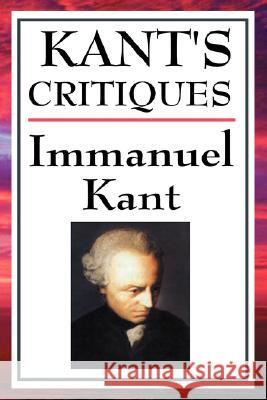
Collected in this 3-in-one omnibus edition are Kants ground breaking critiques. The Critique of Pure Reason, The Critique of Practical Reason, and The Critique of Judgement.
The Critique of Pure Reason is one of the most influential philosophy books of all times. Kants influence on modern perception of reason cannot be over estimated. Here Kant redefines reason and gives us the tools to understand reason on two levels: the empirical and the metaphysical.
The Critique of Practical Reason is the second of Immanuel Kants three critiques and it deals with Kants own moral philosophy and his...
Collected in this 3-in-one omnibus edition are Kants ground breaking critiques. The Critique of Pure Reason, The Critique of Practical Reason, and The...
Ancient Greek philosophy was divided into three sciences: physics, ethics, and logic. This division is perfectly suitable to the nature of the thing; and the only improvement that can be made in it is to add the principle on which it is based, so that we may both satisfy ourselves of its completeness, and also be able to determine correctly the necessary subdivisions....
Ancient Greek philosophy was divided into three sciences: physics, ethics, and logic. This division is perfectly suitable to the nature of the thing; ...
The Critique of Pure Reason is one of the most influential philosophy books of all times. Kant's influence on modern perception of reason cannot be over estimated. Here Kant redefines reason and gives us the tools to understand reason on two levels: the empirical and the metaphysical.
The Critique of Pure Reason is one of the most influential philosophy books of all times. Kant's influence on modern perception of reason cannot be ov...
Collected in this 3-in-one omnibus edition are Kants ground breaking critiques. The Critique of Pure Reason, The Critique of Practical Reason, and The Critique of Judgement. The Critique of Pure Reason is one of the most influential philosophy books of all times. Kants influence on modern perception of reason cannot be over estimated. Here Kant redefines reason and gives us the tools to understand reason on two levels: the empirical and the metaphysical. The Critique of Practical Reason is the second of Immanuel Kants three critiques and it deals with Kants own moral philosophy and his views...
Collected in this 3-in-one omnibus edition are Kants ground breaking critiques. The Critique of Pure Reason, The Critique of Practical Reason, and The...
The eleven essays in this volume constitute Kant's theoretical, pre-critical philosophical writings from 1755 to 1770. Several essays have never been translated into English before, while others have long been unavailable. The development of Kant's thought can be traced to the eventual emergence in 1770 of the two chief tenets of his mature philosophy: the subjectivity of space and time, and the phenomena-noumena distinction. Hb ISBN (1992): 0-521-39214-4
The eleven essays in this volume constitute Kant's theoretical, pre-critical philosophical writings from 1755 to 1770. Several essays have never been ...
The nature and theoretical underpinnings of ethics have been an intellectual driving force animating the pursuits of great scholars. In The Fundamental Principles of the Metaphysic of Morals (1785) Immanuel Kant, one of the most powerful philosophical minds of the eighteenth and nineteenth centuries, inquires into the true nature of morality. In rejecting the results or consequences of action as the foundation of moral judgments, he denies that good or bad effects have any relevance in the moral evaluation of human behavior. Instead, we must rely upon the Good Will for guidance. What is...
The nature and theoretical underpinnings of ethics have been an intellectual driving force animating the pursuits of great scholars. In The Fundamenta...
This expanded edition of James Ellington's preeminent translations of "Grounding for the Metaphysics of Morals and Metaphysical Principles of Virtue" includes his new translation of Kant's essay On a Supposed Right to Lie Because of Philanthropic Concerns, in which Kant replies to one of the standard objections to his moral theory, as presented in the main text of "Grounding," that it requires us to tell the truth even in the face of harmful consequences.
This expanded edition of James Ellington's preeminent translations of "Grounding for the Metaphysics of Morals and Metaphysical Principles of Virtu...