Considered by Kant to be the culmination of his critical philosophy, "The Critique of Judgement" was the last work in the trilogy begun with "The Critique of Pure Reason" and continued with "The Critique of Practical Reason." In this work Kant seeks to establish the a priori principles underlying the faculty of judgement, just as he did in his previous analyses of pure and practical reason. The first part deals with the subject of our aesthetic sensibility; we respond to certain natural phenomena as beautiful, says Kant, when we recognise in nature a harmonious order that satisfies the mind's...
Considered by Kant to be the culmination of his critical philosophy, "The Critique of Judgement" was the last work in the trilogy begun with "The Crit...
Perpetual Peace is an important essay by Immanuel Kant from 1795 which was originally published as Project for a Perpetual Peace. The original concept of perpetual peace is for peace to be a permanent fixture over a certain specific area or location. In modern times, the concept of world peace directly stems from this original idea of a perpetual peace. In this writing of Kant, he argues in favor of civil constitutions with Republican forms of government, world citizenship, free states, the abolishment of standing armies and for states not being able to use force to interfere with the...
Perpetual Peace is an important essay by Immanuel Kant from 1795 which was originally published as Project for a Perpetual Peace. The original concept...
With "The Critique of Pure Reason" Kant laid a new foundation for speculative thought in the western world. He inquired into the nature of reason. He vindicated the reasonableness of some truths which men had indeed felt to be indefeasibly true, but which they had not been able to establish by reasoning.
Kant sought to make a clear separation between the provinces of belief and knowledge. In his view, this is the essence of a critical philosophy. It distinguishes between the perception of that which is in accordance with natural law and the understanding of the moral meaning of things....
With "The Critique of Pure Reason" Kant laid a new foundation for speculative thought in the western world. He inquired into the nature of reason. ...
Die "Vorlesung uber Moralphilosophie" aus den 1770er Jahren ist eine wichtige Erlauterung und Erganzung zur "Grundlegung der Metaphysik der Sitten" von 1785. Die Neuedition der so genannten Menzer-Vorlesung prasentiert diese Vorlesung auf dem aktuellen Stand der Forschung. Zugrunde gelegt ist die Nachschrift Kaehler, die seit 1997 zum Kant-Archiv in Marburg gehort. Der Text ist mit mehreren Handschriften des Archivs der Berlin-Bandenburgischen Akademie der Wissenschaften und der Staatsbibliothek Berlin abgeglichen. Ein Anhang mit textkritischem Apparat und Erlauterungen zu Literatur und...
Die "Vorlesung uber Moralphilosophie" aus den 1770er Jahren ist eine wichtige Erlauterung und Erganzung zur "Grundlegung der Metaphysik der Sitten...
In a footnote to the Preface of his A nthropology Kant gives, if not altogether accurately, the historical background for the publication of this work. The A nthropology is, in effect, his manual for a course of lectures which he gave "for some thirty years," in the winter semesters at the University of Konigsberg. In 1797, when old age forced him to discontinue the course and he felt that his manual would not compete with the lectures themselves, he decided to let the work be published (Ak. VII, 354, 356). The reader will readily see why these lectures were, as Kant says, popular ones,...
In a footnote to the Preface of his A nthropology Kant gives, if not altogether accurately, the historical background for the publication of this work...
Kant's Fundamental Principles of the Metaphysics of Morals is one of the most important works in modern moral philosophy. It belongs beside Plato, Aristotle, Machiavelli, and Hobbes. Here Kant sets out to articulate and defend the Categorical Imperative - the fundamental principle that underlies moral reasoning - and to lay the foundation for a comprehensive account of justice and human virtues.
Kant's Fundamental Principles of the Metaphysics of Morals is one of the most important works in modern moral philosophy. It belongs beside Plato, Ari...
All duties are either duties of right, that is, juridical duties, or duties of virtue, that is, ethical duties. Juridical duties are such as may be promulgated by external legislation; ethical duties are those for which such legislation is not possible.
All duties are either duties of right, that is, juridical duties, or duties of virtue, that is, ethical duties. Juridical duties are such as may be pr...
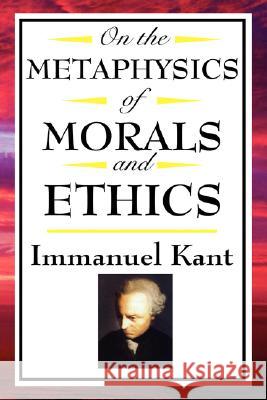
Collected here in this omnibus edition are Immanuel Kants three most important works on the Metaphysics of Morals and Ethics. Included are Kant: Groundwork of the Metaphysics of Morals, Introduction to the Metaphysic of Morals, and The Metaphysical Elements of Ethics.
Kants Fundamental Principles of the Metaphysics of Morals is one of the most important works in modern moral philosophy. It belongs beside Plato, Aristotle, Machiavelli, and Hobbes. Here Kant sets out to articulate and defend the Categorical Imperative - the fundamental principle that underlies moral reasoning - and to lay the...
Collected here in this omnibus edition are Immanuel Kants three most important works on the Metaphysics of Morals and Ethics. Included are Kant: Groun...