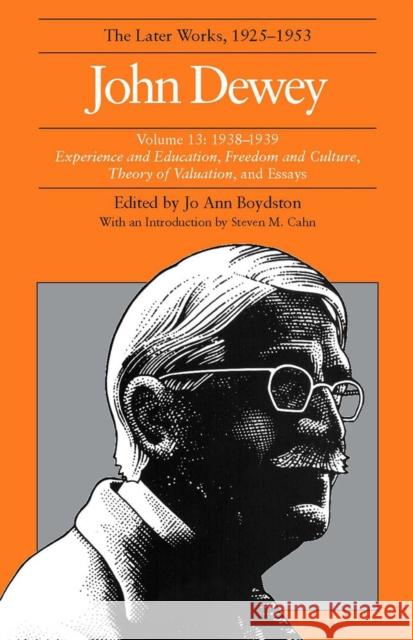
This volume includes all Dewey s writings for 1938 except for "Logic: The Theory of Inquiry "(Volume 12 of The Later Works), as well as his 1939 "Freedom and Culture, Theory of Valuation, "and two items from "Intelligence in the Modern World.""""Freedom and Culture "presents, as Steven M. Cahn points out, the essence of his philosophical position: a commitment to a free society, critical intelligence, and the education required for their advance. "
This volume includes all Dewey s writings for 1938 except for "Logic: The Theory of Inquiry "(Volume 12 of The Later Works), as well as his 1939 "Free...
John Dewey Jo Ann Boydston Southern Illinois University
With the exception of "Experience and Nature, "(Volume 1 of the Later Works), this volume contains all of Dewey s writings for 1925 and 1926, as well as his 1927 book, "The Public and Its Problems. A Modern Language Association s Committee on Scholarly Editions "textual edition.The first essay in this volume, The Development of American Pragmatism, is perhaps Dewey s best-known article of these years, emphasizing the uniquely American origins of his own philosophical innovations. Other essays focus on Dewey s continuing investigation of the nature of intelligent conduct, as, for example, his...
With the exception of "Experience and Nature, "(Volume 1 of the Later Works), this volume contains all of Dewey s writings for 1925 and 1926, as well ...
John Dewey delivered two sets of related lectures at the University of Chicago in the fall quarter 1895 and the spring quarter 1896. Designed for graduate students, the lectures show the birth of Dewey s instrumentalist theory of inquiry in its application to ethical and political thinking.
From 1891 through 1903, Dewey attempted to develop a revolutionary experimentalist approach to ethical inquiry designed to replace the more traditional ways of moral theorizing that relied on the fixed moral knowledge given in advance of the situations in which they were applied. In the lectures on...
John Dewey delivered two sets of related lectures at the University of Chicago in the fall quarter 1895 and the spring quarter 1896. Designed for g...
Offering a new edition of Dewey s 1916 collection of essays
This critical edition of John Dewey s 1916 collection of writings on logic, "Essays in Experimental Logic "in which Dewey presents his concept of logic as the theory of inquiry and his unique and innovative development of the relationship of inquiry to experience is the first scholarly reprint of the work in one volume since 1954. "Essays in Experimental Logic, "edited by D. Micah Hester and Robert B. Talisse, uses the authoritative texts from the "Collected Works of John Dewey, 1882 1953" (published by Southern Illinois...
Offering a new edition of Dewey s 1916 collection of essays
This critical edition of John Dewey s 1916 collection of writings on logic, "Essays i...
Presenting Dewey s new view of philosophical inquiry
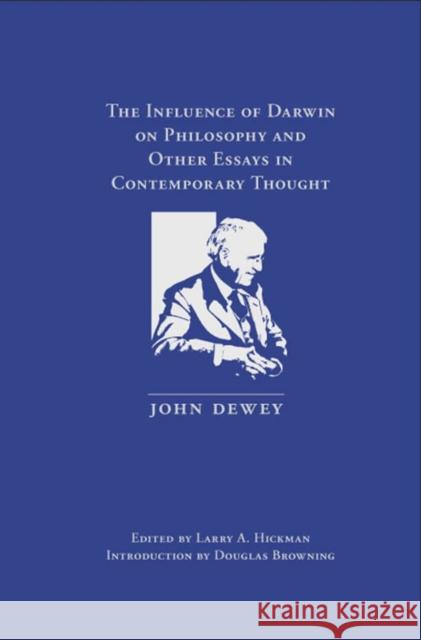
This critical edition of "The Influence of Darwin on Philosophy and Other Essays in Contemporary Thought "presents the results of John Dewey s patient construction, throughout the previous sixteen years, of the radically new view of the methods and concerns of philosophical inquiry. It was a view that he continued to defend for the rest of his life.
In the 1910 "The Influence of Darwin on Philosophy and Other Essays in Contemporary Thought"the first collection of Dewey s previously published, edited essaysJohn Dewey provided readers...
Presenting Dewey s new view of philosophical inquiry
This critical edition of "The Influence of Darwin on Philosophy and Other Essays in Contempo...
The twentieth century has witnessed the blossoming of Western culture: new technology; communications and transportation systems; social, political, educational, agricultural, and medical advances. But with these changes have come the strains and tensions of conflicting interests, desires, and values within the community. John Dewey, one of America's most prolific writers of popular philosophy, believed that humankind could keep a firm hold on its destiny only if the critical intelligence of scientific method and its democratic counterpart were emphasized and promoted. Freedom of inquiry,...
The twentieth century has witnessed the blossoming of Western culture: new technology; communications and transportation systems; social, political, e...
John Dewey, one of America's greatest popular philosophers and educators, emphasizes the importance of critical thinking and the vital role education should play. In this progressive work, written more than 80 years ago, Dewey, recognizing that we are born with the ability to think, argues that the educator's fundamental role is to train us to think well. At a time when America is lamenting the lack of solid training in the sciences at the elementary and secondary levels, Dewey's enthusiastic correlation between the scientific mind and the natural attitude of childhoodmarked by curiosity,...
John Dewey, one of America's greatest popular philosophers and educators, emphasizes the importance of critical thinking and the vital role education ...
This early work is John Dewey s 1908 treatise, Ethics . This comprehensive monograph on the concept of ethics will be of considerable utility to students of philosophy, and would make for a fantastic addition to collections of allied literature. Contents include: Definition and Method, Criterion of the Treatment, Typical Facts of Group Life, Kinship and Household Groups, The Kinship and Family Groups are also Economic and Industrial Units, The Kinship and Family Groups were Political Bodies, etc. John Dewey (1859 1952) was an influential American psychologist and philosopher. Many classic...
This early work is John Dewey s 1908 treatise, Ethics . This comprehensive monograph on the concept of ethics will be of considerable utility to stude...