"One of the most original thinkers and system builders of any time, and certainly the greatest philosopher the United States has ever seen."-Joseph Brent, author of Charles Sanders Peirce: A Life. "Peirce's achievements would take a short book to describe adequately. In philosophy, he founded the most distinctively American school of thought-Pragmatism. As the founder of pragmatism, he was the intellectual hero of both John Dewey and William James. He also created single-handedly the large discipline called Semeiotic-the study of the working of signs-a discipline which engages scholars all...
"One of the most original thinkers and system builders of any time, and certainly the greatest philosopher the United States has ever seen."-Joseph Br...
John Dewey: Dictionary of Education is a comprehensive resource on John Dewey s approach to education. With smart, concise definitions pertaining to Dewey s philosophies, editor Ralph B. Winn has constructed a classic dictionary and indispensible tool for anyone who wants ready access to Dewey's most incisive thought on crucial points in the study of education. John Dewey was the most famous teacher of philosophy in the early twentieth century, and he was known for his lifelong work to reform America s educational system. Dewey was born in Burlington, Vermont in 1859 to strict Calvinist...
John Dewey: Dictionary of Education is a comprehensive resource on John Dewey s approach to education. With smart, concise definitions pertaining to D...
The great 20th century philosopher delivered these lectures in China, which are available now to the public for the first time. The lectures show Dewey at the height of his powers, discussing and criticizing various schools of philosophy including his own experimental position. For the first time Dewey s thinking crystallized into systematic form, thus the lectures are important not only philosophically but historically. In A Survey of Greek Philosophy Dewey gives a brief but comprehensive account of Greek philosophy from prehistory through Aristotle. Dewey s original English notes were lost,...
The great 20th century philosopher delivered these lectures in China, which are available now to the public for the first time. The lectures show Dewe...
First published in 1899, The School and Society describes John Dewey s experiences with his own famous Laboratory School, started in 1896.
Dewey s experiments at the Laboratory School reflected his original social and educational philosophy based on American experience and concepts of democracy, not on European education models then in vogue. This forerunner of the major works shows Dewey s pervasive concern with the need for a rich, dynamic, and viable society.
In his introduction to this volume, Joe R. Burnett states Dewey s theme. Industrialization,...
First published in 1899, The School and Society describes John Dewey s experiences with his own famous Laboratory School, started in ...
John Dewey s "Experience and Nature "has been considered the fullest expression of his mature philosophy since its eagerly awaited publication in 1925. Irwin Edman wrote at that time that with monumental care, detail and completeness, Professor Dewey has in this volume revealed the metaphysical heart that beats its unvarying alert tempo through all his writings, whatever their explicit themes. In his introduction to this volume, Sidney Hook points out that Dewey s "Experience and Nature "is both the most suggestive and most difficult of his writings. The meticulously edited text published...
John Dewey s "Experience and Nature "has been considered the fullest expression of his mature philosophy since its eagerly awaited publication in 1925...
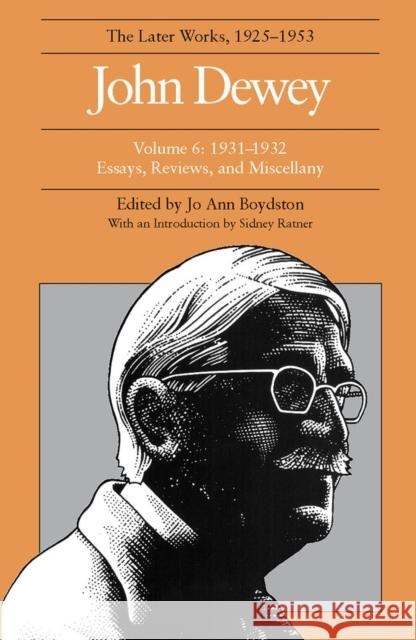
Except for Dewey s and James H. Tufts 1932 "Ethics "(Volume 7 of The Later Works), this volume brings together Dewey s writings for 1931 1932.The Great Depression presented John Dewey and the American people with a series of economic, political, and social crises in 1931 and 1932 that are reflected in most of the 86 items in this volume, even in philosophical essays such as Human Nature. As Sidney Ratner points out in his Introduction, Dewey s interest in international peace is featured in the writings in this volume."
Except for Dewey s and James H. Tufts 1932 "Ethics "(Volume 7 of The Later Works), this volume brings together Dewey s writings for 1931 1932.The Grea...
Art as Experience evolved from John Dewey's Willam James Lectures, delivered at Harvard University from February to May 1931. In his Introduction, Abraham Kaplan places Dewey's philosophy of art within the context of his pragmatism. Kaplan demonstrates in Dewey's esthetic theory his traditional "movement from a dualism to a monism" and discusses whether Dewey's viewpoint is that of the artist, the respondent, or the critic.
Art as Experience evolved from John Dewey's Willam James Lectures, delivered at Harvard University from February to May 1931. In his In...
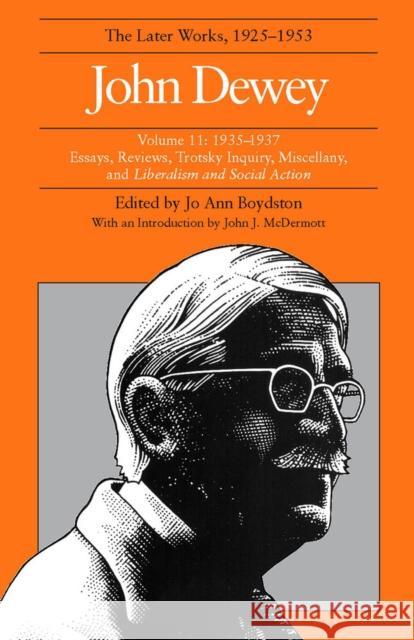
This volume includes ninety-two items from 1935, 1936, and 1937, including Dewey s 1935 Page-Barbour Lectures at the University of Virginia, published as "Liberalism and Social Action."In essay after essay Dewey analyzed, criticized, and reevaluated liberalism. When his controversial "Liberalism and Social Action "appeared, asking whether it was still possible to be a liberal, Horace M. Kallen wrote that Dewey restates in the language and under the conditions of his times what Jefferson s Declaration of Independence affirmed in the language and under the conditions of his. The diverse nature...
This volume includes ninety-two items from 1935, 1936, and 1937, including Dewey s 1935 Page-Barbour Lectures at the University of Virginia, published...