In this groundbreaking social history, Carol and Peter Stearns trace the two hundred-year development of anger, beginning with premodern colonial America. Drawing on diaries and popular advice literature of key periods, Anger deals with the everyday experiences of the family and workplace in its examination of our attempts to control our domestic lives and lessen social tensions by harnessing emotion. Offering an entirely new approach to the study of emotion, the authors inaugurate a new field of study termed "emotionology," which distinguishes collective emotional standards from the...
In this groundbreaking social history, Carol and Peter Stearns trace the two hundred-year development of anger, beginning with premodern colonial Amer...
This book offers a guided tour of the current state scholarship on daily life, including the knowledge that generated and suggestions for further research. Edited by Peter N. Stearns, the eminent social historian and Chair of the Advanced Placement World History committee.
The history of daily life is one of the fastest growing areas of student inquiry and popular interest. Little wonder it raises so many mesmerizing questions and makes the familiar fascinating. What does it mean, for example, that dolls for American girls in the 1870s and 1880s often came complete with caskets and...
This book offers a guided tour of the current state scholarship on daily life, including the knowledge that generated and suggestions for further r...
Western civilization and world history are often seen as different, or even mutually exclusive, routes into historical studies. This volume shows that they can be successfully linked, providing a tool to see each subject in the context of the other, identifying influences and connections.
Western civilization and world history are often seen as different, or even mutually exclusive, routes into historical studies. This volume shows that...
Western civilization and world history are often seen as different, or even mutually exclusive, routes into historical studies. This volume shows that they can be successfully linked, providing a tool to see each subject in the context of the other, identifying influences and connections.
Western Civilization in World History takes up the recent debates about the merits of the well-established 'Western civ' approach versus the newer field of world history. Peter N. Stearns outlines key aspects of Western civilization - often assumed rather than analyzed - and reviews them...
Western civilization and world history are often seen as different, or even mutually exclusive, routes into historical studies. This volume shows t...
Americans have become excessively fearful, and manipulation through fear has become a significant problem in American society, with real impact on policy. By using data from 9/11, this book makes a distinctive contribution to the exploration of recent fear, but also by developing a historical perspective, the book shows how and why distinctive American fears have emerged over the past several decades.
Americans have become excessively fearful, and manipulation through fear has become a significant problem in American society, with real impact on ...
Americans have become excessively fearful, and manipulation through fear has become a significant problem in American society, with real impact on policy. By using data from 9/11, this book makes a distinctive contribution to the exploration of recent fear, but also by developing a historical perspective, the book shows how and why distinctive American fears have emerged over the past several decades.
Americans have become excessively fearful, and manipulation through fear has become a significant problem in American society, with real impact on ...
In the midst of the heated battles swirling around American humanities education, Peter Stearns offers a reconsideration not of what we teach but of why and how we teach it. A humanities program, says Stearns, should teach students not just memorized facts but analytical skills that are vital for a critically informed citizenry. He urges the use of innovative research as the basis of such a curriculum, and he offers specific suggestions on translating curriculum goals into courses that can be taught alongside or instead of the more conventional staples.
In the midst of the heated battles swirling around American humanities education, Peter Stearns offers a reconsideration not of what we teach b...
As a new century and millennium approach, the world braces itself for a frenzied outpouring of popular excitement, tabloid predictions, and religious hysteria, all egged on by a strong dose of mass media attention. Fortunately, historian Peter Stearns has supplied the antidote with this witty and insightful look at earlier millennial fevers and turn-of-the-century neuroses. By examining this past, he provides a useful perspective on the millennial hype coming in the near future. And even if you don't really expect the world to end, the question remains: Can we survive the media's...
As a new century and millennium approach, the world braces itself for a frenzied outpouring of popular excitement, tabloid predictions, and religious ...
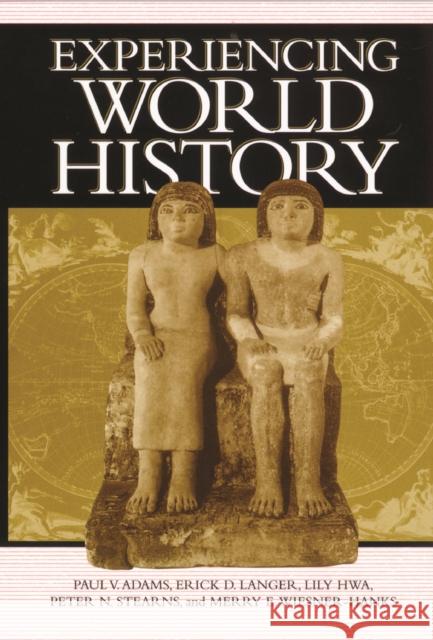
Covering early societies, the classical, postclassical, and modern periods, and the 20th century, and blending the great advances in historical research over the past quarter century, Experiencing World History represents an important addition to the teaching of world history.
Focusing on major issues in social history in the context of world history and divided into five chronological sections that highlight the mixture of change and continuity, the volume traces key aspects of society over time, among them gender; work and leisure; state and society; culture contact and...
Covering early societies, the classical, postclassical, and modern periods, and the 20th century, and blending the great advances in historical res...