Restoration and Reform, 1872-1905, is the fourth and final volume in a monumental new series that traces kabuki's changing relations to Japanese society during the premodern era.
The twelve plays translated in Volume 4 cover the remarkable Meiji period, which followed the restoration of the emperor as the leader of Japan. They reflect the years in which reform-minded leaders struggled to help Japan catch up with the West. Dramatists no less than others sought ways in which to bring their traditional art into the modern world and to bring international respectability to the national...
Restoration and Reform, 1872-1905, is the fourth and final volume in a monumental new series that traces kabuki's changing relations to Japanese so...
Masterpieces of Kabuki contains eighteen outstanding dramas taken from the landmark four-volume series Kabuki Plays On Stage. Together they cover the entire spectrum of kabuki drama from 1697 to 1905, the period during which kabuki's dramaturgy flourished prior to the onset of Western dramatic influence. Major playwrights, chronological periods of playwriting, and a variety of play types (history, domestic, and dance dramas) and performance styles are represented. All but one are in the current repertory and regularly staged. The volume includes introductions to each play and a new general...
Masterpieces of Kabuki contains eighteen outstanding dramas taken from the landmark four-volume series Kabuki Plays On Stage. Together they cover t...
The most reliable source for data on productions of the New York stage, both Broadway and Off Broadway, is now complete from 1920 through 1950 with the publication of this third volume devoted to the 1940s. The volumes for 1920-1930 and 1930-1940 have been called invaluable, indispensable, essential, and other superlatives by reviewers, widely utilized by theatre scholars and researchers, consulted by companies producing revivals, and quoted by Playbill magazine in answering readers' queries. The continuing series represents a remarkable achievement for theatre historian Samuel Leiter, who...
The most reliable source for data on productions of the New York stage, both Broadway and Off Broadway, is now complete from 1920 through 1950 with...
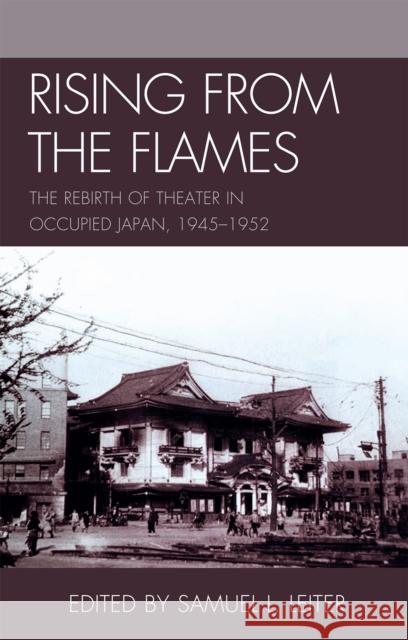
On August 15, 1945, when the war ended, almost all of Tokyo and Osaka's theaters had been destroyed or heavily damaged by American bombs. The Japanese urban infrastructure was reduced to dust, and so, one might have thought, would be the nation's spirit, especially in the face of nuclear bombing and foreign occupation. Yet, less than two weeks after the atom bombs had been dropped, theater began to show signs of life. Before long, all forms of Japanese theater were back on stage, and from death's ashes arose the flower of art. Rising from the Flames contains sixteen essays, many accompanied...
On August 15, 1945, when the war ended, almost all of Tokyo and Osaka's theaters had been destroyed or heavily damaged by American bombs. The Japanese...
Historical Dictionary of Japanese Traditional Theatre is the only dictionary that offers detailed comprehensive coverage of the most important terms, people, and plays in the four principal traditional Japanese theatrical forms--nō, kyōgen, bunraku, and kabuki--supplemented with individual historical essays on each form. This updated edition adds well over 200 plot summaries representing each theatrical form in addition to: -a chronology; -introductory essay; -appendixes; -an extensive bibliography; -over 1500 cross-referenced entries on important terms; -brief biographies of the...
Historical Dictionary of Japanese Traditional Theatre is the only dictionary that offers detailed comprehensive coverage of the most important terms, ...