An important resource for any scholar working on the production history of Shakespeare's plays. . . . Because each entry has a complete list of sources, the book can be used as a helpful bibliography for locating reviews of productions. Choice
An important resource for any scholar working on the production history of Shakespeare's plays. . . . Because each entry has a complete list of source...
The careers, directing accomplishments, ideas, and techniques of six distinguished directors of the European stage--each considered a master of the art--are surveyed in depth by author Samuel L. Leiter in this groundbreaking study. Konstantin Stanislavsky, Vsevolod Meyerhold, Max Reinhardt, Jacques Copeau, Bertolt Brecht, and Jean-Louis Barrault, representative of the broad spectrum of directorial art as it has developed in this century, are examined in six exhaustively detailed, yet compact chapters. In Leiter's informative introduction, salient aspects of the director's art exemplified...
The careers, directing accomplishments, ideas, and techniques of six distinguished directors of the European stage--each considered a master of the...
This multifaceted study, the companion volume to Leiter's "From Stanislavsky to Barrault: Representative Directors of the European Stage" (Greenwood Press, 1991), provides exhaustively detailed, yet compact accounts of the careers and accomplishments of eight outstanding directors of the English-speaking stage as well as separate, thorough bibliographies and chronologies of each. Samuel L. Leiter selected directors David Belasco, Harley Granville-Barker, George Abbott, Sir Tyrone Guthrie, Margaret Webster, Elia Kazan, Joan Littlewood, and Peter Brook as exemplars of the broad spectrum of...
This multifaceted study, the companion volume to Leiter's "From Stanislavsky to Barrault: Representative Directors of the European Stage" (Greenwoo...
Kabuki has been a part of Japanese culture for nearly four centuries. The plays performed today are generally selected from a classic repertoire that gradually ceased to develop once Japan broke the chains of its isolationist policy and began the surge toward Westernization. The plays largely reflect the values of feudal Japan, and they portray a world of noble samurai overcoming evil adversaries, adulterous lovers overcoming their dilemmas through double suicide, parents sacrificing their children in the name of loyalty to a superior, and children giving up their lives for the sake of...
Kabuki has been a part of Japanese culture for nearly four centuries. The plays performed today are generally selected from a classic repertoire th...
Unique in any Western language, this is an invaluable resource for the study of one of the world's great theatrical forms. It includes essays by established experts on Kabuki as well as younger scholars now entering the field, and provides a comprehensive survey of the history of Kabuki; how it is written, produced, staged, and performed; and its place in world theater. Compiled by the editor of the influential Asian Theater Journal, the book covers four essential areas - history, performance, theaters, and plays - and includes a translation of one Kabuki play as an illustration of Kabuki...
Unique in any Western language, this is an invaluable resource for the study of one of the world's great theatrical forms. It includes essays by estab...
Unique in any Western language, this is an invaluable resource for the study of one of the world's great theatrical forms. It includes essays by established experts on Kabuki as well as younger scholars now entering the field, and provides a comprehensive survey of the history of Kabuki; how it is written, produced, staged, and performed; and its place in world theater. Compiled by the editor of the influential Asian Theater Journal, the book covers four essential areas - history, performance, theaters, and plays - and includes a translation of one Kabuki play as an illustration of Kabuki...
Unique in any Western language, this is an invaluable resource for the study of one of the world's great theatrical forms. It includes essays by estab...
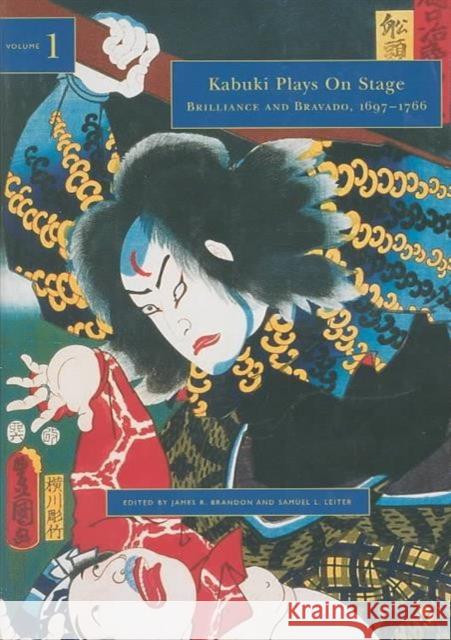
Kabuki Plays On Stage represents a monumental achievement in Japanese theatre studies, being the first collection of kabuki play translations to be published in twenty-five years. Fifty-one plays, published in four volumes, vividly trace kabuki's changing relations to Japanese society during the premodern era.
Volume 1 consists of thirteen plays that showcase early kabuki's scintillating and boisterous styles of performance and illustrates the contrasting dramatic techniques cultivated by actors in Edo (Tokyo) and Kamigata (Osaka and Kyoto). The twelve plays translated in Volume 2...
Kabuki Plays On Stage represents a monumental achievement in Japanese theatre studies, being the first collection of kabuki play translations to be...
Kabuki Plays On Stage represents a monumental achievement in Japanese theatre studies, being the first collection of kabuki play translations to be published in twenty-five years. Fifty-one plays, published in four volumes, vividly trace kabuki's changing relations to Japanese society during the premodern era.
Volume 1 consists of thirteen plays that showcase early kabuki's scintillating and boisterous styles of performance and illustrates the contrasting dramatic techniques cultivated by actors in Edo (Tokyo) and Kamigata (Osaka and Kyoto). The twelve plays translated in Volume 2...
Kabuki Plays On Stage represents a monumental achievement in Japanese theatre studies, being the first collection of kabuki play translations to be...
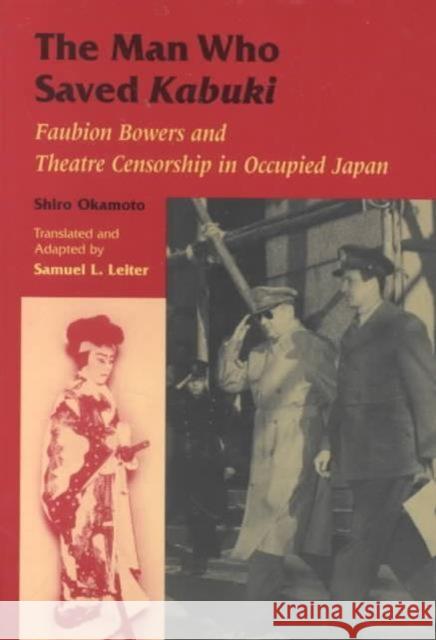
As part of its program to promote democracy in Japan after World War II, the American Occupation, headed by General Douglas MacArthur, undertook to enforce rigid censorship policies aimed at eliminating all traces of feudal thought in media and entertainment, including kabuki. Faubion Bowers (1917-1999), who served as personal aide and interpreter to MacArthur during the Occupation, was appalled by the censorship policies and anticipated the extinction of a great theatrical art. He used his position in the Occupation administration and his knowledge of Japanese theatre in his tireless...
As part of its program to promote democracy in Japan after World War II, the American Occupation, headed by General Douglas MacArthur, undertook to...
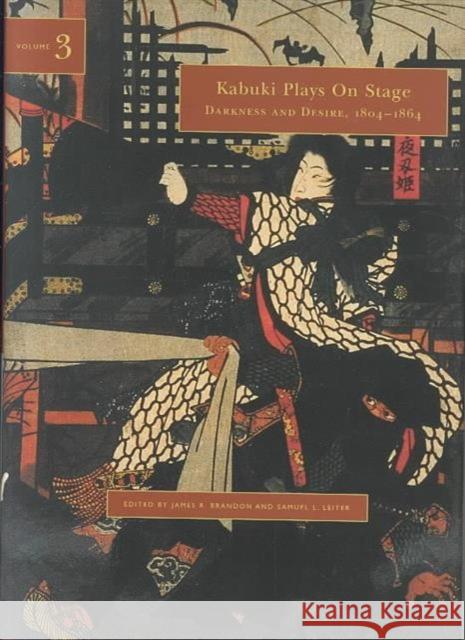
Darkness and Desire, 1804-1864, is the third volume in a monumental new series-the first collection of kabuki play translations to be published in nearly a quarter of a century. Fifty-one plays, published in four volumes, vividly trace kabuki's changing relations to Japanese society during the premodern era.
The fourteen plays translated in Volume 3, Darkness and Desire, 1804-1864, mark an extreme point in the development of kabuki dramaturgy. The plays are remarkable, even within kabuki, for their intense theatricality, gutsy individualism of character, cold-blooded and ferocious...
Darkness and Desire, 1804-1864, is the third volume in a monumental new series-the first collection of kabuki play translations to be published in ...