Completing the translation of Derrida's monumental work Right to Philosophy (the first part of which has already appeared under the title of Who's Afraid of Philosophy?), Eyes of the University brings together many of the philosopher's most important texts on the university and, more broadly, on the languages and institutions of philosophy. In addition to considerations of the implications for literature and philosophy of French becoming a state language, of Descartes' writing of the Discourse on Method in French, and of Kant's and Schelling's philosophies of the...
Completing the translation of Derrida's monumental work Right to Philosophy (the first part of which has already appeared under the title of
Completing the translation of Derrida's monumental work Right to Philosophy (the first part of which has already appeared under the title of Who's Afraid of Philosophy?), Eyes of the University brings together many of the philosopher's most important texts on the university and, more broadly, on the languages and institutions of philosophy.
In addition to considerations of the implications for literature and philosophy of French becoming a state language, of Descartes' writing of the Discourse on Method in French, and of Kant's and Schelling's...
Completing the translation of Derrida's monumental work Right to Philosophy (the first part of which has already appeared under the title of...
This book brings together for the first time five recent essays by Jacques Derrida, which advance his reflections on many issues: lying, perjury, forgiveness, confession, the profession of faith, and, most recently, cruelty, sovereignty, and capital punishment. Strongly linked by their attention to -performatives- and the -as if, - the essays show the necessity of thinking beyond the category of acts that are possible for a subject. Derrida argues forcefully that thought must engage with the im-possible, that is, the order of the unforeseeable event, the absolute future still to come. This...
This book brings together for the first time five recent essays by Jacques Derrida, which advance his reflections on many issues: lying, perjury, forg...
"For what tomorrow will be, no one knows," writes Victor Hugo. This dialogue, proposed to Jacques Derrida by the historian Elisabeth Roudinesco, brings together two longtime friends who share a common history and an intellectual heritage. While their perspectives are often different, they have many common reference points: psychoanalysis, above all, but also the authors and works that have come to be known outside France as "post-structuralist." Beginning with a revealing glance back at the French intellectual scene over the past forty years, Derrida and Roudinesco go on to address a number...
"For what tomorrow will be, no one knows," writes Victor Hugo. This dialogue, proposed to Jacques Derrida by the historian Elisabeth Roudinesco, bring...
This book questions the book itself, archivization, machines for writing, and the mechanicity inherent in language, the media, and intellectuals. Derrida questions what takes place between the paper and the machine inscribing it. He examines what becomes of the archive when the world of paper is subsumed in new machines for virtualization, and whether there can be a virtual event or a virtual archive. Derrida continues his long-standing investigation of these issues, and ties them into the new themes that governed his teaching and thinking in the past few years: the secret, pardon, perjury,...
This book questions the book itself, archivization, machines for writing, and the mechanicity inherent in language, the media, and intellectuals. Derr...
This book questions the book itself, archivization, machines for writing, and the mechanicity inherent in language, the media, and intellectuals. Derrida questions what takes place between the paper and the machine inscribing it. He examines what becomes of the archive when the world of paper is subsumed in new machines for virtualization, and whether there can be a virtual event or a virtual archive. Derrida continues his long-standing investigation of these issues, and ties them into the new themes that governed his teaching and thinking in the past few years: the secret, pardon, perjury,...
This book questions the book itself, archivization, machines for writing, and the mechanicity inherent in language, the media, and intellectuals. Derr...
"For what tomorrow will be, no one knows," writes Victor Hugo.
This dialogue, proposed to Jacques Derrida by the historian Elisabeth Roudinesco, brings together two longtime friends who share a common history and an intellectual heritage. While their perspectives are often different, they have many common reference points: psychoanalysis, above all, but also the authors and works that have come to be known outside France as "post-structuralist."
Beginning with a revealing glance back at the French intellectual scene over the past forty years, Derrida and Roudinesco go on to...
"For what tomorrow will be, no one knows," writes Victor Hugo.
This dialogue, proposed to Jacques Derrida by the historian Elisabeth Roudine...
Rogues, published in France under the title Voyous, comprises two major lectures that Derrida delivered in 2002 investigating the foundations of the sovereignty of the nation-state. The term "Etat voyou" is the French equivalent of "rogue state," and it is this outlaw designation of certain countries by the leading global powers that Derrida rigorously and exhaustively examines. Derrida examines the history of the concept of sovereignty, engaging with the work of Bodin, Hobbes, Rousseau, Schmitt, and others. Against this background, he delineates his understanding of...
Rogues, published in France under the title Voyous, comprises two major lectures that Derrida delivered in 2002 investigating the founda...
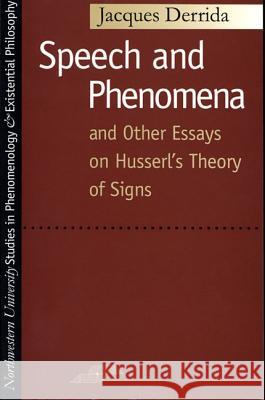
In Speech and Phenomena, Jacques Derriba situates the philosophy of language in relation to logic and rhetoric, which have often been seen as irreconcilable criteria for the use and interpretation of signs. His critique of Husserl attacks the position that language is founded on logic rather than on rhetoric; instead, he claims, meaningful language is limited to expression because expression alone conveys sense.
In Speech and Phenomena, Jacques Derriba situates the philosophy of language in relation to logic and rhetoric, which have often been seen as irreconc...
"Limited Inc "is a major work in the philosophy of language by the celebrated French thinker Jacques Derrida. The book's two essays, "Limited Inc" and "Signature Event Context," constitute key statements of the Derridean theory of deconstruction. They are the clearest exposition to be found of Derrida's most controversial idea, that linguistic meaning is fundamentally indeterminate because the contexts that fix meaning are never stable. "Limited Inc" includes an important new afterword by the author.
"Limited Inc "is a major work in the philosophy of language by the celebrated French thinker Jacques Derrida. The book's two essays, "Limited Inc" and...