This volume contains the speech given by Derrida at Emmanuel Levinas's funeral on December 27, 1995, and his contribution to a colloquium organized to mark the first anniversary of Levinas's death. For both thinkers, the word adieu names a fundamental characteristic of human being: the salutation or benediction prior to all constative language (in certain circumstances, one can say adieu at the moment of meeting) and that given at the moment of separation, sometimes forever, as at the moment of death, it is also the a-dieu, for God or to God before and in any relation to...
This volume contains the speech given by Derrida at Emmanuel Levinas's funeral on December 27, 1995, and his contribution to a colloquium organized to...
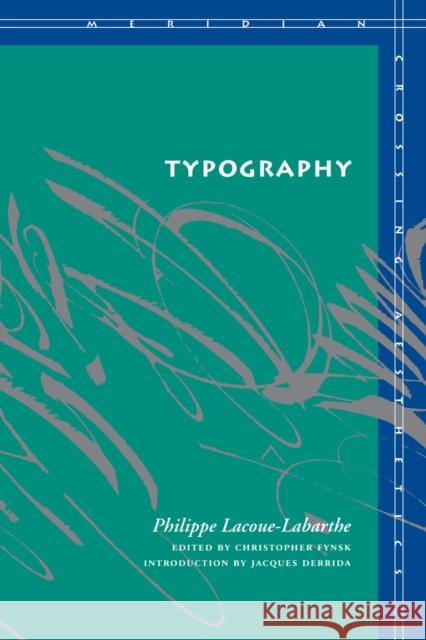
Philosopher, literary critic, translator (of Nietzsche and Benjamin), Philippe Lacoue-Labarthe is one of the leading intellectual figures in France. This volume of six essays deals with the relation between philosophy and aesthetics, particularly the role of mimesis in a metaphysics of representation. Comment 1997] -Typography is a book whose importance has not diminished since its first publication in French in 1979. On the contrary, I would say, it is only now that one can truly begin to appreciate the groundbreaking status of these essays. The points it makes, the way it...
Philosopher, literary critic, translator (of Nietzsche and Benjamin), Philippe Lacoue-Labarthe is one of the leading intellectual figures in France. T...
Maurice Blanchot Jacques Derrida Elizabeth Rottenberg
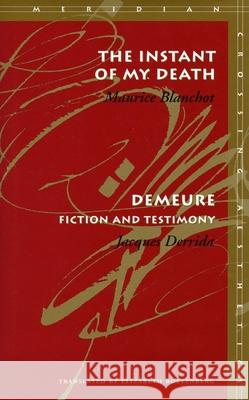
This volume records a remarkable encounter in critical and philosophical thinking: a meeting of two of the great pioneers in contemporary thought, Maurice Blanchot and Jacques Derrida, who are also bound together by friendship and a complex relation to their own pasts. More than a literary text with critical commentary, it constitutes an event of central significance for contemporary philosophical, literary, and political concerns. The book consists of The Instant of My Death, a powerful short prose piece by Blanchot, and an extended essay by Derrida that reads it in the context of...
This volume records a remarkable encounter in critical and philosophical thinking: a meeting of two of the great pioneers in contemporary thought, Mau...
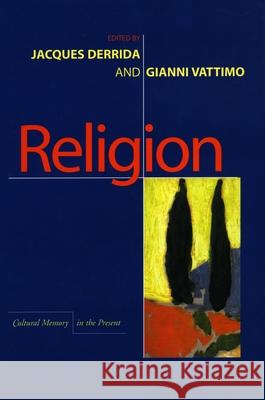
What should we make of the return to the sacred evidenced by the new vitality of churches, sects, and religious beliefs in many parts of the world today? What are the boundaries between the essential traits of religion and those of ethics and justice? Is there a "truth" to religion? This remarkable volume includes reflections on such questions by three of the most important philosophers of our time--Jacques Derrida, Gianni Vattimo, and Hans-Georg Gadamer. Together with other distinguished thinkers, they address a wide range of questions about the meaning, status, and future prospects of...
What should we make of the return to the sacred evidenced by the new vitality of churches, sects, and religious beliefs in many parts of the world tod...
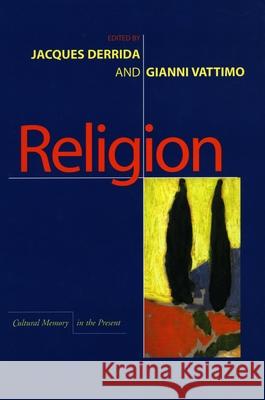
What should we make of the return to the sacred evidenced by the new vitality of churches, sects, and religious beliefs in many parts of the world today? What are the boundaries between the essential traits of religion and those of ethics and justice? Is there a "truth" to religion? This remarkable volume includes reflections on such questions by three of the most important philosophers of our time--Jacques Derrida, Gianni Vattimo, and Hans-Georg Gadamer. Together with other distinguished thinkers, they address a wide range of questions about the meaning, status, and future prospects of...
What should we make of the return to the sacred evidenced by the new vitality of churches, sects, and religious beliefs in many parts of the world tod...
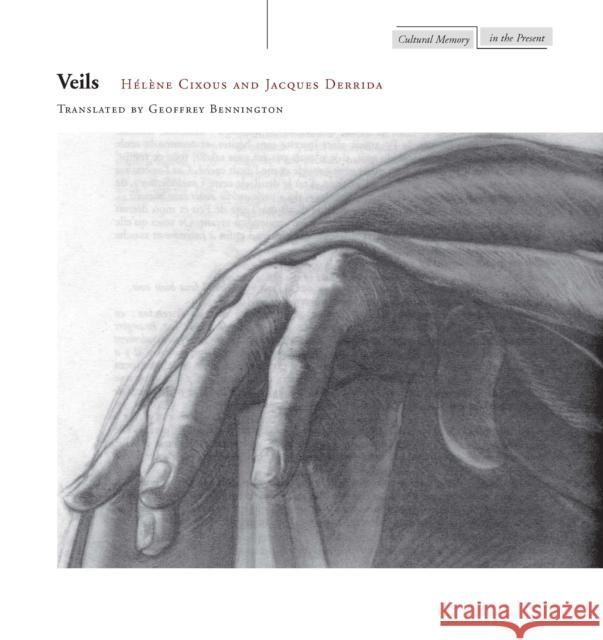
Something of a historical event, this book combines loosely "autobiographical" texts by two of the most influential French intellectuals of our time. "Savoir," by Helene Cixous, is a brief but densely layered account of her experience of recovered sight after a lifetime of severe myopia, an experience that ends with the unexpected turn of grieving for what is lost. Her literary inventiveness mines the coincidence in French between the two verbs "savoir" (to know) and "voir" (to see). Jacques Derrida's "A Silkworm of One's Own" complexly muses on a host of autobiographical, philosophical, and...
Something of a historical event, this book combines loosely "autobiographical" texts by two of the most influential French intellectuals of our time. ...
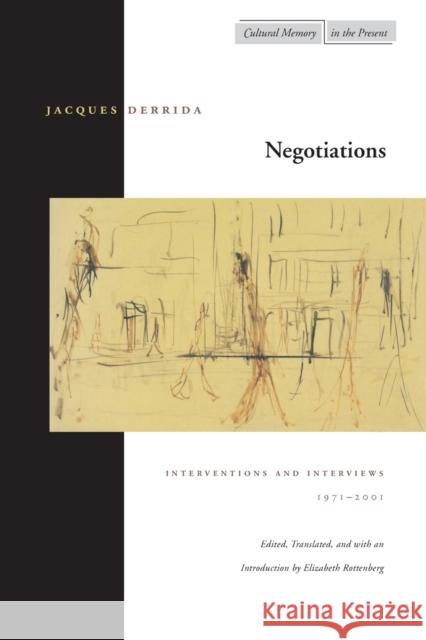
This collection of essays and interviews, some previously unpublished and almost all of which appear in English for the first time, encompasses the political and ethical thinking of Jacques Derrida over thirty years. Passionate, rigorous, beautifully argued, wide-ranging, the texts shed an entirely new light on his work and will be welcomed by scholars in many disciplines--politics, philosophy, history, cultural studies, literature, and a range of interdisciplinary programs. Derrida's arguments vary in their responsiveness to given political questions--sometimes they are vivid polemics on...
This collection of essays and interviews, some previously unpublished and almost all of which appear in English for the first time, encompasses the po...
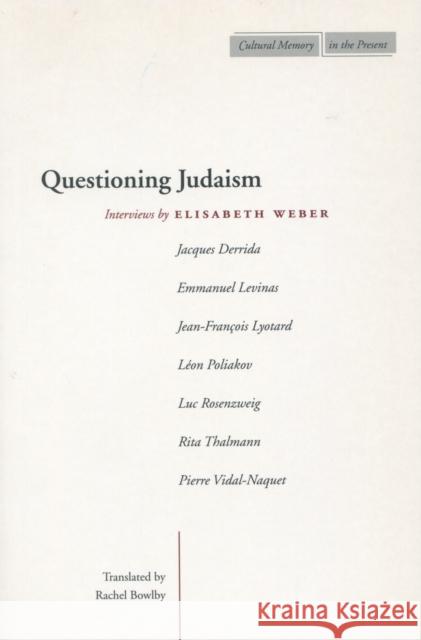
In the wake of the Dreyfus affair and the Shoah, many French intellectuals have maintained rich and complex relationships with Judaism, beyond as well as within the religious dimension. Whether they approach it via history, philosophy, biblical studies or sociology, or following a personal itinerary, many contemporary intellectuals are deeply involved in Jewish culture. Interviewed at length by Elisabeth Weber, this volume presents the meditations of seven well-known French thinkers on the special relations of their own intellectual pursuit to Judaism. As memory or as the place of...
In the wake of the Dreyfus affair and the Shoah, many French intellectuals have maintained rich and complex relationships with Judaism, beyond as well...
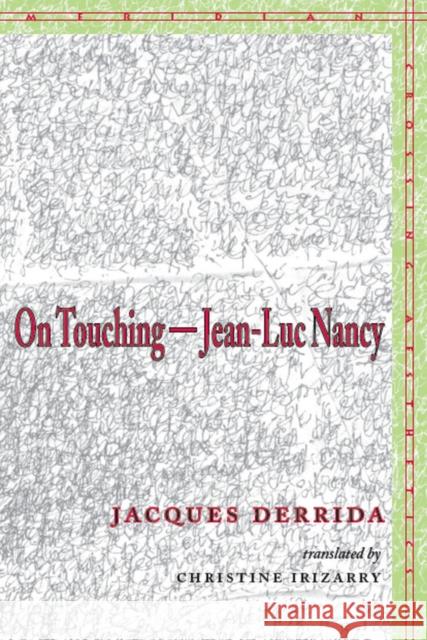
Using the philosophy of Jean-Luc Nancy as an anchoring point, Jacques Derrida in this book conducts a profound review of the philosophy of the sense of touch, from Plato and Aristotle to Jean-Luc Nancy, whose ground-breaking book Corpus he discusses in detail. Emmanuel Levinas, Maurice Merleau-Ponty, Edmund Husserl, Didier Franck, Martin Heidegger, Francoise Dastur, and Jean-Louis Chretien are discussed, as are Rene Descartes, Diderot, Maine de Biran, Felix Ravaisson, Immanuel Kant, Sigmund Freud, and others. The scope of Derrida's deliberations makes this book a virtual encyclopedia...
Using the philosophy of Jean-Luc Nancy as an anchoring point, Jacques Derrida in this book conducts a profound review of the philosophy of the sense o...
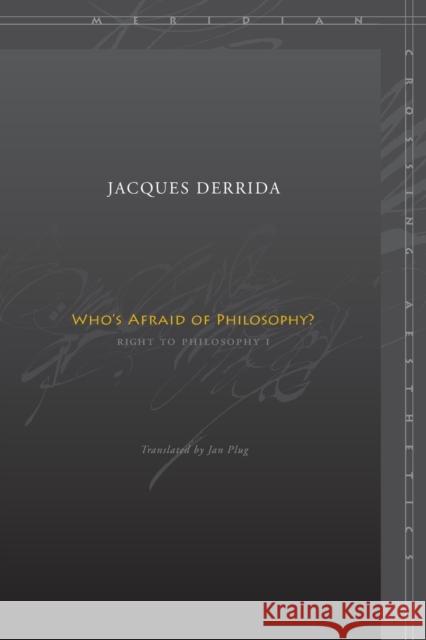
This volume reflects Jacques Derrida's engagement in the late 1970s with French political debates on the teaching of philosophy and the reform of the French university system. He was a founding member of the Research Group on the Teaching of Philosophy (Greph), an activist group that mobilized opposition to the Giscard government's proposals to "rationalize" the French educational system in 1975, and a convener of the Estates General of Philosophy, a vast gathering in 1979 of educators from across France.
While addressing specific contemporary political issues on occasion, thus...
This volume reflects Jacques Derrida's engagement in the late 1970s with French political debates on the teaching of philosophy and the reform of t...