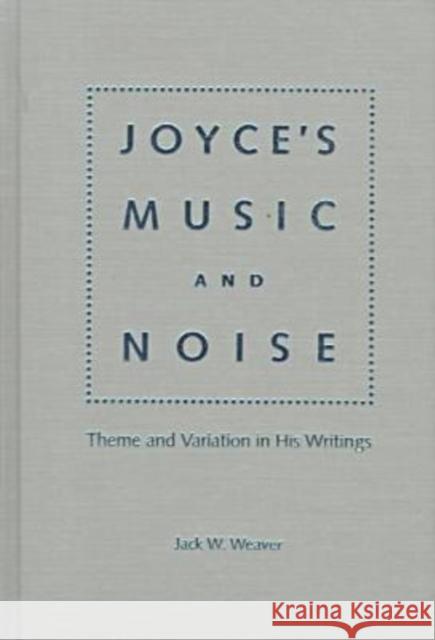
"Breaks new ground for Joyceans. . . . Weaver's work embodies a perceptive, believable explication of Joyce's interpolation of verbal and musical modalities, and in the process makes the reader eminently aware of the interlocking nature of the two art forms."--Zack Bowen, University of Miami
Jack Weaver explains all of Joyce's writing in terms of music and evaluates the music--its form, kind, and technique--in each work. Using Joyce's own rhetoric of theme and variation, Weaver moves from one character to another, through the poems, fiction, and drama, noting improvisations and...
"Breaks new ground for Joyceans. . . . Weaver's work embodies a perceptive, believable explication of Joyce's interpolation of verbal and musical m...
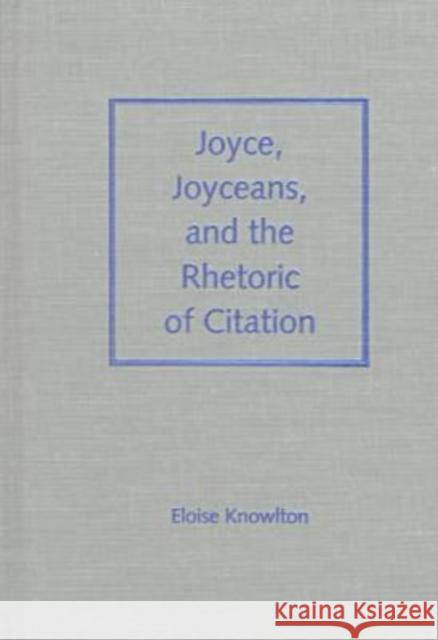
"A new way to discuss Joyce's nearly impossibly complex compositional habits. . . . Knowlton has so sensitized the reader to the issue of quotation that . . . she] permits discussions which have simply not been possible before."--Garry Leonard, University of Toronto
James Joyce never used quotation marks, calling them "perverted" and "unreal." This book springs from that aversion, presenting the first full account of citation from the ancient world forward and tracing Joyce's transgressive relation to that history from Memorabilia to Finnegans Wake. Eloise Knowlton...
"A new way to discuss Joyce's nearly impossibly complex compositional habits. . . . Knowlton has so sensitized the reader to the issue of quotation...
"The first comprehensive study of Joyce and the advertising/commodity nexus. . . . Provides the next step in understanding Joyce--for which Joyceans worldwide are ready and waiting. And it does so eloquently and persuasively and in enormously careful detail and depth of vision. . . . I love this book; I learned from this book. . . . An up-to-date and dramatically useful inquiry into Joycean modernism."--Cheryl Herr, University of Iowa
"The best book on Joyce I have read in years. . . . Leonard] offers new insights, novel readings, and creative interpretations on every page, and all...
"The first comprehensive study of Joyce and the advertising/commodity nexus. . . . Provides the next step in understanding Joyce--for which Joycean...
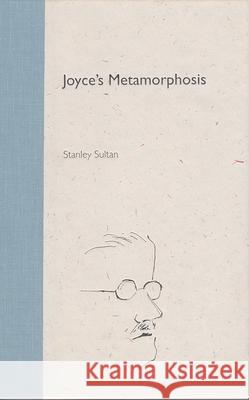
"Sultan brings the distinction between art and autobiography] to center stage. . . . His is a study teachers can profit from and direct students to, for it is accessible and clearly and confidently written. . . . A brilliant reading of Joyce's work."--Thomas F. Staley, University of Texas, Austin
The respected Joyce critic Stanley Sultan describes his newest book as philological biography. Using the fiction the young James Joyce was writing from 1904 to 1906, he traces the process by which Joyce evolved into the mature artist. Sultan argues that Joyce enriched his fiction with a...
"Sultan brings the distinction between art and autobiography] to center stage. . . . His is a study teachers can profit from and direct students t...
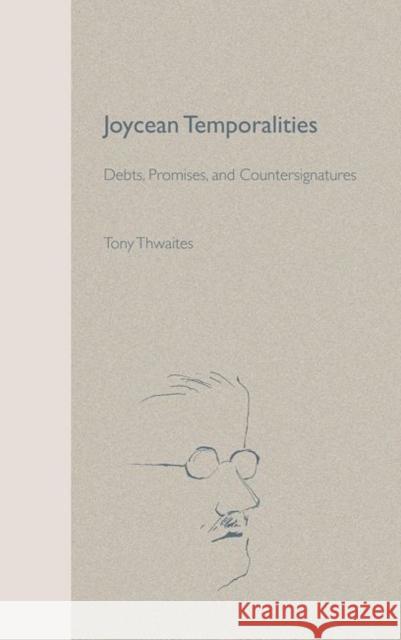
"No one yet has made Joyce's sponging ways so very, very interesting, or so important. Tony Thwaites takes the notions of promise, debt, mortgage, and signature forward to where no critic has yet gone, and back into the Joyce works to their new illumination. He] demonstrates in lucid and engaging prose how the promise--a deferral founded on a certain notion of both past and future--structures Joyce's works."--Eloise Knowlton, Hillsdale College, Hillsdale, Michigan
In arguing that James Joyce's writing is structured everywhere by the peculiar temporalities of the promise--the...
"No one yet has made Joyce's sponging ways so very, very interesting, or so important. Tony Thwaites takes the notions of promise, debt, mortgage, ...
"Outstanding, even spectacular. . . . Kimball shows beyond any doubt that Joyce had by 1922 read key texts by Freud, Jung, Rank, and other analysts, and that his immersion in these then comparatively obscure writings informed his artistic vision in Ulysses. She provides an indispensable roadmap to Joyce's encounter with psychoanalysis."--Peter L. Rudnytsky, Institute for Psychological Study of the Arts, University of Florida, and editor, American Imago
"Expands our sense of how influence can work, and it is rich with fresh insights into Joyce."--Sheldon Brivic, Temple...
"Outstanding, even spectacular. . . . Kimball shows beyond any doubt that Joyce had by 1922 read key texts by Freud, Jung, Rank, and other analysts...