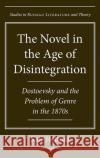
Scholars have long been fascinated by the creative struggles with genre manifested throughout Dostoevsky s career. In The Novel in the Age of Disintegration, Kate Holland brings historical context to bear, showing that Dostoevsky wanted to use the form of the novel as a means of depicting disintegration brought on by various crises in Russian society in the 1860s. This required him to reinvent the genre. At the same time he sought to infuse his novels with the capacity to inspire belief in social and spiritual reintegration, so he returned to some older conventions of a society that...
Scholars have long been fascinated by the creative struggles with genre manifested throughout Dostoevsky s career. In The Novel in the Age of Disin...
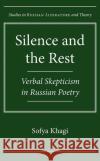
Scholars have long noted the deeply rooted veneration of the power of the word both the expressive and communicative capacities of language in Russian literature and culture. In her ambitious book "Silence and the Rest, " Sofya Khagi illuminates a consistent counternarrative, showing how, throughout its entire history, Russian poetry can be read as an argument for what she calls verbal skepticism. Although she deals with many poets from a two-century tradition, Khagi gives special emphasis to Osip Mandelstam, Joseph Brodsky, and Timur Kibirov, offering readings that add new layers of...
Scholars have long noted the deeply rooted veneration of the power of the word both the expressive and communicative capacities of language in Russ...
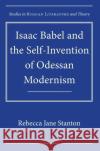
In what marks an exciting new critical direction, Rebecca Stanton contends that the city of Odessa--as a canonical literary image and as a kaleidoscopic cultural milieu--shaped the narrative strategies developed by Isaac Babel and his contemporaries of the Revolutionary generation. Modeling themselves on the tricksters and rogues of Odessa lore, Babel and his fellow Odessans Val-entin Kataev and Yury Olesha manipulated their literary personae through complex, playful, and often subversive negotiations of the boundary between autobiography and fiction. In so doing, they cannily took up a...
In what marks an exciting new critical direction, Rebecca Stanton contends that the city of Odessa--as a canonical literary image and as a kaleidos...
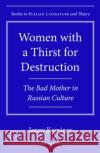
Winner, 2014 AWSS Best Book in Slavic/East European/Eurasian Women's Studies In Russian culture, the archetypal mother is noble and self-sacrificing. In Women with a Thirst for Destruction, however, Jenny Kaminer shows how this image is destabilized during periods of dramatic rupture in Russian society, examining in detail the aftermath of three key moments in the country s history: the emancipation of the serfs in 1861, the Russian Revolution of 1917, and the fall of the Communist regime in 1991. She explores works both familiar and relatively unexamined: Leo...
Winner, 2014 AWSS Best Book in Slavic/East European/Eurasian Women's Studies In Russian culture, the archetypal mother is noble ...
Winner, 2015 International Research Society in Children's Literature (IRSCL) Book Award Voiceless Vanguard: The Infantilist Aesthetic of the Russian Avant-Garde offers a new approach to the Russian avant-garde. It argues that central writers, artists, and theorists of the avant-garde self-consciously used an infantile aesthetic, as inspired by children's art, language, perspective, and logic, to accomplish the artistic renewal they were seeking in literature, theory, and art. It treats the influence of children's drawings on the Neo-Primitivist art of Mikhail Larionov, the role of...
Winner, 2015 International Research Society in Children's Literature (IRSCL) Book Award Voiceless Vanguard: The Infantilist Aesthetic of the Ru...
While Dostoevsky s relation to religion is well-trod ground, there exists no comprehensive study of Dostoevsky and Catholicism. Elizabeth Blake s ambitious and learned Dostoevsky and the Catholic Underground fills this glaring omission in the scholarship. Previous commentators have traced a wide-ranging hostility in Dostoevsky s understanding of Catholicism to his Slavophilism. Blake depicts a far more nuanced picture. Her close reading demonstrates that he is repelled and fascinated by Catholicism in all its medieval, Reformation, and modern manifestations. Dostoevsky saw in...
While Dostoevsky s relation to religion is well-trod ground, there exists no comprehensive study of Dostoevsky and Catholicism. Elizabeth Blake s a...