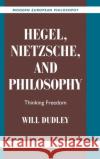
This study explores the theme of freedom in the philosophy of Hegel and Nietzsche. First, Will Dudley sets Hegel's Philosophy of Right within a larger systematic account and deploys the Logic to interpret it. He demonstrates that freedom involves not only the establishment of certain social and political institutions but also the practice of philosophy itself. Then, he reveals how Nietzsche's discussions of decadence, nobility and tragedy lead to an analysis of freedom that critiques heteronomous choice and Kantian autonomy, and ultimately issues a positive conception of liberation.
This study explores the theme of freedom in the philosophy of Hegel and Nietzsche. First, Will Dudley sets Hegel's Philosophy of Right within a larger...
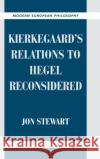
Jon Stewart's groundbreaking study is a major re-evaluation of the complex relationship between the philosophies of Kierkegaard and Hegel. Although the standard view on the subject is that Kierkegaard defined himself as explicitly anti-Hegelian (and viewed Hegel's philosophy with disdain), Jon Stewart demonstrates that Kierkegaard's criticism was not directed specifically to Hegel, but actually to some contemporary Danish Hegelians.
Jon Stewart's groundbreaking study is a major re-evaluation of the complex relationship between the philosophies of Kierkegaard and Hegel. Although th...
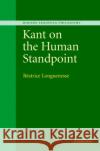
Beatrice Longuenesse considers the three aspects of Kant's philosophy, his epistemology and metaphysics of nature, moral philosophy, and aesthetic theory, under one unifying standpoint: Kant's conception of our capacity to form judgments. She argues that the elements which make up our cognitive access to the world have an equally important role to play in our moral evaluations and our aesthetic judgments. Her book will appeal to all interested in Kant and his thought, ranging over Kant's account of our representations of space and time, his conception of the logical forms of judgments,...
Beatrice Longuenesse considers the three aspects of Kant's philosophy, his epistemology and metaphysics of nature, moral philosophy, and aesthetic the...
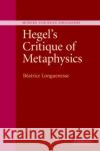
Hegel's Science of Logic has received less attention than his Phenomenology of Spirit, but Hegel himself took it to be his highest philosophical achievement and the backbone of his system. The present book focuses on this most difficult of Hegel's published works. Beatrice Longuenesse offers a close analysis of core issues, including discussions of what Hegel means by 'dialectical logic', the role and meaning of 'contradiction' in Hegel's philosophy, and Hegel's justification for the provocative statement that 'what is actual is rational, what is rational is actual'. She examines both Hegel's...
Hegel's Science of Logic has received less attention than his Phenomenology of Spirit, but Hegel himself took it to be his highest philosophical achie...
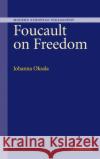
Freedom and the subject were guiding themes for Michel Foucault throughout his philosophical career. Johanna Oksala identifies the different interpretations of freedom in his philosophy and examines three major divisions of it: the archaeological, the genealogical, and the ethical. She demonstrates that in order to fully appreciate Foucault's "project," we must understand his complex relationship to phenomenology, and discusses Foucault's treatment of the body in relation to recent feminist work on this topic.
Freedom and the subject were guiding themes for Michel Foucault throughout his philosophical career. Johanna Oksala identifies the different interpret...
Kant's Critique of Judgment has often been interpreted by scholars as comprising separate treatments of three uneasily connected topics: beauty, biology, and empirical knowledge. Rachel Zuckert's book interprets the Critique as a unified argument concerning all three domains. She argues that on Kant's view, human beings demonstrate a distinctive cognitive ability in appreciating beauty and understanding organic life: an ability to anticipate a whole that we do not completely understand according to preconceived categories. This ability is necessary, moreover, for human beings to gain...
Kant's Critique of Judgment has often been interpreted by scholars as comprising separate treatments of three uneasily connected topics: beauty, biolo...
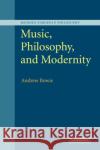
Modern philosophers generally assume that music is a problem to which philosophy ought to offer an answer. Andrew Bowie's Music, Philosophy, and Modernity suggests, in contrast, that music might offer ways of responding to some central questions in modern philosophy. Bowie looks at key philosophical approaches to music ranging from Kant, through the German Romantics and Wagner, to Wittgenstein, Heidegger and Adorno. He uses music to re-examine many ideas about language, subjectivity, metaphysics, truth and ethics, and he suggests that music can show how the predominant images of language,...
Modern philosophers generally assume that music is a problem to which philosophy ought to offer an answer. Andrew Bowie's Music, Philosophy, and Moder...
This is the first book in English on the early works of the German philosopher Johann Gottlieb Fichte (1762-1814). It examines the transcendental theory of self and world from the writings of Fichte's most influential period (1794-1800), and considers in detail recently discovered lectures on the Foundations of Transcendental Philosophy. Combining incomparable erudition, sensitive readings of some of the most difficult of philosophical texts, clarity in exposition and an acute awareness of historical context, this book takes its place as the ideal introduction to Fichte's thought.
This is the first book in English on the early works of the German philosopher Johann Gottlieb Fichte (1762-1814). It examines the transcendental theo...
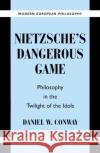
This is the first book-length treatment of the unique nature and development of Nietzsche's post-Zarathustran political philosophy. This later political philosophy is set in the context of the critique of modernity that Nietzsche advances in the years 1885-1888, in such texts as Beyond Good and Evil, On the Genealogy of Morals, Twilight of the Idols, The Antichrist, The Case of Wagner, and Ecce Homo. Daniel Conway has written a powerful book about Nietzsche's own appreciation of the limitations of both his writing style and of his famous prophetic "stance."
This is the first book-length treatment of the unique nature and development of Nietzsche's post-Zarathustran political philosophy. This later politic...
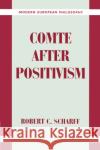
This book provides the only detailed, systematic reconsideration of the neglected nineteenth-century positivist Auguste Comte currently available. Apart from offering an accurate account of what Comte actually wrote, the book argues that Comte's positivism has never had greater contemporary relevance than now. Providing a lucid exposition of Comte and informed by considerable new scholarship on his work, this book will be valuable to philosophers, especially philosophers of science, a wide range of intellectual historians, and to historians of science and psychology.
This book provides the only detailed, systematic reconsideration of the neglected nineteenth-century positivist Auguste Comte currently available. Apa...