Thomas Paine, defender of freedom, independence, and rational common sense during America's turbulent revolutionary period, offers insights into religion which ring sharply true more than two centuries later. This unabridged edition of The Age of Reason sets forth Paine's provocative observations on the place of religion in society.
Thomas Paine, defender of freedom, independence, and rational common sense during America's turbulent revolutionary period, offers insights into relig...
"I think all the great religions of the world - Buddhism, Hinduism, Christianity, Islam, and Communism - both untrue and harmful. It is evident as a matter of logic that, since they disagree, not more than one of them can be true." Bertrand Russell wrote these words in his famous essay, "Why I Am Not A Christian." In Bertrand Russell on God and Religion, Al Seckel presents in one volume the severe scrutiny Russell brought to bear on organized religion in his best essays. Bertrand Russell on God and Religion is an exhaustive compilation of Russell's best essays on religion,...
"I think all the great religions of the world - Buddhism, Hinduism, Christianity, Islam, and Communism - both untrue and harmful. It is evident as a m...
Since Old Testament days discrimination against minorities and other groups has been the rule in history rather than the exception. Chief among these repressive attitudes has been the inferior social and political status of women. Mill offers compelling arguments against the disenfranchisement of women, the infringement of their property rights, and the second-class status they experienced within marriage. One of England's most influential social philosophers, Mill sets the keen sights of his critical, analytic eye on the socio-political justifications for gender supremacy in...
Since Old Testament days discrimination against minorities and other groups has been the rule in history rather than the exception. Chief among these ...
In the rich history of political philosophy, great minds have sought to define the nature and extent of human freedom, with careful justifications offered for the principles proposed. This tradition experienced a heightened degree of enthusiastic intensity upon the publication of On Liberty in England during the nineteenth century. In this, his most powerful essay, John Stuart Mill defends individual liberty against both social and political encroachment, by daring to suggest that lines of demarcation be drawn to outline the proper role of government with respect to individual freedom....
In the rich history of political philosophy, great minds have sought to define the nature and extent of human freedom, with careful justifications off...
As one of the early Enlightenment philosophers in England, John Locke sought to bring reason and critical intelligence to the discussion of the origins of civil society. Endeavoring to reconstruct the nature and purpose of government, a social contract theory is proposed. The Second Treatise sets forth a detailed discussion of how civil society came to be and the nature of its inception. Locke's discussion of tacit consent, separation of powers, and the right of citizens to revolt against repressive governments, has made The Second Treatise one of the most influential essays in the...
As one of the early Enlightenment philosophers in England, John Locke sought to bring reason and critical intelligence to the discussion of the origin...
Written in part as a theoretical reply to the stodgy conservatism of Edmund Burke's Reflections on the French Revolution (1790), Paine's Rights of Man (1791-92) sets forth a manifesto of popular democratic rule in the established tradition of John Locke and Jean-Jacques Rousseau. In it Paine offers a discussion of the nature of political man and proceeds to encourage the grass-roots revolutionary movements that seek to analyze critically and, where necessary, reform or replace social and political institutions, many of which tend only to repress those whom they were initially...
Written in part as a theoretical reply to the stodgy conservatism of Edmund Burke's Reflections on the French Revolution (1790), Paine's Rig...
During his long life (1872-1970) Bertrand Russell was one of a handful of social thinkers, let alone internationally recognized philosophers, whose views on contemporary issues won for him a devoted and supportive audience on the one hand and a host of vituperative critics on the other. Russell's revolutionary writings frequently placed him in the center of controversy with conservatives and all those who were unwilling to consider moral questions from a rational rather than an emotional stance. Al Seckel has compiled an exhaustive collection of Russell's very best and most...
During his long life (1872-1970) Bertrand Russell was one of a handful of social thinkers, let alone internationally recognized philosophers, whose vi...
One of America's most influential social philosophers offers a restatement of traditional liberal-democratic views as they pertain to our constitutional form of government. The topics explored in Sidney Hook's book include the nature and extent of human freedom, the Bill of Rights, judicial review as it pertains to constitutional interpretation and the balance of powers among the three branches of government, censorship, freedom of speech, freedom of religion, social justice, the importance of intelligence in political and moral spheres, as well as civil disobedience and the right to...
One of America's most influential social philosophers offers a restatement of traditional liberal-democratic views as they pertain to our constitution...
Jeremy Bentham's work on The Principles of Morals and Legislation emerges from its historic roots in hedonism and teleology as a scientific attempt to assess the moral content of human action by focusing on its results or consequences. Proceeding from the assumption that human beings desire pleasure (and avoid pain), Bentham's unique perspective, known as utilitarianism, is used to construct a fascinating calculus for determining which action to perform when confronted with situations requiring moral decision-makingthe goal of which is to arrive at the -greatest happiness of the greatest...
Jeremy Bentham's work on The Principles of Morals and Legislation emerges from its historic roots in hedonism and teleology as a scientific attempt to...
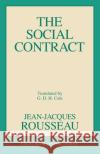
With the publication of The Social Contract in 1761, Jean-Jacques Rousseau took his place among the leading political philosophers of the Enlightenment. Like his contractarian predecessors (Thomas Hobbes and John Locke), Rousseau sought to ground his political theory in an understanding of human nature, which he believed to be basically good but corrupted by the conflicting interests within society. Here self-interest degenerated into a state of war from which humanity could only be extricated by the imposition of a contract. As a party to the compact, each individual would find his...
With the publication of The Social Contract in 1761, Jean-Jacques Rousseau took his place among the leading political philosophers of the Enlig...