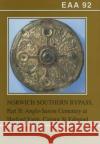
The Anglo-Saxon cemetery at Harford Farm consisted of two groups of late 7th-century inhumation burials surviving only as stains within a prehistoric barrow cemetery. Of the thirty-one graves grouped on a bluff overlooking the river, most contained either unaccompanied burials or burials with just knife and buckle; but three, all probably female, were lavishly equipped. The fifteen graves further south, loosely arranged around a prehistoric barrow, were mostly 'knife and buckle' burials, but one was more richly furnished. The character of the grave-goods and the manner of burial are typical...
The Anglo-Saxon cemetery at Harford Farm consisted of two groups of late 7th-century inhumation burials surviving only as stains within a prehistoric ...
Excavations and a watching brief at St Faith's Lane uncovered part of a 10th- to 12th-century street frontage comprising incomplete remains of timber structures, pits and ditches. This title explores the site and what was uncovered.
Excavations and a watching brief at St Faith's Lane uncovered part of a 10th- to 12th-century street frontage comprising incomplete remains of timber ...
In the 1980s, work began on construction of the vast underground Castle Mall shopping centre in Norwich. The associated archaeological excavation was one of the largest of its kind in northern Europe, designed to investigate not only the castle bailey but also pre-Conquest settlement and, for the post-Conquest period, areas of the surrounding medieval city.
The report describes evidence for late Saxon streets, houses and graveyards; the developing fortifications of an urban castle established before 1100; gradual encroachment by the townspeople into the castle precinct after the 13th...
In the 1980s, work began on construction of the vast underground Castle Mall shopping centre in Norwich. The associated archaeological excavation was ...
A hoard of coins of the shadowy East Anglian King Beonna triggered off a project which revealed not only late Neolithic activity but also a Viking burial and a small part of a rural settlement of the 8th to 13th centuries AD. Saturation coverage by metal detector at all stages of the work produced a large assemblage of metal objects which suggests that the 'normal' quantity and range of finds collected from conventionally excavated sites may often fall short of the true population.
A hoard of coins of the shadowy East Anglian King Beonna triggered off a project which revealed not only late Neolithic activity but also a Viking bur...
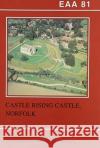
Aby Beric Morley and David Gurney This book starts with a wide-ranging overview of Castle Rising, going on to review the archaeological evidence, in conjunction with comment on the archaeological explorations themselves, for the site from prehistoric times up to the post-medieval period.
Aby Beric Morley and David Gurney This book starts with a wide-ranging overview of Castle Rising, going on to review the archaeological evidence, in c...
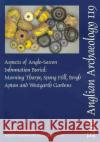
Oxbow says: Excavated in the 1970s, the sites of Morning Thorpe, Bergh Apton and Spong Hill in Norfolk and Westgarth Gardens in Suffolk, have only previously been published as catalogues. This volume aims to discuss the evidence from these four cemeteries in more general terms to gain insights into Anglo-Saxon social structure. Containing approximately five hundred inhumations, dating from the mid-5th to 7th century, the burials contain a wealth of artefacts which are used to establish a chronology and trace changes in material culture and burial practice over time. Issues of weapon and dress...
Oxbow says: Excavated in the 1970s, the sites of Morning Thorpe, Bergh Apton and Spong Hill in Norfolk and Westgarth Gardens in Suffolk, have only pre...
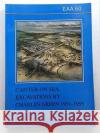
The Roman defended site at Caister, hitherto viewed as a small town, can now be seen as an early coastal fort probably contemporary with Reculver and Brancaster, both of which appear in the Notitia Dignitatum as forts of the Saxon shore. The Caister fort is of earlier Roman type, with a defensive wall backed up by an earthen rampart. Finds indicate occupation by cavalry from the early 3rd century to later 4th century, although specifically late military equipment is absent. The site was unoccupied until the Middle Saxon period, when outside the walls an extensive cemetery developed which was...
The Roman defended site at Caister, hitherto viewed as a small town, can now be seen as an early coastal fort probably contemporary with Reculver and ...
Aby Phil Andrews and Kenneth Penn Three major excavations and other work in Thetford reveal settlement north of the river by AD1000, within a semi-circular defensive enclosure which probably pre-dates that south of the river, but was initially little more than a bridgehead. Occupation peaked in the 11th and 12th centuries, with a shift of people to the north bank, followed by medieval decline. The bones represent a range of domestic animals, dominated by sheep kept for wool, cattle for meat and dairy products, and then pigs. Some stray Middle Saxon finds may hint at re-use of the Iron Age...
Aby Phil Andrews and Kenneth Penn Three major excavations and other work in Thetford reveal settlement north of the river by AD1000, within a semi-cir...
The enigmatic remains of Baconsthorpe Castle in north-east Norfolk belie the story of a very grand fortified manor house. Owned by the Heydon family from the early 15th to the late 17th century, the house once comprised an inner moated enclosure, an outer court and gatehouse, a barn, mere and gardens and park. This report outlines the history of Baconsthorpe based on documentary and iconographic evidence, and archaeological investigations of the 1950s and, especially, the excavations of 1972. As well as an analysis of the standing remains and earthworks, this volume presents the artefactual...
The enigmatic remains of Baconsthorpe Castle in north-east Norfolk belie the story of a very grand fortified manor house. Owned by the Heydon family f...