The Anglo-Saxon cemetery at Harford Farm consisted of two groups of late 7th-century inhumation burials surviving only as stains within a prehistoric barrow cemetery. Of the thirty-one graves grouped on a bluff overlooking the river, most contained either unaccompanied burials or burials with just knife and buckle; but three, all probably female, were lavishly equipped. The fifteen graves further south, loosely arranged around a prehistoric barrow, were mostly 'knife and buckle' burials, but one was more richly furnished. The character of the grave-goods and the manner of burial are typical...
The Anglo-Saxon cemetery at Harford Farm consisted of two groups of late 7th-century inhumation burials surviving only as stains within a prehistoric ...
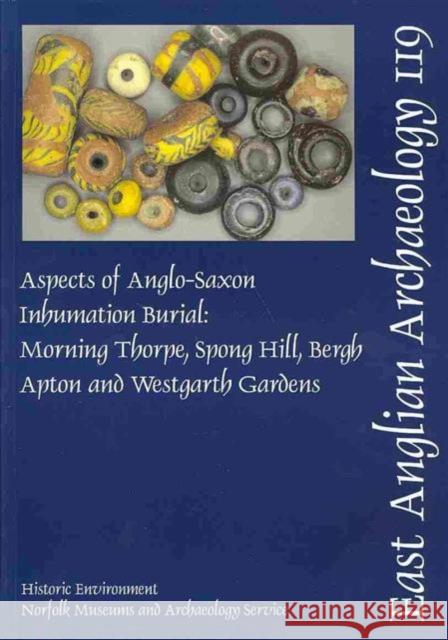
Oxbow says: Excavated in the 1970s, the sites of Morning Thorpe, Bergh Apton and Spong Hill in Norfolk and Westgarth Gardens in Suffolk, have only previously been published as catalogues. This volume aims to discuss the evidence from these four cemeteries in more general terms to gain insights into Anglo-Saxon social structure. Containing approximately five hundred inhumations, dating from the mid-5th to 7th century, the burials contain a wealth of artefacts which are used to establish a chronology and trace changes in material culture and burial practice over time. Issues of weapon and dress...
Oxbow says: Excavated in the 1970s, the sites of Morning Thorpe, Bergh Apton and Spong Hill in Norfolk and Westgarth Gardens in Suffolk, have only pre...