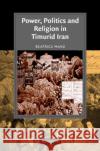
Beatrice Forbes Manz uses the history of Iran under the Timurid ruler Shahrukh (1409 1447) to analyse the relationship between government and society in the medieval Middle East. She provides a rich portrait of Iranian society over an exceptionally broad spectrum - the dynasty and its servitors, city elite and provincial rulers, and the religious classes, both ulama' and Sufi. The work addresses two issues central to pre-modern Middle Eastern history: how a government without the monopoly of force controlled a heterogeneous society, and how a society with diffuse power structures remained...
Beatrice Forbes Manz uses the history of Iran under the Timurid ruler Shahrukh (1409 1447) to analyse the relationship between government and society ...
In a lucidly argued revisionist study of military society in Ottoman Egypt, Jane Hathaway contends that the basic framework within which this elite operated was the household, a conglomerate of patron-client ties. Using Turkish and Arabic archival sources, the author focuses on the Qazdagli household, a military group that came to dominate Egypt. This pioneering study will have a major impact on the understanding of Egyptian history, and will be essential reading for scholars in the field, and for premodern historians generally.
In a lucidly argued revisionist study of military society in Ottoman Egypt, Jane Hathaway contends that the basic framework within which this elite op...
In the thirteenth century the Mongols created a vast transcontinental empire that transported skilled artisans from one cultural zone to another. Among those transported were Muslim textile workers, resettled in China, where they made clothes for the imperial court. In a fascinating account, the author considers the significance of cloth and color in the political and cultural life of the Mongols. Situated within the broader context of the history of the Silk Road, the book will interest not only historians of the Middle East and Asia, but also art historians and textile specialists.
In the thirteenth century the Mongols created a vast transcontinental empire that transported skilled artisans from one cultural zone to another. Amon...
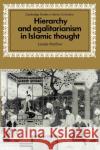
By analyzing a wide range of Arab and Persian literature, Louise Marlow demonstrates that Islam's initial orientation was markedly egalitarian, but the social aspect of this egalitarianism was soon undermined in the aftermath of Islam's political success. Although the memory of its early promise never entirely receded, social egalitarianism was soon associated with political subversion. The originality and chronological scope of Louise Marlow's book will ensure a wide readership of Islamic historians and of scholars assessing the impact of the recent Islamic revival.
By analyzing a wide range of Arab and Persian literature, Louise Marlow demonstrates that Islam's initial orientation was markedly egalitarian, but th...
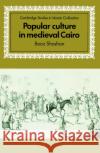
This is the first book-length study of popular culture in a medieval Islamic city. Dr. Shoshan draws together a wealth of Arabic sources to explore popular religion against the background of the growing influence of Sufism, an important biography of Muhammad that was suppressed by the learned, and the origins and popular practices of the annual Nawruz festival. He also assesses the political beliefs and economic expectations of the Carene commoners and the complex relationship between the culture of the elite and that of the people of Cairo.
This is the first book-length study of popular culture in a medieval Islamic city. Dr. Shoshan draws together a wealth of Arabic sources to explore po...
This comparative and broad-ranging book spans three centuries of Ottoman history. It offers a new interpretation of the relations between the central Ottoman empire and provincial Iraqi society in the early modern period, and demonstrates that, contrary to the accepted view, their military, fiscal and political links strenghtened rather than weakened over the period. The book will be of interest to historians of the Middle East and to Ottomanists, as well as to political scientists and those concerned with the process of state formation.
This comparative and broad-ranging book spans three centuries of Ottoman history. It offers a new interpretation of the relations between the central ...
High rates of divorce, often taken to be a modern and western phenomenon, were also typical of medieval Islamic societies. By pitting these high rates of divorce against the Islamic ideal of marriage, Yossef Rapoport radically challenges usual assumptions about the legal inferiority of Muslim women and their economic dependence on men. He argues that marriages in late medieval Cairo, Damascus and Jerusalem had little in common with the patriarchal models advocated by jurists and moralists. The transmission of dowries, women's access to waged labour, and the strict separation of property...
High rates of divorce, often taken to be a modern and western phenomenon, were also typical of medieval Islamic societies. By pitting these high rates...
The empire of the Qara Khitai, which was one of the least known and most fascinating dynasties in the history of Central Asia, existed for nearly a century before it was conquered by the Mongols in 1218. Arriving in Central Asia from China, the Qara Khitai ruled over a mostly Muslim population. Their history affords a unique window onto the extensive cross-cultural contacts between China, Inner Asian nomads and the Muslim world in the period preceding the rise of Chinggis Khan. Using an extensive corpus of Muslim and Chinese sources, Michal Biran comprehensively examines the political,...
The empire of the Qara Khitai, which was one of the least known and most fascinating dynasties in the history of Central Asia, existed for nearly a ce...
The Ismailis, among whom are the followers of the Aga Khan, rose to prominence during the fourth Islamic/tenth Christian century. They developed a remarkably successful intellectual programme to sustain and support their political activities, promoting demands of Islamic doctrine together with the then newly imported sciences from abroad. The high watermark of this intellectual movement is best illustrated in the writings of the Ismaili theoretician Abu Yaqub al-Sijistani. Using both published and manuscript writings of al-Sijistani that have hitherto been largely hidden, forgotten or...
The Ismailis, among whom are the followers of the Aga Khan, rose to prominence during the fourth Islamic/tenth Christian century. They developed a rem...