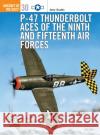
This book charts the story of the lesser known aces who flew the mighty Republic aircraft as a tactical fighter-bomber with the Ninth Air Force, rather than as a long-range escort. It also details the exploits of the Mediterranean-based 325th FG, which was the only P-47 group within the strategic Fifteenth Air Force. Thunderbolt aces within the Ninth Air Force, particularly, were rare, despite some 15 groups flying the fighter. Supporting troops on the ground rather than searching out aerial foes, was the name of the game for the men of the Ninth. However, with the Luftwaffe often opposing...
This book charts the story of the lesser known aces who flew the mighty Republic aircraft as a tactical fighter-bomber with the Ninth Air Force, rathe...
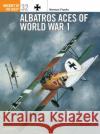
The Albatros family of fighters were amongst the most effective aircraft employed by the Idlfieg (Imperial German Air Service) for much of World War 1, with the D.III and D.Va being flown by most of the 363 pilots who qualified as aces at some point in their often brief careers. The Albatros was the scourge of the RFC on the Western Front in 1916-17, with pilots of the calibre of von Richthofen, Boelke and Schleich cutting swathes through their opponents. Well over 4000 Albatros scouts were built between 1916 and 1918, and they were also extensively used by the Austro-Hungarians against...
The Albatros family of fighters were amongst the most effective aircraft employed by the Idlfieg (Imperial German Air Service) for much of World War 1...
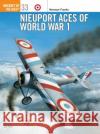
The French Nieuport company provided the Allied air forces with the first true fighter scout of World War 1 in the shape of the diminutive XI of 1915. Based on the Bebe racer, built for the abandoned Gordon-Bennett Trophy of the previous year, the aircraft utilised a sesquiplane (lower wing much smaller than the upper wing) arrangement which gave the XI extreme manoeuvrability. It was the only scout respected by the all-conquering German Fokker E-series of 1915-16, and was flown by French, British, Russian, Belgian and Italian aces. The XI was replaced from May 1916 onwards by the bigger and...
The French Nieuport company provided the Allied air forces with the first true fighter scout of World War 1 in the shape of the diminutive XI of 1915....
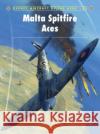
The siege of Malta during World War 2 is one of the great epics of aerial warfare. In 1942, it was described alternately as both a 'fighter pilot's paradise' and 'the most bombed place on earth'. During the peak of the Axis efforts against Malta, it suffered 154 consecutive days and nights of bombing, 100 nights more that London suffered during the Blitz.
The destruction of Axis convoys by Malta-based aircraft proved to be one of the decisive factors in the defeat of Rommel's forces in North Africa. This vital position would have been lost if it had not been for the successful...
The siege of Malta during World War 2 is one of the great epics of aerial warfare. In 1942, it was described alternately as both a 'fighter pilot's...
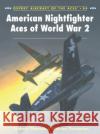
The Americans lagged behind their European contemporaries in military aviation in the late 1930s, and it took the Battle of Britain to awaken an isolated America to the necessity of having aircraft that could defend targets against nighttime attack by bomber aircraft. With the help of the RAF, the importance of creating such a specialized fighter force was given top priority. This book examines the numerous aircraft types that were used by the US in this role, beginning with the early 'stop-gap' conversions like the TBM Avenger, Lockheed Ventura and the A-20 Havoc (P-70).
It goes on...
The Americans lagged behind their European contemporaries in military aviation in the late 1930s, and it took the Battle of Britain to awaken an is...
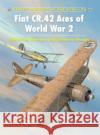
The Fiat CR.42, a logical development of the Fiat CR.32, was the last single-seat fighter biplane to be produced. It entered service with the Italian Regia Aeronautica in May 1939 before being exported to Belgium, Hungary and Sweden. Its combat debut came when the Belgian air force threw its fleet into action during the German invasion of the Low Countries on 10th May 1940. Despite being quickly overwhelmed, the Belgian pilots managed to make a number of aerial claims. The CR.42 became heavily involved in the fighting in North Africa and although it was gradually replaced by more modern...
The Fiat CR.42, a logical development of the Fiat CR.32, was the last single-seat fighter biplane to be produced. It entered service with the Itali...
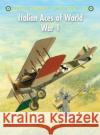
The Italian aces of World War 1 have gone down in history as the irrefutable masters of the skies in the battle against their Austro-Hungarian enemies. In this often forgotten theater of warfare these remarkable pilots gave the Italian forces an undisputed air superiority and left an enduring legacy as extraordinary men. Having interviewed the descendants of almost every Italian ace from the Great War, Paolo Varriale uncovers these fighters' incredible and sometimes tragic histories. Years of painstaking research has culminated in this truly groundbreaking study which brings to life the...
The Italian aces of World War 1 have gone down in history as the irrefutable masters of the skies in the battle against their Austro-Hungarian enemies...
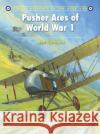
The quest for an effective fighter airplane to achieve air superiority during World War 1 resulted in a series of pusher fighter planes, designed with the engine at the rear and the machine gun at the front. These ungainly, heavy looking fighters did surprisingly well and they were able to hold their own against their German counterparts - including the Fokker Eindeckers with their synchronized machine guns - until 1917. By then, however, the drag-producing design rendered the pusher fighter unable to match the performance of tractor-engined machines. This is the story of the unusual pusher...
The quest for an effective fighter airplane to achieve air superiority during World War 1 resulted in a series of pusher fighter planes, designed with...
Entering service with the US Navy as a carrier-borne fighter, the Brewster F2A, later named Buffalo by the British and simply the Brewster by the Finns, saw relatively little service with its own nation. Indeed, it was to see action on just one occasion in US colors: the engagement off Midway by USMC F2As saw a number of Japanese carrier aircraft shot down, including two by future ace Col Charles M Kunz.
The F2A was also ordered for the RAF in 1939, and although it soon became apparent that the type was not suitable for use against the mighty Luftwaffe over Western Europe, the...
Entering service with the US Navy as a carrier-borne fighter, the Brewster F2A, later named Buffalo by the British and simply the Brewster by the F...
This title is the natural conclusion to the collection of titles chronicling the exploits of the fighter pilots of the German Luftwaffe of World War 2 that has been part of - and contributed in some small measure to the success of - Osprey's long running Aircraft of the Aces series. Since the first appearance of Aircraft of the Aces 2 back in 1994, a further ten titles by various authors have been published on German fighters and their pilots. Together, these provide a comprehensive and unique overview of all the famous names (together with some lesser-known ones) who flew fighters 'for...
This title is the natural conclusion to the collection of titles chronicling the exploits of the fighter pilots of the German Luftwaffe of World Wa...