• Wyszukiwanie zaawansowane
  • Kategorie
  • Kategorie BISAC
  • Książki na zamówienie
  • Promocje
  • Granty
  • Książka na prezent
  • Opinie
  • Pomoc
  • Załóż konto
  • Zaloguj się

Inclusive Innovation: Evidence and Options in Rural India » książka


zaloguj się | załóż konto
Logo Krainaksiazek.pl

koszyk

konto

szukaj
topmenu
Księgarnia internetowa
Szukaj
Książki na zamówienie
Promocje
Granty
Książka na prezent
Moje konto
Pomoc
 
 
Wyszukiwanie zaawansowane
Pusty koszyk
Bezpłatna dostawa dla zamówień powyżej 20 złBezpłatna dostawa dla zamówień powyżej 20 zł

Kategorie główne

• Nauka
 [2952079]
• Literatura piękna
 [1850969]

  więcej...
• Turystyka
 [71058]
• Informatyka
 [151066]
• Komiksy
 [35579]
• Encyklopedie
 [23181]
• Dziecięca
 [620496]
• Hobby
 [139036]
• AudioBooki
 [1646]
• Literatura faktu
 [228729]
• Muzyka CD
 [379]
• Słowniki
 [2932]
• Inne
 [445708]
• Kalendarze
 [1409]
• Podręczniki
 [164793]
• Poradniki
 [480107]
• Religia
 [510956]
• Czasopisma
 [511]
• Sport
 [61267]
• Sztuka
 [243299]
• CD, DVD, Video
 [3411]
• Technologie
 [219640]
• Zdrowie
 [100984]
• Książkowe Klimaty
 [124]
• Zabawki
 [2281]
• Puzzle, gry
 [3363]
• Literatura w języku ukraińskim
 [258]
• Art. papiernicze i szkolne
 [8020]
Kategorie szczegółowe BISAC

Inclusive Innovation: Evidence and Options in Rural India

ISBN-13: 9788132239277 / Angielski / Twarda / 2020
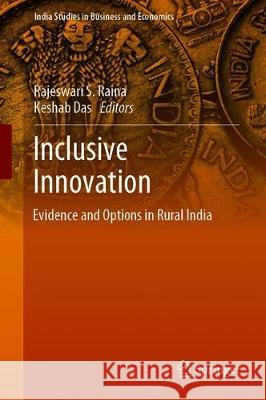
Raina, Rajeswari S.
Inclusive Innovation: Evidence and Options in Rural India Raina, Rajeswari S. 9788132239277 Springer - książkaWidoczna okładka, to zdjęcie poglądowe, a rzeczywista szata graficzna może różnić się od prezentowanej.

Inclusive Innovation: Evidence and Options in Rural India

ISBN-13: 9788132239277 / Angielski / Twarda / 2020

Raina, Rajeswari S.
cena 201,24
(netto: 191,66 VAT:  5%)

Najniższa cena z 30 dni: 192,74
Termin realizacji zamówienia:
ok. 22 dni roboczych.

Darmowa dostawa!

This book discusses the role of inclusive innovation for development in rural India. It uses the evidence of innovation in the context of skewed or limited livelihood options and multiple knowledge systems to argue that if inclusive innovation is to happen, the actors and the nature of the innovation system need reform. The book presents cases of substantive technological changes and institutional reforms enabling inclusive innovation in rural manufacturing, sustainable agriculture, health services, and the processes of technological learning in traditional informal networks, as well as in formal modern commodity markets. These cases offer lessons to enable learning and change within the state and formal science and technology (S&T) organizations. By focusing on these actors central to development economics and innovation systems framework, the book bridges the widening conceptual gaps between these two parallel knowledge domains, and offers options for action by several actors to enable inclusive innovation systems. The content is thus of value to a wide audience consisting of researchers, policy makers, NGOs and industry observers.


Kategorie:
Nauka, Biologia i przyroda
Kategorie BISAC:
Business & Economics > Industries - Agribusiness
Business & Economics > Production & Operations Management
Business & Economics > Development - Economic Development
Wydawca:
Springer
Seria wydawnicza:
India Studies in Business and Economics
Język:
Angielski
ISBN-13:
9788132239277
Rok wydania:
2020
Wydanie:
2019
Oprawa:
Twarda
Wolumenów:
01
Dodatkowe informacje:
Wydanie ilustrowane

Part I: The Problem

Chapter 1. Inclusion and Innovation in India’s Rural Development Agenda
Chapter 2. Inclusive Innovation Systems: Exploring Spatial, Organizational and Institutional Exclusion
Part II The Evidence: Inclusive Innovation in Formal Organized Spaces
Chapter 3. Molecular Biology and Genetics: Inclusive Innovation in Indian Agriculture
Chapter 4. Gender and Inclusion: Demands for Innovation and Resistance in the Agricultural Science Curriculum
Chapter 5. Commodity Markets, Computers and Inclusive Development: A Study of Marketing and Price Formation of Cardamom under e-auction
Chapter 6. Turnaround in Maternal and Child Healthcare of India: Role of Institutional Innovation and ASHA
Chapter 7. Learning from China: S&T and Innovation Policy Responsiveness
Part III The Evidence: Inclusive Innovation in Informal Spaces and Systems
Chapter 8. Exploring Challenges for Innovation in Handloom Clusters of Assam: Lessons for Policy
Chapter 9. Social Innovation and Entrepreneurship in India: Nurturing the Institutional sine qua non for the Informal Sector
Chapter 10. Enabling Inclusive Innovation: The Role of Informal Knowledge Networks in Rural Low-tech Clusters
Chapter 11. Factors Determining Innovation in Micro Enterprise in Clusters in India
Part IV The Options
Chapter 12. Integrating Innovation into Rural Development: Persistent Exclusions as Entry Points

Rajeswari S. Raina is a Professor at Shiv Nadar University’s School of Humanities and Social Sciences (SHSS), Department of International Relations and Governance Studies, and Associate Director of the University’s Centre for Public Affairs and Critical Theory (C-PACT). With a background in the agricultural sciences and the social sciences (Ph.D., Economics from Kerala University, through the Centre for Development Studies, Trivandrum), her research explores the complex relationships between development policy and knowledge—formal scientific and diverse informal knowledge systems. Her research questions have been mainly in the social studies of science, innovation systems and policies and institutional learning capacities, specifically in the agricultural and rural sectors, and the environment in India and Asia. Individually and in collaboration with networks of actors in the government, civil society and environmental organizations, farming communities and international agencies, her current research focuses on the knowledge politics of and institutional reform for (a) poverty relevant science, technology and innovation, (b) ecological and bio-economic wellbeing, and (c) sustainable agriculture–environment–nutrition interfaces and state nutrition programmes. Well published in internationally refereed journals, edited and co-authored books, several domestic and international task force and working group reports, her edited books are Science, Technology and Development in India: Encountering Values (Orient BlackSwan 2015), and (co-edited with Julien-Francois Gerber) Post-growth Thinking in India (Orient BlackSwan, 2018).

 Keshab Das is a Professor at the Gujarat Institute of Development Research, Ahmedabad, India. He holds M.Phil. (Applied Economics) and Ph.D. (Economics) degrees from the Jawaharlal Nehru University, New Delhi (through the Centre for Development Studies, Trivandrum). He also holds a bachelor’s degree in Journalism and Mass Communications. He is a recipient of the VKRV Rao Prize in Social Sciences (Economics) and had been empanelled as an Indian Council for Cultural Relations Chair Professor in Economics. He has been a visiting research fellow/faculty at the NKC Centre for Development Studies, Bhubaneswar, Odisha; Punjabi University, Patiala, Punjab; Tshwane University of Technology, Pretoria, South Africa; University of Insubria, Varese, Italy; International Institute of Social Studies (ISS), The Hague, the Netherlands; University of Manchester, Manchester, UK; Institute of Developing Economies, Chiba, Japan; Institute for Studies in Industrial Development, New Delhi; CNRS-REGARDS, Bordeaux, France; Maison des Sciences de l’Homme (MSH), Paris, France; and Institute of Development Studies, Brighton, UK. Published extensively, his research focuses on issues in local and regional development; industrialisation strategies; informal sector; micro, small and medium enterprises (MSMEs), clusters and globalisation; innovation; labour; basic infrastructure; and politics of development. Among others, his two published books with Springer are Globalization and Standards: Issues and Challenges in Indian Business (ed., 2014), and Manufacturing Exports from Indian States: Determinants and Policy Imperatives (co-authored with Jaya Prakash Pradhan, 2016).

This book discusses the role of inclusive innovation for development in rural India. It uses the evidence of innovation in the context of skewed or limited livelihood options and multiple knowledge systems to argue that if inclusive innovation is to happen, the actors and the nature of the innovation system need reform. The book presents cases of substantive technological changes and institutional reforms enabling inclusive innovation in rural manufacturing, sustainable agriculture, health services, and the processes of technological learning in traditional informal networks, as well as in formal modern commodity markets. These cases offer lessons to enable learning and change within the state and formal science and technology (S&T) organizations. By focusing on these actors central to development economics and innovation systems framework, the book bridges the widening conceptual gaps between these two parallel knowledge domains, and offers options for action by several actors to enable inclusive innovation systems. The content is thus of value to a wide audience consisting of researchers, policy makers, NGOs and industry observers.




Udostępnij

Facebook - konto krainaksiazek.pl


Opinie o Krainaksiazek.pl na Opineo.pl

Partner Mybenefit

Krainaksiazek.pl w programie rzetelna firma Krainaksiaze.pl - płatności przez paypal

Czytaj nas na:

Facebook - krainaksiazek.pl
  • książki na zamówienie
  • granty
  • książka na prezent
  • kontakt
  • pomoc
  • opinie
  • regulamin
  • polityka prywatności

Zobacz:

  • Księgarnia czeska

  • Wydawnictwo Książkowe Klimaty

1997-2026 DolnySlask.com Agencja Internetowa

© 1997-2022 krainaksiazek.pl
     
KONTAKT | REGULAMIN | POLITYKA PRYWATNOŚCI | USTAWIENIA PRYWATNOŚCI
Zobacz: Księgarnia Czeska | Wydawnictwo Książkowe Klimaty | Mapa strony | Lista autorów
KrainaKsiazek.PL - Księgarnia Internetowa

Polityka prywatnosci - link
Krainaksiazek.pl - płatnośc Przelewy24
Przechowalnia Przechowalnia




