• Wyszukiwanie zaawansowane
  • Kategorie
  • Kategorie BISAC
  • Książki na zamówienie
  • Promocje
  • Granty
  • Książka na prezent
  • Opinie
  • Pomoc
  • Załóż konto
  • Zaloguj się

Fortschritte Der Chemie Organischer Naturstoffe / Progress in the Chemistry of Organic Natural Products / Progrès Dans La Chimie Des Substances Organi » książka


zaloguj się | załóż konto
Logo Krainaksiazek.pl

koszyk

konto

szukaj
topmenu
Księgarnia internetowa
Szukaj
Książki na zamówienie
Promocje
Granty
Książka na prezent
Moje konto
Pomoc
 
 
Wyszukiwanie zaawansowane
Pusty koszyk
Bezpłatna dostawa dla zamówień powyżej 40 złBezpłatna dostawa dla zamówień powyżej 40 zł

Kategorie główne

• Nauka
 [3084275]
• Literatura piękna
 [1809953]

  więcej...
• Turystyka
 [52027]
• Informatyka
 [156199]
• Komiksy
 [35973]
• Encyklopedie
 [23064]
• Dziecięca
 [610142]
• Hobby
 [103153]
• AudioBooki
 [1529]
• Literatura faktu
 [194613]
• Muzyka CD
 [277]
• Słowniki
 [2941]
• Inne
 [440174]
• Kalendarze
 [453]
• Podręczniki
 [165831]
• Poradniki
 [420511]
• Religia
 [508205]
• Czasopisma
 [470]
• Sport
 [61077]
• Sztuka
 [248418]
• CD, DVD, Video
 [3355]
• Technologie
 [230839]
• Zdrowie
 [98323]
• Książkowe Klimaty
 [126]
• Zabawki
 [2511]
• Puzzle, gry
 [3464]
• Literatura w języku ukraińskim
 [272]
• Art. papiernicze i szkolne
 [6677]
Kategorie szczegółowe BISAC

Fortschritte Der Chemie Organischer Naturstoffe / Progress in the Chemistry of Organic Natural Products / Progrès Dans La Chimie Des Substances Organi

ISBN-13: 9783709180549 / Angielski / Miękka / 2012 / 528 str.
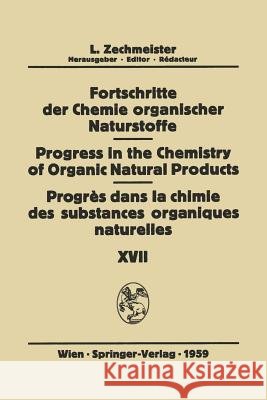
P. H. Abelson; H. Barkemeyer; K. Bernauer
Fortschritte Der Chemie Organischer Naturstoffe / Progress in the Chemistry of Organic Natural Products / Progrès Dans La Chimie Des Substances Organi Abelson, P. H. 9783709180549 Springer - książkaWidoczna okładka, to zdjęcie poglądowe, a rzeczywista szata graficzna może różnić się od prezentowanej.

Fortschritte Der Chemie Organischer Naturstoffe / Progress in the Chemistry of Organic Natural Products / Progrès Dans La Chimie Des Substances Organi

ISBN-13: 9783709180549 / Angielski / Miękka / 2012 / 528 str.

P. H. Abelson; H. Barkemeyer; K. Bernauer
cena 202,19
(netto: 192,56 VAT:  5%)

Najniższa cena z 30 dni: 192,74
Termin realizacji zamówienia:
ok. 16-18 dni roboczych.

Darmowa dostawa!

Als Bitterstoffe bezeichnet man bitter schmeckende, N- und S-freie, O-haltige Substanzen, die noch nicht in andere groBe Verbindungsklassen, wie Alkaloide, Farbstoffe, Sterine usw. , eingegliedert sind. Bis heute ist es nicht gelungen, eine Beziehung zwischen dem bitteren Geschmack und der chemischen Konstitution zu entdecken (75). Wenn auch viele Bitterstoffe Keton- oder Lactongruppierungen enthalten, so ist doch das Vorhandensein derartiger Gruppen zur Erregung der auf "bitter" ansprechenden Geschmackssinnes-zellen keine notwendige V oraussetzung. Das Vorkommen der Bitterstoffe ist nicht auf bestimmte Pflanzen- familien beschrankt, wenn sie auch in einigen besonders zahlreich ver- treten sind, wie z. B. in den Gentianaceen oder den Compositen. Ent- stehung oder eventuelle Aufgabe der Bitterstoffe in den Pflanzen sind vollig unbekannt. Lediglich bei den Gentianaceen sind bisher Versuche zur Lokalisierung des Bildungsortes durch 1. KORTE (9I) unternommen worden. Hier konnte sowohl durch Pfropfungsversuche wie auch durch Wurzelkulturen gezeigt werden, daB weder SproB noch Wurzel allein fur die Bitterstoffbildung verantwortlich ist. 1m allgemeinen sind die Bitterstoffe in allen Organen der Pflanzen zu finden (I37); bei den stets bitteren Gentianaceen sind die Samen bitterstoff-frei. 1m Verlauf der Vegetationsperiode kann es zu Schwankungen im Bitterstoffgehalt kommen, hieruber liegen aber ebenfalls nur wenige Untersuchungen vor (IOI). Es hat ferner in manchen Fallen den Anschein, als stiege mit zunehmendem Alter einer Pflanze auch die Bitterkeit an (75). Die Existenz der Bitterstoffe ist schon seit langer Zeit bekannt, bereits im 15. J a~rhundert werden sie in deutschen Krauterbuchern beschrieben (IIO).


Kategorie:
Nauka, Chemia
Kategorie BISAC:
Science > Chemia - Organiczna
Medical > Farmakologia
Medical > Farmacja
Wydawca:
Springer
Seria wydawnicza:
Fortschritte Der Chemie Organischer Naturstoffe Progress in
Język:
Angielski
ISBN-13:
9783709180549
Rok wydania:
2012
Wydanie:
Softcover Repri
Numer serii:
000401901
Ilość stron:
528
Waga:
0.77 kg
Wymiary:
22.9 x 15.2
Oprawa:
Miękka
Wolumenów:
01
Dodatkowe informacje:
Wydanie dwujęzyczne

/ Contents / — Table des matières.- Flavones and Isoflavones.- I. Introduction.- II. Structural Relations and Interconversions.- III. Occurrence in Plants.- Glycosides.- Hydroxylation Patterns.- IV. Isolation.- V. Color Reactions.- VI. Survey of Natural Flavones.- Flavone, 5-Hydroxyflavone and Dihydroxyflavones.- Trihydroxyflavones.- Tetrahydroxyflavones.- Pentahydroxyflavones.- Hexahydroxyflavones.- Heptahydroxyflavones.- Furanoflavones.- VII. Survey of Natural Isoflavones.- Polycyclic Compounds Containing the Isoflavone or Isoflavanone Nucleus.- VIII. Absorption Spectra of Flavones and Isoflavones.- Ultraviolet Spectra.- Infrared Spectra.- IX. Determination of the Structure of Flavones and Isoflavones.- Degradation of Isoflavones.- X. Synthesis of Flavones.- XI. Synthesis of Isoflavones.- XII. Synthesis of Flavone and Isoflavone Glycosides.- XIII. Biogenesis of Flavones and Isoflavones.- XIV. Physiological Properties of Flavones and Isoflavones.- Flavones.- Isoflavones.- XV. Tables.- 1. Visible Color and ?max of Methanolic Solutions of some Flavones after Reduction with Mg and HCl.- 2. Trihydroxyflavones and their Methyl Ethers.- 3. Tetrahydroxyflavones and their Methyl Ethers.- 4. Quercetin and its Derivatives.- 5. Pentahydroxyflavones other than Quercetin and their Methyl or Methylene Ethers.- 6. Hexahydroxyflavones and their Derivatives.- 7. Natural Isoflavones.- 8. Ultraviolet Absorption Spectra of some Naturally Occurring Flavones in Ethanol.- 9. Ultraviolet Absorption Spectra of some Naturally Occurring Isoflavones in Ethanol.- 10. Hydroxyl and Carbonyl Frequencies of some Naturally Occurring Flavonoids.- References.- Fortschritte der Chemie der Vitamine D und ihrer Abkömmlinge.- I. Konstitution der Vitamine D und ihrer Abkömmlinge.- 1. Vitamine D.- 2. 5,6-trans-Vitamine D.- 3. iso-Vitamine D.- 4. Praecalciferole.- 5. Tachysterine.- 6. iso-Tachysterine.- 7. u-Tachysterin.- 8. Pyrotachysterin(e).- 9. Suprasterine.- 10. Dihydro-Verbindungen.- 11. C(3)-Ketone.- II. Neue Abbauprodukte der Vitamine D.- 1. Die stereoisomeren 5,6-Dihydroxy-Vitamine D3.- 2. Die trans-C,D-Abbau-alkohole.- 3. Die Seitenketten-alkohole.- 4. Seitenketten-acetoxy-aldehyde.- 5. Das 8-Methyl-trans-hydrindanol-(4)-on-(1) und die 8-Methyl-hydrindandione.- III. Photochemische Isomerisierung.- IV. Thermische Isomerisierung.- V. Chemische Isomerisierung.- VI. Ergebnisse von Baron, Le Boulch und Raoul.- VII. Verschiedene Verbindungen.- 1. Ätio-Analoga der Praecalciferole und der Vitamine D.- 2. Vitamin D-homologe Verbindung.- 3. Strukturisomere Vitamin D-Verbindung.- 4. 9,10-seco-D-Homo-Steroid-Verbindung.- 5. Vitamin Dm.- VIII. Partialsynthesen.- 1. 3-Desoxy-14?-praecalciferol2.- 2. iso-Vitamin D2-methyläther-C(3)-Epimerengemisch und iso-Tachysterin-methyläther-C(3)-Epimerengemisch.- 3. 3-Desoxy-iso-tachysterine.- 4. 6,7-cis-iso-Tachysterin2-methyläther-C(3)-Epimerengemisch.- IX. Totalsynthese des Vitamins D3.- 1. Das Hydrindansystem.- 2. Die Seitenkette.- 3. Trienchromophor, Epimeren-trennung, trans ? cis-Isomerisierung.- Neuere Ergebnisse der Chemie pflanzlicher Bitterstoffe.- I. Einleitung.- Der bittere Geschmack und die Bestimmung des Bitterwertes.- Therapeutische Verwendung der Bitterstoffe.- Wirtschaftliche Bedeutung der Bitterstoffe.- II. Bitterstoffe der Gentianaceen.- 1. Gentiopikrin.- 2. Amarogentin.- 3. Loganin.- III. Bitterstoffe der Asclepiadaceen.- 1. Kondurangin.- 2. Vincetoxin.- IV. Bitterstoffe der Compositen.- 1. Absinthin und Anabsinthin.- 2. Cnicin.- 3. Lactucin und Lactucopikrin.- 4. Tenulin.- 5. Helenalin.- 6. Alantolactone.- V. Bitterstoffe der Menispermaceen.- 1. Columbin.- 2. Picrotoxinin (Picrotoxin).- VI. Bitterstoffe der Coriariaceen.- Tutin und Coriamyrtin.- VII. Bitterstoffe der Urticaceen.- Hopfenbitterstoffe: Humulon, Lupulon, Humulinon.- VIII. Bitterstoffe der Labiaten.- Marrubiin.- IX. Bitterstoffe der Apocynaceen.- Plumierid.- X. Tabellen.- Alkaloide aus Calebassencurare und südamerikanischen Strychnosarten.- I. Einleitung.- II. Die Entwicklung der Chemie der Calebassen-Alkaloide.- III. Die Auftrennung des Calebassencurare in Einzelalkaloide.- IV. Die Alkaloide südamerikanischer Strychnosarten.- 1. Übersicht.- 2. Die Alkaloide aus Strychnos toxifera.- 3. Die Alkaloide aus Str. melinoniana Baillon.- 4. Die Alkaloide aus Str. amazonica Kruk., Str. macrophylla und Str. guianensis (Aubl.) Mart.- 5. Diabolin und Desacetyl-diabolin aus Str. diaboli Sandw.- V. Die Elektronenspektren der Alkaloide aus Calebassencurare und südamerikanischen Strychnosarten.- VI. Konstitution von Calebassen- und südamerikanischen Strychnos-Alkaloiden.- Vorbemerkung.- A. Alkaloide vom Yohimbin-Typus.- 1. Übersicht.- 2. C-Mavacurin, C-Alkaloid-Y und C-Fluorocurin.- 3. Lochnerin und Lochneram.- 4. Melinonin-A.- 5. Melinonin-B.- 6. Melinonin-E.- 7. Melinonin-G.- B. Alkaloide vom Strychnin-Typus.- 1. Übersicht.- 2. C-Fluorocurarin.- 3. C-Dihydrotoxiferin.- 4. C-Toxiferin-I und Caracurin-V.- 5. C-Curarin-I.- 6. C-Calebassin.- 7. Experimentelle Verknüpfung und Systematik der Alkaloide vom Strychnin-Typus.- VII. Zur Biogenese der Alkaloide aus Calebassencurare und südamerikanischen Strychnosarten.- VIII. Zur Pharmakologie der Alkaloide aus Calebassencurare und südamerikanischen Strychnosarten.- 1. Allgemeines.- 2. Der Maustest.- 3. Curare-Wirkung und Nebenwirkungen.- 4. Resorption, Verteilung und Ausscheidung von Calebassen-Alkaloiden.- 5. Nachweis der Fixierung des C-Curarins-I an den motorischen Endplatten.- 6. Konstitution und Curare-Wirksamkeit.- IX. Tabellen.- 1. Alkaloide aus Calebassencurare.- 2. Strychnosarten, die Calebassen-Alkaloide führen.- 3. Aus südamerikanischen Strychnosarten isolierte Alkaloide.- 4. Calebassen- und Strychnos-Alkaloide nach UV-Spektren geordnet.- 5. Natürliche Alkaloide vom Strychnin-Typus.- Occurrence and Metabolism of Simple Indoles in Plants.- I. Volatile Indoles.- 1. Indole.- 2. Skatole (3-Methylindole).- II. Tryptophan and its Derivatives.- 1. L-Tryptophan [2-Amino-3-(3-indole)-propionic Acid].- 2. L-Abrine (Amino-N-methyltryptophan).- 3. L-Hypaphorine (Tryptophan Betaine).- 4. Malonyl-tryptophan.- III. Indole Bases and Some Related Compounds.- 1. Gramine [3-(Dimethylaminomethyl)-indole].- 2. Tryptamine [3-(2-Aminoethyl)-indole].- 3. Amino-N-methyltryptamine.- 4. Amino-N,N-dimethyltryptamine and its N-Oxide.- 5. 5-Hydroxytryptamine [3-(2-Aminoethyl)-5-indolol].- 6. 5-Methoxy - amino - N - methyl - tryptamine [3-(2-Methylaminoethyl)-5-methoxyindole].- 7. Bufotenine [3-(2-Dimethylaminoethyl)-5-indolol] and its N-Oxide.- 8. 5-Hydroxy-3-indoleacetic Acid.- IV. Potential Precursors of 3-Indoleacetic Acid.- 1. 3-Indoleacetaldehyde.- 2. 3-Indoleacetonitrile.- 3. 3-Indolepyruvic Acid.- 4. Ascorbigen.- V. 3-Indoleacetic Acid.- VI. Products Formed from 3-Indoleacetic Acid.- 1. 3-Indolealdehyde.- 2. Ethyl 3-Indoleacetate.- 3. 3-Indoleacetamide.- 4. 3-Indoleacetylaspartic Acid.- VII. Some Other Indoles.- 1. 3-Indolecarboxylic Acid.- 2. 3-Indoleglycolic Acid.- 3. Indican.- References.- Some Biochemical Aspects of Disease in Plants.- I. Introduction.- II. Abnormal Growth in Plant Disease.- 1. Ethylene Production and its Effects.- 2. Gibberellin.- 3. Crown Gall Induction.- III. Abnormal Metabolic Pathways in Disease.- IV. Abnormal Water Economy.- 1. Lycomarasmin.- 2. Fusaric Acid.- 3. Pectic Enzymes.- V. Conclusion.- References.- The Chemical Structure of the Normal Human Hemoglobins.- I. Introduction.- II. Nomenclature.- III. The Hemoglobin Molecule as a Whole.- 1. Iron Content.- 2. The Molecular Weight.- 3. The Shape of the Molecule.- IV. The Prosthetic Group.- V. The Linkage Between Heme and Globin.- VI. The Normal Human Hemoglobins.- 1. The Change in the Type of Hemoglobin in the Individual Human as a Function of Age.- 2. Does an Embryonic Hemoglobin Actually Exist?.- VII. The Purity of Hemoglobin in Hemoglobin Preparations.- 1. Isolation.- 2. Effect of the Isolation Procedure on the Purity of Hemoglobin Preparations.- 3. Heterogeneity of Hemoglobin Preparations.- 4. Biological Significance of the Heterogeneity of Hemoglobin Preparations.- VIII. Chemical Investigations of Hemoglobin.- 1. Amino Acid Composition.- a) Adult Hemoglobin.- b) Fetal Hemoglobin.- c) Comparison of the Amino Acid Composition of Adult and Fetal Hemoglobin.- 2. Sulfhydryl Groups.- 3. N-Terminal Amino Acid Residues and Sequences.- a) Adult Hemoglobin.- b) Fetal Hemoglobin.- 4. C-Terminal Amino Acid Residues.- 5. Investigation of Internal Sequences.- 6. The Insoluble Residue from Tryptic Hydrolysates.- 7. The Separation of the Polypeptide Chains of Hemoglobin.- IX. Discussion and Conclusions.- 1. The Hemoglobin Molecule as a Whole.- 2. The Polypeptide Chains Themselves.- 3. Final Remarks.- References.- Paleobiochemistry and Organic Geochemistry.- Major Constituents of Living Matter.- Preservation of Organic Substances.- Organic Complexes of High Molecular Weight.- The Stability of Organic Substances.- Organic Substances in Soils and Rocks.- Amino Acids in Soils.- Peats and Coals.- Amino Acids in Sediments.- Amino Acids in Shells and Calcareous Tests.- Amino Acids in Bone.- Lipides.- Carbohydrates.- Carbohydrates in Fossils.- Porphyrins.- Precambrian Occurrences.- The Perspective.- References.- The Electron Gas Theory of the Color of Natural and Artificial Dyes: Applications and Extensions.- I. Quantum Mechanical Determination of the Position of the Absorption Bands of Simple Dyes with an Unbranched, a Ring-Shaped, or a Branched Electron Gas.- 1. A Simple Model of Vitamin B12.- 2. A Simple Electron Gas Ring Model of the Phthalocyanines and Benzoporphyrines.- 3. A Simple Model of Dyes with a Branched Electron Gas.- II. A Refined One-dimensional Model Considering Irregularities of Potential along the Chain (Wave Shape Potential Model).- 1. Qualitative Discussion of Some Quantum Mechanical Aspects of Polyenes and Symmetrical Cyanines.- 2. A Quantitative Treatment of the Light Absorption of Polyenes.- 3. Treatment of the Light Absorption of Polyacetylenes.- 4. Wave Shape Potential Model of Cyanines, Aza-cyanines and Some Other Dye Classes.- 5. A Simple Treatment of Polyenes, Polyacetylenes, and Unsymmetrical Cyanines (Sine Curve Potential Model).- III. The Two-dimensional Electron Gas Model.- IV. Intensity and Structure of Absorption Bands.- 1. Oscillator Strength of an Absorption Band.- 2. Structure of Absorption Bands.- References.- Namenverzeichnis. Index of Names. Index des Auteurs.- Sachverzeichnis. Index of Subjects. Index des Matières.


Udostępnij

Facebook - konto krainaksiazek.pl


Opinie o Krainaksiazek.pl na Opineo.pl

Partner Mybenefit

Krainaksiazek.pl w programie rzetelna firma Krainaksiaze.pl - płatności przez paypal

Czytaj nas na:

Facebook - krainaksiazek.pl
  • książki na zamówienie
  • granty
  • książka na prezent
  • kontakt
  • pomoc
  • opinie
  • regulamin
  • polityka prywatności

Zobacz:

  • Księgarnia czeska

  • Wydawnictwo Książkowe Klimaty

1997-2026 DolnySlask.com Agencja Internetowa

© 1997-2022 krainaksiazek.pl
     
KONTAKT | REGULAMIN | POLITYKA PRYWATNOŚCI | USTAWIENIA PRYWATNOŚCI
Zobacz: Księgarnia Czeska | Wydawnictwo Książkowe Klimaty | Mapa strony | Lista autorów
KrainaKsiazek.PL - Księgarnia Internetowa

Polityka prywatnosci - link
Krainaksiazek.pl - płatnośc Przelewy24
Przechowalnia Przechowalnia





