• Wyszukiwanie zaawansowane
  • Kategorie
  • Kategorie BISAC
  • Książki na zamówienie
  • Promocje
  • Granty
  • Książka na prezent
  • Opinie
  • Pomoc
  • Załóż konto
  • Zaloguj się

analysis marine » książka


zaloguj się | załóż konto
Logo Krainaksiazek.pl

koszyk

konto

szukaj
topmenu
Księgarnia internetowa
Szukaj
Książki na zamówienie
Promocje
Granty
Książka na prezent
Moje konto
Pomoc
 
 
Wyszukiwanie zaawansowane
Pusty koszyk
Bezpłatna dostawa dla zamówień powyżej 20 złBezpłatna dostawa dla zamówień powyżej 20 zł

Kategorie główne

• Nauka
 [2949524]
• Literatura piękna
 [1817948]

  więcej...
• Turystyka
 [70715]
• Informatyka
 [151291]
• Komiksy
 [35671]
• Encyklopedie
 [23176]
• Dziecięca
 [612440]
• Hobby
 [136066]
• AudioBooki
 [1740]
• Literatura faktu
 [226030]
• Muzyka CD
 [378]
• Słowniki
 [2918]
• Inne
 [445441]
• Kalendarze
 [1181]
• Podręczniki
 [166545]
• Poradniki
 [469898]
• Religia
 [508035]
• Czasopisma
 [502]
• Sport
 [61392]
• Sztuka
 [242759]
• CD, DVD, Video
 [3348]
• Technologie
 [219537]
• Zdrowie
 [98738]
• Książkowe Klimaty
 [124]
• Zabawki
 [2382]
• Puzzle, gry
 [3543]
• Literatura w języku ukraińskim
 [259]
• Art. papiernicze i szkolne
 [7107]
Kategorie szczegółowe BISAC

analysis marine

ISBN-13: 9780470044407 / Angielski / Twarda / 2007 / 456 str.
Gerald J. Bakus
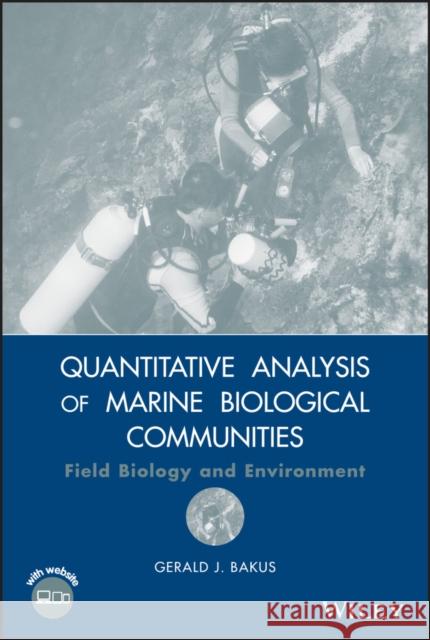
analysis marine  Bakus, Gerald J. 9780470044407 Wiley-Interscience - książkaWidoczna okładka, to zdjęcie poglądowe, a rzeczywista szata graficzna może różnić się od prezentowanej.

analysis marine

ISBN-13: 9780470044407 / Angielski / Twarda / 2007 / 456 str.

Gerald J. Bakus
cena 731,82
(netto: 696,97 VAT:  5%)

Najniższa cena z 30 dni: 722,88
Termin realizacji zamówienia:
ok. 30 dni roboczych.

Darmowa dostawa!

Quantitative methods specifically tailored for the marine biologist


While there are countless texts published on quantitative methods and many texts that cover quantitative terrestrial ecology, this text fills the need for the special quantitative problems confronting marine biologists and biological oceanographers. The author combines common quantitative techniques with recent advances in quantitative methodology and then demonstrates how these techniques can be used to study marine organisms, their behaviors, and their interactions with the environment. Readers learn how to better design experiments and sampling, employ sophisticated mathematical techniques, and accurately interpret and communicate the results.

Most of this text is written at an introductory level, with a few topics that advance to more complex themes. Among the topics covered are plot/plotless sampling, biometrics, experimental design, game theory, optimization, time trends, modeling, and environmental impact assessments.

Even readers new to quantitative methods will find the material accessible, with plenty of features to engage their interest, promote learning, and put their knowledge into practice:
* One or more examples are provided to illustrate each individual quantitative technique presented in the text
* The accompanying CD-ROM features two multimedia programs, several statistical programs, help to run complex statistical programs, and additional information amplifying topics covered in the text
* References lead readers to additional information to pursue individual topics in greater depth

Quantitative Analysis of Marine Biological Communities, with its extensive use of examples, is ideal for undergraduate and graduate students in marine biology. Marine biologists, regardless of their level of experience, will also discover new approaches to quantitative analysis tailored to the particular needs of their field.


Kategorie:
Nauka, Chemia
Kategorie BISAC:
Science > Life Sciences - Ecology
Wydawca:
Wiley-Interscience
Język:
Angielski
ISBN-13:
9780470044407
Rok wydania:
2007
Ilość stron:
456
Waga:
0.77 kg
Wymiary:
24.33 x 16.15 x 2.74
Oprawa:
Twarda
Wolumenów:
01
Dodatkowe informacje:
Bibliografia

"This book assists with this decision making process by providing an overview of a wide range of sampling and analytical methodologies used in marine biological studies, and indeed in other ecosystems". (The Geographical Journal, 1 March 2010)

"The book is most appropriate for...students" (The Quarterly Review of Biology)


Preface.

Acknowledgments.

Contributors.

1. Biological Sampling Design and Related Topics.

1.1 Profi ling Methods and Underwater Techniques.

1.1.1 Introduction.

1.1.2 Profi ling a Beach.

1.1.3 Underwater Profi les.

1.1.4 Underwater Techniques.

1.2 Sampling Populations.

1.2.1 Introduction.

1.2.2 Sampling Design.

1.2.3 Physical–Chemical Factors.

1.2.4 Timing of Sampling.

1.2.5 Size of the Sampling Area.

1.2.6 Scale.

1.2.7 Modus Operandi.

1.2.8 Sample Size or Number of Sample Units Required.

1.3 Quantitative Sampling Methods.

1.3.1 Introduction.

1.3.2 Table of Random Numbers.

1.3.3 Quadrat Shape.

1.3.4 Optimal Quadrat Size.

1.3.5 Simple Random Sampling.

1.3.6 Haphazard (Convenience, Accidental, Arbitrary) Sampling.

1.3.7 Stratifi ed Random Sampling.

1.3.8 Systematic Sampling.

1.3.9 Fixed Quadrats.

1.3.10 Point Contact (Percentage Cover).

1.3.11 Line and Belt (Strip) Transects.

1.3.12 Adaptive Sampling.

1.3.13 Sequential Sampling.

1.3.14 Rapid Sampling Methods.

1.3.15 Introduction to Plotless Sampling.

1.3.16 Best Guess or Estimation.

1.3.17 Catch or Weight Per Unit Effort (CPUE).

1.3.18 Coordinate Lines.

1.3.19 Cluster Sampling.

1.3.20 Introduction to Distance Measurements.

1.3.21 Nearest Neighbor and Point to Nearest Object.

1.3.22 Point–Center Quarter or Point Quarter Method.

1.3.23 Line Intercepts.

1.3.24 Strong Method.

1.3.25 Weinberg Method.

1.3.26 Nishiyama Method.

1.3.27 Mark (or Tag) and Recapture (Mark and Resight) Techniques.

1.3.28 Visual Methods for Fishes.

1.3.29 Narcotizing Agents and Poison Stations.

1.4 Other Methods of Estimating the Abundance of Populations.

1.4.1 Comparison of Estimated Populations with Other Methods.

1.4.2 Removal Trapping or Collecting.

1.4.3 Other Methods.

1.4.4 Large Scale Sampling.

2. Types of Data, Standardizations and Transformations, Introduction to Biometrics, Experimental Design.

2.1 Introduction.

2.2 Types of Data.

2.3 Data Standardization or Normalization (Relativization).

2.4 Data Transformation.

2.5 Statistical Distributions and Procedures.

2.6 Descriptive Statistics (Sample Statistics).

2.7 Statistics with One or Two Variables.

2.8 Experimental Design and Analysis.

2.9 Power Analysis.

2.10 Multiple Comparisons Tests.

2.11 Nonparametric Tests, Covariance, Correlation, and Regression.

2.12 Multivariate Statistics.

2.13 Ranking Analysis (Nonparametric Correlation).

2.14 Randomization Methods.

2.15 General Linear Programming.

2.16 Maximum Likelihood.

2.17 Bayesian Statistics.

2.18 How to Lie with Statistics.

3. Quantitative Methods in Field Ecology and Other Useful Techniques and Information.

A. Introduction.

3.1 Introduction.

B. Population Patterns.

3.2 Distributions (Dispersion).

3.3 Dispersal.

3.4 Home Range.

3.5 Random Walk.

3.6 Feeding Ecology.

C. Population Growth.

3.7 Size–frequency Distribution.

3.8 Growth of Individuals in a Population.

3.9 Natality.

3.10 Mortality.

3.11 Construction of Life Tables.

3.12 Population Dynamics Models.

3.13 Population Growth and Productivity.

3.14 Null Models.

D. Diversity and Related Indices.

3.15 Species Richness, Diversity, Evenness, and Dominance.

3.16 Keystone Species.

3.17 Homogeneity–Heterogeneity Indices.

3.18 Niche Breadth.

3.19 Niche Overlap.

3.20 Concordance.

E. Advanced Topics.

3.21 Game Theory.

3.22 Optimality or Optimization Models.

3.23 Transition Matrices.

3.24 Fractals.

3.25 Deterministic Chaos.

3.26 Artifi cial Neural Networks.

3.27 Expert Systems.

3.28 Digitization, Image Processing, Image Measurement, and Image Analysis or Pattern Recognition.

3.29 Multimedia Development.

3.30 Landscape Ecology.

3.31 Aquatic Ecotoxicology.

3.32 Coastal Zone Management.

3.33 Conservation and Environment.

3.34 Environmental Impact Assessments.

3.35 Analysis of DNA/RNA Sequences.

3.36 Fuzzy Logic.

3.37 Meta–Analysis.

4. Community Analyses: Similarity Dissimilarity Indices, Cluster Analysis, Dendrograms, Analysis of Similarities, Indicator Species.

4.1 Introduction.

4.2 Methods of Handling Data.

4.3 Measures of Similarity and Difference (Similarity and Dissimilarity).

4.4 Cluster Analysis.

4.5 Species–Site Groups.

4.6 Mantel Test.

4.7 Analysis of Similarities.

4.8 Indicator Species Analysis.

5. Community Analysis: Ordination and Other Multivariate Techniques.

5.1 Introduction.

5.2 Principal Component Analysis.

5.3 Factor Analysis (FA).

5.4 Redundancy Analysis.

5.5 Correspondence Analysis (CA) or Reciprocal Averaging (RA).

5.6 Detrended Correspondence Analysis (DCA or Decorana).

5.7 Nonmetric Multidimensional Scaling (MDS, NMDS, NMS, NMMDS).

5.8 MANOVA and MANCOVA.

5.9 Discriminant Analysis (DA) (Discriminant Function Analysis, Canonical Variates Analysis).

5.10 Principal Coordinate Analysis (PCoA) (Metric Multidimensional Scaling).

5.11 Canonical Correspondence Analysis (CCA).

5.12 Multiple Regression (MR) (Multiple Linear Regression).

5.13 Path Analysis.

5.14 Canonical Correlation Analysis (CANCOR).

5.15 Canonical Variate Analysis (CVA).

5.16 Multi–Response Permutation Procedures (MRPP).

5.17 Other Multivariate Techniques.

6. Time Trend Analysis.

A. Introduction.

6.1 Introduction.

B. Time Series Analysis.

6.2 Smoothing or Filtering Techniques.

6.3 Serial Correlation (Auto– and Cross–Correlation).

6.4 Autoregression.

C. Frequency Analysis.

6.5 Frequency Analysis.

7. Modeling and Systems Analysis.

7.1 Introduction.

7.2 Philosophy of Modeling.

7.3 Model Components and Model Development.

8. Marine Sampling and Measuring Devices.

8.1 Introduction.

8.2 Oceanographic Devices.

8.3 Marine Bottom Sampling Devices.

8.4 Marine Water Sampling Devices.

8.5 Sampling Plankton, Bacteria and Viruses.

8.6 Sampling Fishes.

8.7 Sampling Reptiles, Birds and Mammals.

8.8 Natural History Observations.

Appendices.

Addendum.

References.

Index.

GERALD J. BAKUS, PHD, is Professor of Biology at the University of Southern California. He has more than five decades of experience in biology and the marine sciences. In addition to his many published research and review articles, Dr. Bakus is the author of Quantitative Ecology and Marine Biology and Coral Reef Ecosystems.

Quantitative methods specifically tailored for the marine biologist

While there are countless texts published on quantitative methods and many texts that cover quantitative terrestrial ecology, this text fills the need for the special quantitative problems confronting marine biologists and biological oceanographers. The author combines common quantitative techniques with recent advances in quantitative methodology and then demonstrates how these techniques can be used to study marine organisms, their behaviors, and their interactions with the environment. Readers learn how to better design experiments and sampling, employ sophisticated mathematical techniques, and accurately interpret and communicate the results.

Most of this text is written at an introductory level, with a few topics that advance to more complex themes. Among the topics covered are plot/plotless sampling, biometrics, experimental design, game theory, optimization, time trends, modeling, and environmental impact assessments.

Even readers new to quantitative methods will find the material accessible, with plenty of features to engage their interest, promote learning, and put their knowledge into practice:

  • One or more examples are provided to illustrate each individual quantitative technique presented in the text
  • The accompanying CD–ROM features two multimedia programs, several statistical programs, help to run complex statistical programs, and additional information amplifying topics covered in the text
  • References lead readers to additional information to pursue individual topics in greater depth

Quantitative Analysis of Marine Biological Communities, with its extensive use of examples, is ideal for undergraduate and graduate students in marine biology. Marine biologists, regardless of their level of experience, will also discover new approaches to quantitative analysis tailored to the particular needs of their field.

Bakus, Gerald J. GERALD J. BAKUS, PHD, is Professor of Biology at t... więcej >


Udostępnij

Facebook - konto krainaksiazek.pl


Opinie o Krainaksiazek.pl na Opineo.pl

Partner Mybenefit

Krainaksiazek.pl w programie rzetelna firma Krainaksiaze.pl - płatności przez paypal

Czytaj nas na:

Facebook - krainaksiazek.pl
  • książki na zamówienie
  • granty
  • książka na prezent
  • kontakt
  • pomoc
  • opinie
  • regulamin
  • polityka prywatności

Zobacz:

  • Księgarnia czeska

  • Wydawnictwo Książkowe Klimaty

1997-2026 DolnySlask.com Agencja Internetowa

© 1997-2022 krainaksiazek.pl
     
KONTAKT | REGULAMIN | POLITYKA PRYWATNOŚCI | USTAWIENIA PRYWATNOŚCI
Zobacz: Księgarnia Czeska | Wydawnictwo Książkowe Klimaty | Mapa strony | Lista autorów
KrainaKsiazek.PL - Księgarnia Internetowa

Polityka prywatnosci - link
Krainaksiazek.pl - płatnośc Przelewy24
Przechowalnia Przechowalnia





