What is Information?: Propagating Organization in the Biosphere, Symbolosphere, Technosphere and Econosphere » książka





What is Information?: Propagating Organization in the Biosphere, Symbolosphere, Technosphere and Econosphere
ISBN-13: 9781608889969 / Angielski / Miękka / 2014 / 194 str.
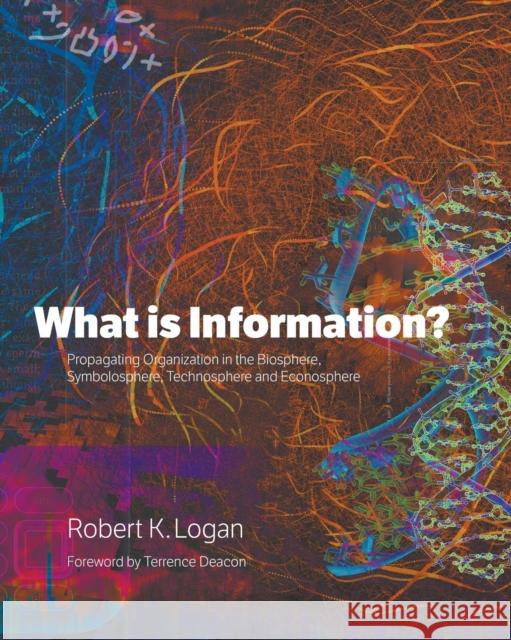
What is Information?: Propagating Organization in the Biosphere, Symbolosphere, Technosphere and Econosphere
ISBN-13: 9781608889969 / Angielski / Miękka / 2014 / 194 str.
(netto: 91,91 VAT: 5%)
Najniższa cena z 30 dni: 92,36
ok. 16-18 dni roboczych.
Darmowa dostawa!
What is information? A fitting question given the importance of information and the central role it plays in the economic and cultural life at the beginning of the 21st Century. It is said that we live in the Information Age, a claim that is hard to dispute given the ubiquity of the vast array of information technology (IT) at our disposal to generate, communicate, interpret and exploit information. We are surrounded by information thanks to computing and the digital "new media" such as the Internet, the Web, blogs, email, instant messaging, text messaging, cell phones, VOIP, Web cams, iPods, Blackberries, iPhones, virtual reality, virtual worlds, RFID or smart tags, nanotechnology and ubiquitous computing. The irony of our total immersion in information and the central role it plays in our economic, social and cultural life is that for the most part we do not really have a clear understanding of exactly what information is. Information is not a simple straightforward concept but rather it is a very slippery notion used in many different ways and in many different contexts. Linguistically and grammatically the word information is a noun but in actuality it is a process and hence is like a verb. A consideration of the concept of information gives rise to a number of interesting questions, which we will explore in this study. Is there only one form of information or are there several kinds of information? In other words is information an invariant or a universal independent of its frame of reference or is it context dependent? What is the relationship of information to meaning, communication and organization? Is information a thing like a noun or a process like a verb? Is information material, a form of energy or is it just a pattern? Is information a uniquely human phenomenon or do non-human forms of life contain information also? What is the role of information in the propagation of life? What is the relationship of information to energy and entropy? What is the relationship of information to science? What is the relationship of information to media? Does information or the processing of information play a role in the creative arts? These are some of the questions we will address in this book as we try to flesh out our understanding of exactly what it is that we call information. We will consider the historic development of the concept of information to get a handle on the exact meaning of this thing or process that defines our age and is also the engine of economic growth. We trace the development of the concept of information from the earliest uses of the word to the beginning of information theory, as formulated by Shannon and Weaver. By information theory we mean the "branch of mathematics that overlaps into communications engineering, biology, medical science, sociology, and psychology. The theory is devoted to the discovery and exploration of mathematical laws that govern the behavior of data as it is transferred, stored, or retrieved" (Searchnetworking.com 2002). We will also study the role of information in the four spheres of influence on human life, namely, the biosphere of living organisms, the symbolosphere, which consists of language, the human mind and all the products of the mind including culture; the technosphere of technology, and the econosphere of economics and government.
What is information? A fitting question given the importance of information and the central role it plays in the economic and cultural life at the beginning of the 21st Century. It is said that we live in the Information Age, a claim that is hard to dispute given the ubiquity of the vast array of information technology (IT) at our disposal to generate, communicate, interpret and exploit information. We are surrounded by information thanks to computing and the digital "new media" such as the Internet, the Web, blogs, email, instant messaging, text messaging, cell phones, VOIP, Web cams, iPods, Blackberries, iPhones, virtual reality, virtual worlds, RFID or smart tags, nanotechnology and ubiquitous computing.The irony of our total immersion in information and the central role it plays in our economic, social and cultural life is that for the most part we do not really have a clear understanding of exactly what information is. Information is not a simple straightforward concept but rather it is a very slippery notion used in many different ways and in many different contexts. Linguistically and grammatically the word information is a noun but in actuality it is a process and hence is like a verb. A consideration of the concept of information gives rise to a number of interesting questions, which we will explore in this study. Is there only one form of information or are there several kinds of information? In other words is information an invariant or a universal independent of its frame of reference or is it context dependent? What is the relationship of information to meaning, communication and organization? Is information a thing like a noun or a process like a verb? Is information material, a form of energy or is it just a pattern? Is information a uniquely human phenomenon or do non-human forms of life contain information also? What is the role of information in the propagation of life?What is the relationship of information to energy and entropy?What is the relationship of information to science?What is the relationship of information to media?Does information or the processing of information play a role in the creative arts?These are some of the questions we will address in this book as we try to flesh out our understanding of exactly what it is that we call information. We will consider the historic development of the concept of information to get a handle on the exact meaning of this thing or process that defines our age and is also the engine of economic growth. We trace the development of the concept of information from the earliest uses of the word to the beginning of information theory, as formulated by Shannon and Weaver. By information theory we mean the "branch of mathematics that overlaps into communications engineering, biology, medical science, sociology, and psychology. The theory is devoted to the discovery and exploration of mathematical laws that govern the behavior of data as it is transferred, stored, or retrieved" (Searchnetworking.com 2002). We will also study the role of information in the four spheres of influence on human life, namely, the biosphere of living organisms, the symbolosphere, which consists of language, the human mind and all the products of the mind including culture; the technosphere of technology, and the econosphere of economics and government.




Czytaj nas na:
KrainaKsiazek.PL - Księgarnia Internetowa


