• Wyszukiwanie zaawansowane
  • Kategorie
  • Kategorie BISAC
  • Książki na zamówienie
  • Promocje
  • Granty
  • Książka na prezent
  • Opinie
  • Pomoc
  • Załóż konto
  • Zaloguj się

Vision and Navigation: The Carnegie Mellon Navlab » książka


zaloguj się | załóż konto
Logo Krainaksiazek.pl

koszyk

konto

szukaj
topmenu
Księgarnia internetowa
Szukaj
Książki na zamówienie
Promocje
Granty
Książka na prezent
Moje konto
Pomoc
 
 
Wyszukiwanie zaawansowane
Pusty koszyk
Bezpłatna dostawa dla zamówień powyżej 20 złBezpłatna dostawa dla zamówień powyżej 20 zł

Kategorie główne

• Nauka
 [2949965]
• Literatura piękna
 [1857847]

  więcej...
• Turystyka
 [70818]
• Informatyka
 [151303]
• Komiksy
 [35733]
• Encyklopedie
 [23180]
• Dziecięca
 [617748]
• Hobby
 [139972]
• AudioBooki
 [1650]
• Literatura faktu
 [228361]
• Muzyka CD
 [398]
• Słowniki
 [2862]
• Inne
 [444732]
• Kalendarze
 [1620]
• Podręczniki
 [167233]
• Poradniki
 [482388]
• Religia
 [509867]
• Czasopisma
 [533]
• Sport
 [61361]
• Sztuka
 [243125]
• CD, DVD, Video
 [3451]
• Technologie
 [219309]
• Zdrowie
 [101347]
• Książkowe Klimaty
 [123]
• Zabawki
 [2362]
• Puzzle, gry
 [3791]
• Literatura w języku ukraińskim
 [253]
• Art. papiernicze i szkolne
 [7933]
Kategorie szczegółowe BISAC

Vision and Navigation: The Carnegie Mellon Navlab

ISBN-13: 9780792390688 / Angielski / Twarda / 1990 / 370 str.
Charles E. Thorpe
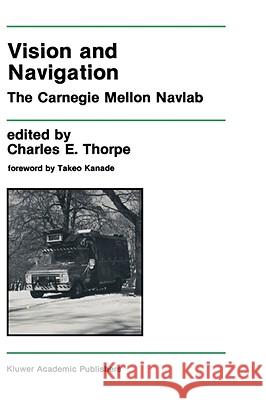
Vision and Navigation: The Carnegie Mellon Navlab Thorpe, Charles E. 9780792390688 Kluwer Academic Publishers - książkaWidoczna okładka, to zdjęcie poglądowe, a rzeczywista szata graficzna może różnić się od prezentowanej.

Vision and Navigation: The Carnegie Mellon Navlab

ISBN-13: 9780792390688 / Angielski / Twarda / 1990 / 370 str.

Charles E. Thorpe
cena 806,99 zł
(netto: 768,56 VAT:  5%)

Najniższa cena z 30 dni: 771,08 zł
Termin realizacji zamówienia:
ok. 22 dni roboczych
Bez gwarancji dostawy przed świętami

Darmowa dostawa!

Mobile robots are playing an increasingly important role in our world. Remotely operated vehicles are in everyday use for hazardous tasks such as charting and cleaning up hazardous waste spills, construction work of tunnels and high rise buildings, and underwater inspection of oil drilling platforms in the ocean. A whole host of further applications, however, beckons robots capable of autonomous operation without or with very little intervention of human operators. Such robots of the future will explore distant planets, map the ocean floor, study the flow of pollutants and carbon dioxide through our atmosphere and oceans, work in underground mines, and perform other jobs we cannot even imagine; perhaps even drive our cars and walk our dogs. The biggest technical obstacles to building mobile robots are vision and navigation-enabling a robot to see the world around it, to plan and follow a safe path through its environment, and to execute its tasks. At the Carnegie Mellon Robotics Institute, we are studying those problems both in isolation and by building complete systems. Since 1980, we have developed a series of small indoor mobile robots, some experimental, and others for practical applicationr Our outdoor autonomous mobile robot research started in 1984, navigating through the campus sidewalk network using a small outdoor vehicle called the Terregator. In 1985, with the advent of DARPA's Autonomous Land Vehicle Project, we constructed a computer controlled van with onboard sensors and researchers. In the fall of 1987, we began the development of a six-legged Planetary Rover.


Kategorie:
Technologie
Kategorie BISAC:
Technology & Engineering > Robotics
Technology & Engineering > Electrical
Technology & Engineering > Automation
Wydawca:
Kluwer Academic Publishers
Seria wydawnicza:
Theory and Decision Library
Język:
Angielski
ISBN-13:
9780792390688
Rok wydania:
1990
Wydanie:
1990
Numer serii:
000051475
Ilość stron:
370
Waga:
1.59 kg
Wymiary:
23.4 x 15.6
Oprawa:
Twarda
Wolumenów:
01

1. Introduction.- 1.1. Mobile Robots.- 1.2. Overview.- 1.3. Acknowledgments.- 2. Color Vision for Road Following.- 2.1. Introduction.- 2.2. SCARF.- 2.2.1. Two Camera System.- 2.2.2 Classifier.- 2.2.3. Interpretation.- 2.2.4. Model Formation.- 2.2.5. WARP Implementation.- 2.2.6. Discussion.- 2.3. UNSCARF.- 2.3.1. Unsupervised Classification Segmentation.- 2.3.2. Interpretation.- 2.3.3. Discussion and Future Work.- 2.4. Results and Conclusions.- 2.5. References.- 3. Explicit Models for Robot Road Following.- 3.1 Implicit Models Considered Harmful.- 3.2 Systems, Models, and Assumptions.- 3.2.1 SCARF: Color Classification.- 3.2.2 Maryland.- 3.2.3 VITS.- 3.2.4 Dickmanns and Grafe.- 3.3 FERMI.- 3.3.1 Explicit Models.- 3.3.2 Trackers.- 3.3.3 Tracker Fusion.- 3.3.4 Interpretations.- 3.3.5 Current Status.- 3.4 References.- 4. An Approach to Knowledge-Based Interpretation of Outdoor Natural Color Road Scenes.- 4.1. Abstract.- 4.2. Introduction.- 4.3. Related Work.- 4.4. Adjustable Explicit Scene Models and the Interpretation Cycle.- 4.4.1. Adjustable Explicit Scene Models.- 4.4.2. Interpretation Cycle.- 4.5. System Overview.- 4.6. Results of the Road Scene Interpretation.- 4.7. The Road Scene Interpretation System in Detail.- 4.7.1. Feature Extraction and Intermediate Representation.- 4.7.2. Initial Hypothesis Generation.- 4.7.3. Context Control.- 4.7.4. Evaluation.- 4.7.5. Modeling.- 4.7.6. Extrapolation.- 4.7.7. Road Map Generation.- 4.7.8. System Analysis.- 4.8. Future Work.- 4.8.1. Inexhaustive Region Segmentation for a High-level Interpreter.- 4.8.2. Adaptive Data Abstraction.- 4.9. Conclusion.- 4.10. Acknowledgement.- 4.11. References.- 5. Neural Network Based Autonomous Navigation.- 5.1. Introduction.- 5.2. Network Architecture.- 5.3. Training And Performance.- 5.4. Network Representation.- 5.5. Discussion And Extensions.- 5.6. Conclusion.- 5.7. References.- 6. Car Recognition for the CMU Navlab.- 6.1 Introduction.- 6.1.1 The function of object recognition in autonomous navigation.- 6.1.2 Choice of domain.- 6.1.3 The goals and state of the research.- 6.2 Related work.- 6.3 The LASSIE object recognition program.- 6.3.1 Overview.- 6.3.2 Description of the segmentation and grouping stages.- 6.3.3 Feature-fetchers and the search for initial matches.- 6.3.4 Verification of initial matches.- 6.4 Results.- 6.5 Directions for future work.- 6.6 Summary.- 6.7 References.- 7. Building and Navigating Maps of Road Scenes Using Active Range and Reflectance Data.- 7.1. Introduction.- 7.2. Following roads using active reflectance images.- 7.3. Building maps from range and reflectance images.- 7.4. Map-based road following.- 7.5. Conclusion.- 7.6. References.- 8. 3-D Vision Techniques for Autonomous Vehicles.- 8.1. Introduction.- 8.2. Active range and reflectance sensing.- 8.2.1. From range pixels to points in space.- 8.2.2. Reflectance images.- 8.2.3. Resolution and noise.- 8.3. Terrain representations.- 8.3.1. The elevation map as the data structure for terrain representation.- 8.3.2. Terrain representations and path planners.- 8.3.3. Low resolution: Obstacle map.- 8.3.4. Medium resolution: Polygonal terrain map.- 8.3.5. High resolution: Elevation maps for rough terrain.- 8.4. Combining multiple terrain maps.- 8.4.1. The terrain matching problem: iconic vs. feature-based.- 8.4.2. Feature-based matching.- 8.4.3. Iconic matching from elevation maps.- 8.5. Combining range and intensity data.- 8.5.1. The geometry of video cameras.- 8.5.2. The registration problem.- 8.5.3. Application to outdoor scene analysis.- 8.6. Conclusion.- 8.7. References.- 9. The CODGER System for Mobile Robot Navigation.- 9.1 Introduction.- 9.2 Overview of the CODGER System.- 9.3 Data Storage and Transfer.- 9.3.1 Database Tokens.- 9.3.2 Synchronization Primitives.- 9.4 Geometric Representation and Reasoning.- 9.4.1 Geometric Data and Indexing.- 9.4.2 Frames and Frame Generators.- 9.4.3 Geometric Consistency and AffIxment Groups.- 9.5 Conclusions.- 9.6 References.- 10. The Driving Pipeline: A Driving Control Scheme for Mobile Robots.- 10.1 Introduction.- 10.2 Processing Steps and Driving Unit.- 10.2.1 Prediction and the Driving Unit.- 10.2.2 Perception and Driving Unit.- 10.2.3 Environment Modeling and the Driving Unit.- 10.2.4 Local Path Planning and the Driving Unit.- 10.2.5 Vehicle Control and the Driving Unit.- 10.3 Continuous Motion, Adaptive Control, and the Driving Pipeline.- 10.3.1 Pipelined Execution for Continuous Motion.- 10.3.2 Execution Intervals of the Driving Pipeline.- 10.3.3 Parallelism in the Driving Pipeline.- 10.3.4 Vehicle Speed and Driving Pipeline.- 10.4 The Driving Pipeline in Action: Experimental Results.- 10.4.1 Implementing the Driving Pipeline.- 10.4.2 Processing Steps and Driving Units.- 10.4.3 Pipeline Execution and Parallelism.- 10.4.4 Execution Intervals.- 10.4.5 Vehicle Speed.- 10.4.6 Sensor Aiming.- 10.5 Conclusion.- 10.6 References.- 11. Multi-Resolution Constraint Modeling for Mobile Robot Planning.- 11.1 Introduction.- 11.2 The Local Navigation Problem.- 11.2.1 Goal satisfaction.- 11.2.2 Environmental admissibility.- 11.2.3 Kinematic constraints.- 11.2.4 Uncertainty in path execution.- 11.3 Finding Trajectories.- 11.3.1 Searching the constraint space.- 11.3.2 Testing subspaces for constraint satisfaction.- 11.4 Experiments.- 11.5 Conclusions.- 11.6 Acknowledgements.- 11.7 References.- 12. Navlab: An Autonomous Navigation Testbed.- 12.1 Introduction.- 12.2 Controller.- 12.2.1 System Architecture.- 12.2.2 Virtual Vehicle.- 12.2.3 Motion Control.- 12.3 Vehicle Shell.- 12.3.1 Exterior Design.- 12.3.2 Interior Design.- 12.4 Locomotion.- 12.4.1 Steering.- 12.4.2 Drive.- 12.5 Electrical System.- 12.5.1 AC Power.- 12.6 Telemetry.- 12.7 Perceptive Sensing and Computing.- 12.7.1 Video.- 12.7.2 Laser Ranging.- 12.7.3 Computing Configuration for Sensing.- 12.8 Conclusion.- 13. Vehicle and Path Models for Autonomous Navigation.- 13.1 Introduction.- 13.2 Vehicle Representation.- 13.2.1 Vehicle Kinematics.- 13.2.2 Vehicle Dynamics.- 13.2.3 Systemic Effects.- 13.3 Path Representation.- 13.4 Path Tracking.- 13.4.1 Feedback Control.- 13.4.2 Feedforward Control.- 13.4.3 Speed Control.- 13.5 Results.- 13.6 Conclusions.- 13.7 References.- 14. The Warp Machine on Navlab.- 14.1 Introduction.- 14.2 History of the Warp Machine on Navlab.- 14.3 FIDO.- 14.3.1 FIDO Algorithm.- 14.3.2 Implementation of FIDO on Warp.- 14.3.3 Performance of the Vision Modules.- 14.4 SCARF.- 14.4.1 SCARF Algorithm.- 14.4.2 Implementation of SCARF on the Warp Machine.- 14.4.3 Performance of SCARF Implementations.- 14.5 ALVINN.- 14.6 Evaluation of the Warp Machine on Navlab.- 14.6.1 Warp Hardware.- 14.6.2 Warp Software.- 14.7 Conclusions.- 14.8 References.- 15. Outdoor Visual Navigation for Autonomous Robots.- 15.1 Introduction.- 15.2 Example Systems.- 15.2.1 Navlab Controller and Architecture.- 15.2.2 Autonomous Mail Vehicle.- 15.2.3 Generic Cross-Country Vehicle.- 15.2.4 Planetary Exploration by Walking Robot.- 15.3 Discussion and Conclusions.- 15.4 Acknowledgements.- 15.5 References.


Udostępnij

Facebook - konto krainaksiazek.pl


Opinie o Krainaksiazek.pl na Opineo.pl

Partner Mybenefit

Krainaksiazek.pl w programie rzetelna firma Krainaksiaze.pl - płatności przez paypal

Czytaj nas na:

Facebook - krainaksiazek.pl
  • książki na zamówienie
  • granty
  • książka na prezent
  • kontakt
  • pomoc
  • opinie
  • regulamin
  • polityka prywatności

Zobacz:

  • Księgarnia czeska

  • Wydawnictwo Książkowe Klimaty

1997-2025 DolnySlask.com Agencja Internetowa

© 1997-2022 krainaksiazek.pl
     
KONTAKT | REGULAMIN | POLITYKA PRYWATNOŚCI | USTAWIENIA PRYWATNOŚCI
Zobacz: Księgarnia Czeska | Wydawnictwo Książkowe Klimaty | Mapa strony | Lista autorów
KrainaKsiazek.PL - Księgarnia Internetowa

Polityka prywatnosci - link
Krainaksiazek.pl - płatnośc Przelewy24
Przechowalnia Przechowalnia





