Chapter One: History, definition and current state of V2G
- V2G as a Concept
o Defining what is and isn’t V2G
- History of V2G
- The technology of V2G
- Actors and Roles of V2G
- Current Global Status of V2G
Chapter Two: Potential of V2G implementation
- Summarizing the benefits of V2G
o Economic revenues
o Technical superiority to other forms storage
o Ancillary services, grid efficiency
o Renewable energy integration
o Microgrid, emergency backup, vehicle-to-home
o Vehicle-to-X
- From fleets to individuals
- Interactions with super and smart grids
- Conceptualizing future of V2G
Chapter Three: Technical Challenges to V2G
- Battery Degradation
- Charger efficiency
- Standards:
o Network standards
o Communication standard (ISO 15118)
- Scaling up aggregation
- V2G & the evolution of the energy system
o Digitalization and big data
o Privacy, security and safety concerns
o Democracy and transparency
Chapter Four: Economic and business challenges to V2G
- Costs and revenue
o Decreasing the additional cost of V2G
Bidirectional chargers
Increasing communication capacity
o Double Taxation
o Moving beyond the low-hanging markets: across markets and across regions
- Business models
o Pricing and revenue models
o Ownership structure: Aggregators and other actors
o Defining the evolving market: Integration with other technologies
Chapter Five: Political and Regulatory Challenges to V2G
- Regulation:
o Decision-makers and actors interaction
o Market regulations
Developing and defining the storage market
Net metering
Taxation regulations
- Policy support
o Support for EVs
o Political support for storage markets
Competing storage notions/visions
Authorizing and galvanizing TSO/DSO projects
Pilot Projects and Niche Development
Chapter Six: Society and V2G
- Consumer Perspectives of V2G
o Consumer knowledge and awareness
o Fear of Battery Degradation
o Consumer Acceptance - Reliability & Range Anxiety
- Conceptualizing the Consumer in V2G
o Diffusion Studies
o Sociotechnical Transitions
o Science & Technology Studies
- Strategies to increase consumer knowledge and acceptance
o Tinkering
o Economic value transfers
o Information and Education
o Experience
- Major social research gaps:
o User behavior
o Carbon & Health Impacts of V2G
o Vision and narratives
o Social justice
o Gender Norms
o Urban resilience & disaster/emergency capacity
Chapter Seven: Deployment Pathways and Policy Recommendations
- General flexible storage policies
- Policies specific to V2G – Pilot projects, chargers, standards
- V2G Roadmap for a generalized country
- V2G policies beyond countries? (e.g. international standardization)
Chapter Eight: Realizing a V2G Future
- Key themes
- V2G in the context of energy transitions
- Further research
Lance Noel is a postdoctoral researcher at Aarhus University, Denmark, where he is lead researcher on a $1.6 million grant on the sociotechnical benefits and barriers of electric vehicles and vehicle-to-grid in the Nordic region.
Gerardo Zarazua de Rubens is a doctoral fellow at Aarhus University, Denmark, working on energy and transport systems, data analytics and business development. His recent focus has been on Electric Vehicle and Vehicle-to-Grid implementation in Europe.
Johannes Kester is a postdoctoral researcher at Aarhus University, Denmark, working on sociotechnical transformations in electricity and alternative transport systems, energy policy, and the role of security in these transformations.
Benjamin K. Sovacool is Professor of Energy Policy at the School of Business, Management, and Economics, University of Sussex, UK. He is also Director of the Center for Energy Technologies and Professor of Business and Social Sciences in the Department of Business Development and Technology at Aarhus University in Denmark.
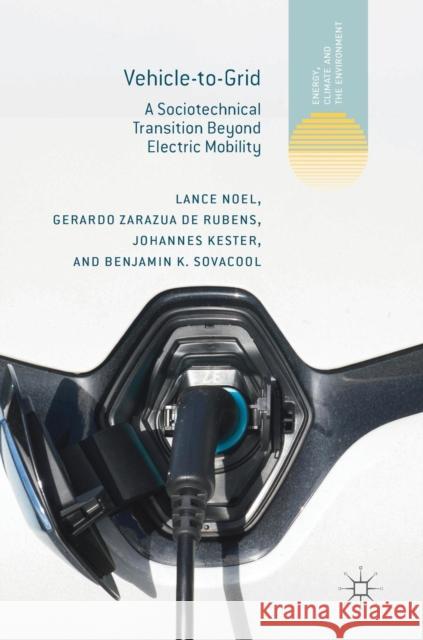
This book defines and charts the barriers and future of vehicle-to-grid technology: a technology that could dramatically reduce emissions, create revenue, and accelerate the adoption of battery electric cars. This technology connects the electric power grid and the transportation system in ways that will enable electric vehicles to store renewable energy and offer valuable services to the electricity grid and its markets. To understand the complex features of this emergent technology, the authors explore the current status and prospect of vehicle-to-grid, and detail the sociotechnical barriers that may impede its fruitful deployment. The book concludes with a policy roadmap to advise decision-makers on how to optimally implement vehicle-to-grid and capture its benefits to society while attempting to avoid the impediments discussed earlier in the book.
Lance Noel is a postdoctoral researcher at Aarhus University, Denmark, where he is lead researcher on a $1.6 million grant on the sociotechnical benefits and barriers of electric vehicles and vehicle-to-grid in the Nordic region.
Gerardo Zarazua de Rubens is a doctoral fellow at Aarhus University, Denmark, working on energy and transport systems, data analytics and business development. His recent focus has been on Electric Vehicle and Vehicle-to-Grid implementation in Europe.
Johannes Kester is a postdoctoral researcher at Aarhus University, Denmark, working on sociotechnical transformations in electricity and alternative transport systems, energy policy, and the role of security in these transformations.
Benjamin K. Sovacool is Professor of Energy Policy at the School of Business, Management, and Economics, University of Sussex, UK. He is also Director of the Center for Energy Technologies and Professor of Business and Social Sciences in the Department of Business Development and Technology at Aarhus University in Denmark.