• Wyszukiwanie zaawansowane
  • Kategorie
  • Kategorie BISAC
  • Książki na zamówienie
  • Promocje
  • Granty
  • Książka na prezent
  • Opinie
  • Pomoc
  • Załóż konto
  • Zaloguj się

Universal Theory of Automata » książka


zaloguj się | załóż konto
Logo Krainaksiazek.pl

koszyk

konto

szukaj
topmenu
Księgarnia internetowa
Szukaj
Książki na zamówienie
Promocje
Granty
Książka na prezent
Moje konto
Pomoc
 
 
Wyszukiwanie zaawansowane
Pusty koszyk
Bezpłatna dostawa dla zamówień powyżej 20 złBezpłatna dostawa dla zamówień powyżej 20 zł

Kategorie główne

• Nauka
 [2949965]
• Literatura piękna
 [1857847]

  więcej...
• Turystyka
 [70818]
• Informatyka
 [151303]
• Komiksy
 [35733]
• Encyklopedie
 [23180]
• Dziecięca
 [617748]
• Hobby
 [139972]
• AudioBooki
 [1650]
• Literatura faktu
 [228361]
• Muzyka CD
 [398]
• Słowniki
 [2862]
• Inne
 [444732]
• Kalendarze
 [1620]
• Podręczniki
 [167233]
• Poradniki
 [482388]
• Religia
 [509867]
• Czasopisma
 [533]
• Sport
 [61361]
• Sztuka
 [243125]
• CD, DVD, Video
 [3451]
• Technologie
 [219309]
• Zdrowie
 [101347]
• Książkowe Klimaty
 [123]
• Zabawki
 [2362]
• Puzzle, gry
 [3791]
• Literatura w języku ukraińskim
 [253]
• Art. papiernicze i szkolne
 [7933]
Kategorie szczegółowe BISAC

Universal Theory of Automata

ISBN-13: 9783519020547 / Niemiecki / Miękka / 1974 / 240 str.
H. Ehrig;K. -D Kiermeier;H. -J Kreowski
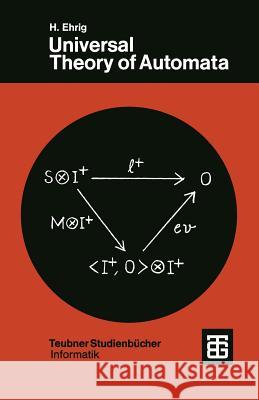
Universal Theory of Automata Ehrig, H. 9783519020547 Springer - książkaWidoczna okładka, to zdjęcie poglądowe, a rzeczywista szata graficzna może różnić się od prezentowanej.

Universal Theory of Automata

ISBN-13: 9783519020547 / Niemiecki / Miękka / 1974 / 240 str.

H. Ehrig;K. -D Kiermeier;H. -J Kreowski
cena 169,68 zł
(netto: 161,60 VAT:  5%)

Najniższa cena z 30 dni: 162,13 zł
Termin realizacji zamówienia:
ok. 22 dni roboczych
Bez gwarancji dostawy przed świętami

Darmowa dostawa!

Our purpose in writing this book is to present a universal theory of automata which on one hand unifies the theories of several well-known types of automata and on the other hand allows interesting new applications and results. The frame work for our development is category theory, especially universal constructions in monoidal categories. But we will carefully motivate and introduce all those (and only those) notions and results of category theory which are needed in our approach. The reader is only assumed to be familiar with sets, deterministic functions, relations and the basic no tions of structural mathematics. However, some knowledge of discrete probability distributions, linear algebra and general topology would be useful in understanding the corre sponding applications and in having a better background for the general theory. All our constructions and results are motivated and interpreted carefully with respect to the classical theory of deterministic, partial, linear, topolog ical, nondeterministic, relational and stochastic automata. The book is mainly devoted to students of theoretical com puter science or mathematics and can be used as a textbook in graduate courses or seminars. On the other hand it will also be useful for many other people, who are concerned with the interesting new research area of category theory applied to computation and control.


Kategorie:
Technologie
Kategorie BISAC:
Technology & Engineering > Automation
Wydawca:
Springer
Seria wydawnicza:
Xteubner Studienbucher Informatik
Język:
Niemiecki
ISBN-13:
9783519020547
Rok wydania:
1974
Wydanie:
1974
Numer serii:
000477221
Ilość stron:
240
Waga:
0.28 kg
Wymiary:
21.59 x 13.97 x 1.3
Oprawa:
Miękka
Wolumenów:
01
Dodatkowe informacje:
Bibliografia
Wydanie ilustrowane

1. Unified Representation of Automata.- deterministic, nondeterministic, stochastic, linear, bilinear, and topological automata (1.1–1.7); monoidal categories (1.8–1.10); automata in monoidal categories (1.11–1.14).- 2. Some Problems in Automata Theory.- behavior, reduction, minimization and realization of deterministic automata (2.1–2.6); nondeterministic automata (2.7); transition monoids (2.8); structure theory (2.9).- 3. General Concepts of Reduction, Minimization and Realization.- concept of systematics (3.1); reduced, minimal and realizing systems and subsystematics (3.2–3.3); reduction theorem (3.4); minimal realization theorem (3.6).- 4. Behavior of Automata in Closed Categories: The Deterministic Case.- extended output morphisms and coproducts (4.2); machine morphisms and closed categories (4.3–4.4); characterization of automata (4.5); behavior and image-factorization (4.6–4.7); behavior characterization (4.8); list of examples (4.9).- 5. Reduction and Minimization of Automata in Closed Categories.- systematic of automata in closed categories (5.2); minimal realization theorem (5.3); observable and reduced automata (5.4); reduction and minimization theorem (5.5); monoid automata and transition monoids (5.6–5.7).- 6. Behavior of Automata in Pseudoclosed Categories: The Nondeterministic Case.- automata in pseudoclosed categories — extended output, machine morphism and behavior (6.2–6.4); characterization of machine morphisms and behaviors (6.6–6.7); list of examples (6.8).- 7. Reduction and Minimization of Automata in Pseudoclosed Categories.- construction of reduced and observable automata (7.2–7.4); realization (7.5); systematic of automata in pseudoclosed categories (7.6); reduction theorem (7.7); minimization theorem (7.8); strong minimality (7.9).- 8. Power Automata.- construction of power automata (8.2); power automata theorem (8.3–8.4); kernel automata (8.5).- 9. Initial Automata.- systematic of initial automata (9.2); free realization (9.3); minimal realization theorem (9.5); reachability theorem (9.7); reduction and observability construction (9.8–9.9); observable and finite realization (9.10); initial power automata (9.11).- 10. Scoop Minimization.- scoops and scoop automata theorem (10.2–10.4); scoop construction (10.5–10.7); scoop minimization theorem (10.8).- 11. Structure Theory of Automata.- construction of equalizer, product, coequalizer, coproduct and free automata (11.2–11.7); characterization of iso-, mono- and epimorphisms (11.8); factorization of automata morphisms (11.9).- 12. Appendix: Basic Notions of Category Theory.- categories (12.1); diagrams (12.2); iso-, mono-, epimorphisms (12.3); products, coproducts (12.4); functors (12.5); natural transformations (12.6); adjoint functors (12.7); comma categories (12.8); special limits and colimits (12.9–12.10).- Special Symbols.- References.


Udostępnij

Facebook - konto krainaksiazek.pl


Opinie o Krainaksiazek.pl na Opineo.pl

Partner Mybenefit

Krainaksiazek.pl w programie rzetelna firma Krainaksiaze.pl - płatności przez paypal

Czytaj nas na:

Facebook - krainaksiazek.pl
  • książki na zamówienie
  • granty
  • książka na prezent
  • kontakt
  • pomoc
  • opinie
  • regulamin
  • polityka prywatności

Zobacz:

  • Księgarnia czeska

  • Wydawnictwo Książkowe Klimaty

1997-2025 DolnySlask.com Agencja Internetowa

© 1997-2022 krainaksiazek.pl
     
KONTAKT | REGULAMIN | POLITYKA PRYWATNOŚCI | USTAWIENIA PRYWATNOŚCI
Zobacz: Księgarnia Czeska | Wydawnictwo Książkowe Klimaty | Mapa strony | Lista autorów
KrainaKsiazek.PL - Księgarnia Internetowa

Polityka prywatnosci - link
Krainaksiazek.pl - płatnośc Przelewy24
Przechowalnia Przechowalnia





