• Wyszukiwanie zaawansowane
  • Kategorie
  • Kategorie BISAC
  • Książki na zamówienie
  • Promocje
  • Granty
  • Książka na prezent
  • Opinie
  • Pomoc
  • Załóż konto
  • Zaloguj się

Turbo-Like Codes: Design for High Speed Decoding » książka


zaloguj się | załóż konto
Logo Krainaksiazek.pl

koszyk

konto

szukaj
topmenu
Księgarnia internetowa
Szukaj
Książki na zamówienie
Promocje
Granty
Książka na prezent
Moje konto
Pomoc
 
 
Wyszukiwanie zaawansowane
Pusty koszyk
Bezpłatna dostawa dla zamówień powyżej 20 złBezpłatna dostawa dla zamówień powyżej 20 zł

Kategorie główne

• Nauka
 [2946912]
• Literatura piękna
 [1852311]

  więcej...
• Turystyka
 [71421]
• Informatyka
 [150889]
• Komiksy
 [35717]
• Encyklopedie
 [23177]
• Dziecięca
 [617324]
• Hobby
 [138808]
• AudioBooki
 [1671]
• Literatura faktu
 [228371]
• Muzyka CD
 [400]
• Słowniki
 [2841]
• Inne
 [445428]
• Kalendarze
 [1545]
• Podręczniki
 [166819]
• Poradniki
 [480180]
• Religia
 [510412]
• Czasopisma
 [525]
• Sport
 [61271]
• Sztuka
 [242929]
• CD, DVD, Video
 [3371]
• Technologie
 [219258]
• Zdrowie
 [100961]
• Książkowe Klimaty
 [124]
• Zabawki
 [2341]
• Puzzle, gry
 [3766]
• Literatura w języku ukraińskim
 [255]
• Art. papiernicze i szkolne
 [7810]
Kategorie szczegółowe BISAC

Turbo-Like Codes: Design for High Speed Decoding

ISBN-13: 9781402063909 / Angielski / Twarda / 2007 / 84 str.
Aliazam Abbasfar
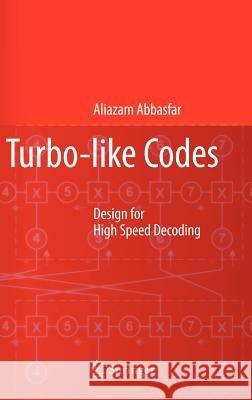
Turbo-Like Codes: Design for High Speed Decoding Abbasfar, Aliazam 9781402063909 Springer - książkaWidoczna okładka, to zdjęcie poglądowe, a rzeczywista szata graficzna może różnić się od prezentowanej.

Turbo-Like Codes: Design for High Speed Decoding

ISBN-13: 9781402063909 / Angielski / Twarda / 2007 / 84 str.

Aliazam Abbasfar
cena 401,58
(netto: 382,46 VAT:  5%)

Najniższa cena z 30 dni: 385,52
Termin realizacji zamówienia:
ok. 22 dni roboczych
Dostawa w 2026 r.

Darmowa dostawa!

The common property among turbo-like code is that they consist of very simple constituent codes that are connected to each other with random or pseudorandom interleavers. The crucial novelty in these codes is the iterative decoding. This means that the constituent codes are decoded separately, which is ef?cient and practically feasible since they are very simple codes. Then, they pass new information to each other in a course of a few iterations. It has been shown that iterative decoding is a generalization of the well-known probability or belief propagation algorithm. The belief propagation algorithm that has been essential for development of new ideas throughout this work is described in the context of coding. The basic theorems for this algorithm are explained and proven in the following paragraphs. Thisis then followed by a description of the computational algorithm. The probability propagation algorithm is proven in c- junctionwithatree-structuredgraph graphswithoutanycycle.Infact, thegraphical representation of any problem solved by this algorithm is the centerpiece of the algorithm. The generalization of the algorithm for graphs with cycles is presented later on. Representation of codes on graph is the next step towards characterization of the iterative decoding as an example of the probability propagation algorithm. The graph representations are presented for a few codes that are commonly used in turbo-like codes."


Kategorie:
Technologie
Kategorie BISAC:
Technology & Engineering > Electrical
Computers > Information Theory
Technology & Engineering > Electronics - General
Wydawca:
Springer
Język:
Angielski
ISBN-13:
9781402063909
Rok wydania:
2007
Wydanie:
2007
Ilość stron:
84
Waga:
0.73 kg
Wymiary:
23.5 x 15.5
Oprawa:
Twarda
Wolumenów:
01
Dodatkowe informacje:
Wydanie ilustrowane

List of Figures. List of Tables. Acknowledgments. Abstract. 1 Introduction. 1.1 Outline. 2 Turbo concept. 2.1 Turbo codes and turbo-like codes. 2.2 Iterative decoding. 2.3 Probability propagation algorithms. 2.4 Message passing algorithm. 2.5 Graphs with cycles. 2.6 Codes on graph. 3 High speed turbo decoders. 3.1 Introduction. 3.2 BCJR algorithm. 3.3 Turbo decoding. 3.4 Pipelined turbo decoder. 3.5 Parallel turbo decoder. 3.6 Speed gain and efficiency. 3.7 Interleaver Design. 3.8 Hardware complexity. 3.9 Conclusion. 4 Very simple turbo-like codes. 4.1 Introduction. 4.2 RA codes. 4.3 RA codes with puncturing. 4.4 ARA codes. 4.5 Other precoders. 4.6 Hardware complexity. 4.7 Conclusion. 5 High speed turbo-like decoders. 5.1 Introduction. 5.2 Parallel ARA decoder. 5.3 Speed gain and efficiency. 5.4 Interleaver design. 5.5 Projected graph. 5.6 General hardware architecture. 5.7 Conclusion. References. Index.

The advent of turbo codes has sparked tremendous research activities around the theoretical and practical aspects of turbo codes and turbo-like codes. The crucial novelty in these codes is the iterative decoding.

Turbo-like Codes introduces turbo error correcting concept in a simple language, including a general theory and the algorithms for decoding turbo-like code. It presents a unified framework for the design and analysis of turbo codes and LDPC codes and their decoding algorithms.

A major focus of Turbo-like Codes is on high speed turbo decoding, which targets applications with data rates of several hundred million bits per second (Mbps). In this book a novel high-speed turbo decoder is presented that exploits parallelization. Parallelism is achieved very efficiently by exploiting the flexibility of message-passing algorithm. It has been shown that very large speed gains can be achieved by this scheme while the efficiency is maintained reasonably high. Memory access, which poses a practical problem for the proposed parallel turbo decoder, is solved by introducing the conflict-free interleaver. The latency is further improved by designing a special kind of conflict-free interleaver. Furthermore, an algorithm to design such interleaver is presented. It is shown that the performance of turbo code is not sacrificed by using the interleaver with the proposed structure.

Although turbo code has near Shannon-capacity performance and the proposed architecture for parallel turbo decoder provides a very efficient and highly regular hardware, the circuit is still very complex and demanding for very high-speed decoding. Therefore, the next step would be finding turbo-like codes that not only achieve excellent error correction capability, but also are very simple. As a result, a class of new Low-Density Parity-Check (LDPC) codes for different rates and block-sizes, called Accumulate-Repeat-Accumulate (ARA) codes, is presented. The performance of ARA codes is analyzed and shown that some ARA codes perform very close to random codes, which achieve Shannon limit.


Udostępnij

Facebook - konto krainaksiazek.pl


Opinie o Krainaksiazek.pl na Opineo.pl

Partner Mybenefit

Krainaksiazek.pl w programie rzetelna firma Krainaksiaze.pl - płatności przez paypal

Czytaj nas na:

Facebook - krainaksiazek.pl
  • książki na zamówienie
  • granty
  • książka na prezent
  • kontakt
  • pomoc
  • opinie
  • regulamin
  • polityka prywatności

Zobacz:

  • Księgarnia czeska

  • Wydawnictwo Książkowe Klimaty

1997-2025 DolnySlask.com Agencja Internetowa

© 1997-2022 krainaksiazek.pl
     
KONTAKT | REGULAMIN | POLITYKA PRYWATNOŚCI | USTAWIENIA PRYWATNOŚCI
Zobacz: Księgarnia Czeska | Wydawnictwo Książkowe Klimaty | Mapa strony | Lista autorów
KrainaKsiazek.PL - Księgarnia Internetowa

Polityka prywatnosci - link
Krainaksiazek.pl - płatnośc Przelewy24
Przechowalnia Przechowalnia





