• Wyszukiwanie zaawansowane
  • Kategorie
  • Kategorie BISAC
  • Książki na zamówienie
  • Promocje
  • Granty
  • Książka na prezent
  • Opinie
  • Pomoc
  • Załóż konto
  • Zaloguj się

Tritium and Helium-3 in Metals » książka


zaloguj się | załóż konto
Logo Krainaksiazek.pl

koszyk

konto

szukaj
topmenu
Księgarnia internetowa
Szukaj
Książki na zamówienie
Promocje
Granty
Książka na prezent
Moje konto
Pomoc
 
 
Wyszukiwanie zaawansowane
Pusty koszyk
Bezpłatna dostawa dla zamówień powyżej 20 złBezpłatna dostawa dla zamówień powyżej 20 zł

Kategorie główne

• Nauka
 [2946600]
• Literatura piękna
 [1856966]

  więcej...
• Turystyka
 [72221]
• Informatyka
 [151456]
• Komiksy
 [35826]
• Encyklopedie
 [23190]
• Dziecięca
 [619653]
• Hobby
 [140543]
• AudioBooki
 [1577]
• Literatura faktu
 [228355]
• Muzyka CD
 [410]
• Słowniki
 [2874]
• Inne
 [445822]
• Kalendarze
 [1744]
• Podręczniki
 [167141]
• Poradniki
 [482898]
• Religia
 [510455]
• Czasopisma
 [526]
• Sport
 [61590]
• Sztuka
 [243598]
• CD, DVD, Video
 [3423]
• Technologie
 [219201]
• Zdrowie
 [101638]
• Książkowe Klimaty
 [124]
• Zabawki
 [2473]
• Puzzle, gry
 [3898]
• Literatura w języku ukraińskim
 [254]
• Art. papiernicze i szkolne
 [8170]
Kategorie szczegółowe BISAC

Tritium and Helium-3 in Metals

ISBN-13: 9783642735127 / Angielski / Miękka / 2011 / 159 str.
Rainer L. Sser
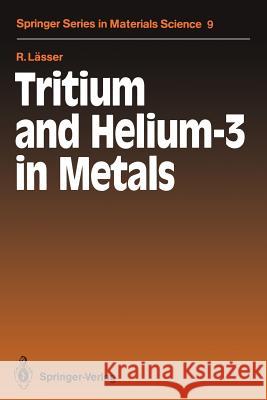
Tritium and Helium-3 in Metals Rainer L 9783642735127 Springer - książkaWidoczna okładka, to zdjęcie poglądowe, a rzeczywista szata graficzna może różnić się od prezentowanej.

Tritium and Helium-3 in Metals

ISBN-13: 9783642735127 / Angielski / Miękka / 2011 / 159 str.

Rainer L. Sser
cena 403,47 zł
(netto: 384,26 VAT:  5%)

Najniższa cena z 30 dni: 385,52 zł
Termin realizacji zamówienia:
ok. 22 dni roboczych
Bez gwarancji dostawy przed świętami

Darmowa dostawa!

Hydrogen can behave as an alkaline metal or a halogen and can react with nearly all elements of the periodic table. This explains the large number of metal hydrides. Since T. Graham's first observation of the absorption of hydrogen in palladium in 1866 the behaviour of hydrogen in metals has been studied very extensively. The interest was motivated by the possible application of metal-hydrogen systems in new technologies (e.g., moderator material in nuclear fission reactors, reversible storage material for thermal energy and large amounts of hydrogen) and by the fact that metal hydrides show very exciting physical properties (e.g., superconductivity, quantum diffusion, order-disorder transitions, phase diagrams, etc.). Many of these properties have been determined for the stable hydrogen isotopes Hand D in various metals. In comparison, very little is known about the behaviour of the ra- dioactive isotope tritium in metals. This book is a first attempt to summarize part of the knowledge of tritium gained in the last few years. In addition to the task of presenting the properties of tritium in metals, I have tried to compare these data with those of protium and deuterium. Furthermore, helium-3 is connected inse- parably with tritium via the tritium decay. Therefore one chapter of this book is solely devoted to the curious properties of helium in metals caused mainly by its negligible solubility.


Kategorie:
Nauka, Fizyka
Kategorie BISAC:
Technology & Engineering > Materials Science - General
Science > Termodynamika
Science > Fizyka jądrowa
Wydawca:
Springer
Seria wydawnicza:
Springer Series in Materials Science
Język:
Angielski
ISBN-13:
9783642735127
Rok wydania:
2011
Wydanie:
Softcover Repri
Numer serii:
000044317
Ilość stron:
159
Waga:
0.27 kg
Wymiary:
23.5 x 15.5
Oprawa:
Miękka
Wolumenów:
01

1. Introduction.- 1.1 Brief Historical Survey.- 1.2 Hydrogen Isotopes.- 1.3 Hydrogen in Metals.- 1.4 Helium in Metals.- 1.5 Organization of the Book.- 2. General Aspects of Tritium.- 2.1 Production of Tritium.- 2.1.1 Natural Tritium Production.- 2.1.2 Tritium Production in Nuclear Reactors.- 2.1.3 Tritium Production in Future Fusion Reactors.- 2.1.4 Tritium Production by Nuclear Explosions.- 2.2 Risks Associated with Tritium.- 2.2.1 Incorporation.- 2.2.2 More Indirect Risks.- 2.3 Discharge of Tritium to the Environment.- 2.4 Tritium Handling in Future Fusion Reactors.- 2.4.1 Multiple Containment.- 2.4.2 Pumping and Recycling.- Pumps and Impurity Removal.- Hydrogen Isotope Separation.- 2.4.3 Tritium Breeding Materials.- 2.4.4 Planned Tritium Use at JET.- 2.5 Tritium Waste Handling.- 3. Preparation of Metal Tritides.- 3.1 Electrolytical Charging of Metals with Tritium.- 3.2 Breeding of Tritium in Metals.- 3.3 Tritium Charging of Metals by Means of Nuclear Reactions and Ion Implantation.- 3.4 Tritium Charging of Metals from the Gas Phase.- 3.4.1 Uranium Tritide Storage Containers.- 3.4.2 A Typical Sample Chamber.- 3.4.3 Capacitance Manometers.- 3.4.4 Glove Boxes.- 3.4.5 Material for the First Containment.- 3.5 Tritium Charging of Metals by Means of Metal Tritides.- 3.6 Metals Employed for Tritium Storage.- 3.6.1 Uranium Tritide.- 3.6.2 Palladium Tritide.- 3.6.3 LaNi5-xAlx Tritides.- 3.6.4 Vanadium Tritide.- 3.6.5 Tritides of Ti, Zr, La and the Rare Earths.- 3.6.6 Stability of Binary and Ternary Metal Tritides.- 3.7 Permeability of Tritium in Metals.- 4. Analysis of Tritium in Metals.- 4.1 Outgassing and/or Combustion.- 4.2 Gas Release Behaviour of MTr Samples.- 4.3 Tritium Induced X Rays.- 4.4 Tritium Imaging.- 4.5 Tritium Autoradiography.- 5. Properties of Protium, Deuterium and Tritium in Selected Metals.- 5.1 Solubility of Protium, Deuterium and Tritium in Palladium.- 5.1.1 Solubility of Protium, Deuterium and Tritium in the ? Phase of the Pd-X (X=H, D, T) System.- 5.1.2 Solubility of Protium, Deuterium and Tritium in the ?, ?+? and ? Phases of the Pd-X (X=H, D, T) System.- 5.2 Solubility of Protium, Deuterium and Tritium in Palladium Silver Alloys.- 5.2.1 Solubility of Protium, Deuterium and Tritium in Palladium Silver Alloys for Hydrogen Concentrations r?0.02.- 5.2.2 Solubility of Protium, Deuterium and Tritium in Palladium Silver Alloys for Hydrogen Concentrations r?0.50.- 5.3 Solubility of Protium, Deuterium and Tritium in Lithium and Yttrium.- 5.4 Solubility of Protium and Deuterium in Vanadium.- 5.5 Isotope Dependence of the Phase Boundaries in the Pd-X, V-X and Nb-X (X = H, D, T) Systems.- 5.5.1 Phase Boundaries of the Pd-H, Pd-D and Pd-T Systems.- 5.5.2 The Phase Diagram of the V-T System.- 5.5.3 The Phase Diagram of the Nb-T System.- 5.6 Optical Vibrations of Protium, Deuterium and Tritium in Niobium.- 5.7 Superconductivity of the Pd-H, Pd-D and Pd-T Systems.- 5.8 Isotope Dependence of Phonon Dispersion Curves in PdD0.63 and PdT0.7.- 5.9 Isotope Effect in Dingle Temperatures and Extremal Cross Sections of the Fermi Surface in PdHr, PdDr and PdTr.- 5.10 Diffusion of Protium, Deuterium and Tritium in Selected Metals.- 5.10.1 Diffusion of H, D, T in V, Nb, Ta.- 5.10.2 Diffusion of H, D, T in Dilute Pd-Fe Alloys.- 5.10.3 Diffusion of H, D, T in Cu and Ni.- 5.11 Lattice Dilation in V, Nb, and Ta Produced by Protium, Deuterium and Tritium.- 6. Properties of Helium-3 in Selected Metals.- 6.1 Basic Properties of Helium in Metals.- 6.1.1 Energetics of Helium in Metals.- 6.1.2 Kinetics of Helium Precipitation in Metals.- 6.2 Helium Release from Metal Tritides.- 6.3 He Bubbles in Metal Tritides.- 6.3.1 NMR Measurements.- 6.3.2 TEM Measurements.- TEM Measurements of PdTr0-cHec Samples.- TEM Measurements of VTr0-cHec Samples.- TEM Measurements of NbTr0-cHec Samples.- TEM Measurements of ZrTr0-cHec Samples.- 6.3.3 Observation of Solid-Fluid Transitions of 3He in the Bubbles of PdTr0-cHec Samples.- 6.4 Acoustic Emission by Metal Tritides.- 6.5 Swelling of Various Metal Tritides.- 6.6 Lattice Parameter and Width of the Rocking Curves of TaTr0-cHec Samples in the ? Phase.- 6.6.1 X-Ray Diffraction Measurements of TaTr0-cHec.- 6.6.2 Neutron-Scattering Measurements of TaTr0-cHec.- 6.7 Preliminary Results for Helium-3-Induced Effects in Selected Metals.- 6.7.1 Mechanical Properties of Metal Tritides.- 6.7.2 He-Induced Change of the Tritium Diffusion in Dilute Tantalum Tritides.- 6.7.3 Phase Transitions in Metal Tritides.- 6.7.4 Resistivity of Lutetium Tritides.- 6.7.5 Analysis of Metal Tritides Using Positron-Annihilation Techniques.- 6.7.6 Room-Temperature Creep of Metal Tritides.- 7. Conclusion and Outlook.- References.


Udostępnij

Facebook - konto krainaksiazek.pl


Opinie o Krainaksiazek.pl na Opineo.pl

Partner Mybenefit

Krainaksiazek.pl w programie rzetelna firma Krainaksiaze.pl - płatności przez paypal

Czytaj nas na:

Facebook - krainaksiazek.pl
  • książki na zamówienie
  • granty
  • książka na prezent
  • kontakt
  • pomoc
  • opinie
  • regulamin
  • polityka prywatności

Zobacz:

  • Księgarnia czeska

  • Wydawnictwo Książkowe Klimaty

1997-2025 DolnySlask.com Agencja Internetowa

© 1997-2022 krainaksiazek.pl
     
KONTAKT | REGULAMIN | POLITYKA PRYWATNOŚCI | USTAWIENIA PRYWATNOŚCI
Zobacz: Księgarnia Czeska | Wydawnictwo Książkowe Klimaty | Mapa strony | Lista autorów
KrainaKsiazek.PL - Księgarnia Internetowa

Polityka prywatnosci - link
Krainaksiazek.pl - płatnośc Przelewy24
Przechowalnia Przechowalnia





