• Wyszukiwanie zaawansowane
  • Kategorie
  • Kategorie BISAC
  • Książki na zamówienie
  • Promocje
  • Granty
  • Książka na prezent
  • Opinie
  • Pomoc
  • Załóż konto
  • Zaloguj się

Thermodynamics of Energy Conversion and Transport » książka


zaloguj się | załóż konto
Logo Krainaksiazek.pl

koszyk

konto

szukaj
topmenu
Księgarnia internetowa
Szukaj
Książki na zamówienie
Promocje
Granty
Książka na prezent
Moje konto
Pomoc
 
 
Wyszukiwanie zaawansowane
Pusty koszyk
Bezpłatna dostawa dla zamówień powyżej 20 złBezpłatna dostawa dla zamówień powyżej 20 zł

Kategorie główne

• Nauka
 [2946600]
• Literatura piękna
 [1856966]

  więcej...
• Turystyka
 [72221]
• Informatyka
 [151456]
• Komiksy
 [35826]
• Encyklopedie
 [23190]
• Dziecięca
 [619653]
• Hobby
 [140543]
• AudioBooki
 [1577]
• Literatura faktu
 [228355]
• Muzyka CD
 [410]
• Słowniki
 [2874]
• Inne
 [445822]
• Kalendarze
 [1744]
• Podręczniki
 [167141]
• Poradniki
 [482898]
• Religia
 [510455]
• Czasopisma
 [526]
• Sport
 [61590]
• Sztuka
 [243598]
• CD, DVD, Video
 [3423]
• Technologie
 [219201]
• Zdrowie
 [101638]
• Książkowe Klimaty
 [124]
• Zabawki
 [2473]
• Puzzle, gry
 [3898]
• Literatura w języku ukraińskim
 [254]
• Art. papiernicze i szkolne
 [8170]
Kategorie szczegółowe BISAC

Thermodynamics of Energy Conversion and Transport

ISBN-13: 9780387989389 / Angielski / Twarda / 2000 / 335 str.
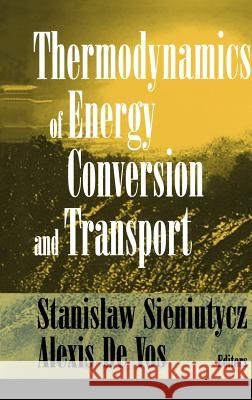
Stanislaw Sieniutycz; Alexis De Vos; S. Sieniutycz
Thermodynamics of Energy Conversion and Transport Stanislaw Sieniutycz Alexis D S. Sieniutycz 9780387989389 Springer - książkaWidoczna okładka, to zdjęcie poglądowe, a rzeczywista szata graficzna może różnić się od prezentowanej.

Thermodynamics of Energy Conversion and Transport

ISBN-13: 9780387989389 / Angielski / Twarda / 2000 / 335 str.

Stanislaw Sieniutycz; Alexis De Vos; S. Sieniutycz
cena 605,23 zł
(netto: 576,41 VAT:  5%)

Najniższa cena z 30 dni: 578,30 zł
Termin realizacji zamówienia:
ok. 22 dni roboczych
Bez gwarancji dostawy przed świętami

Darmowa dostawa!

It is becoming more and more important to manage energy resources effectively: to maximize their benefits while minimizing the negative environmental impacts. Scientist and engineers are thus faced with the problem of optimizing complex systems subject to constraints from, ecology, economics, and thermodynamics. It is chiefly to the last that the present volume is addressed. Nonequilibrium thermodynamic approaches, such as finite-time thermodynamics and Second-Law analyses, can provide realistic models and analyses that can be used to search for optimum ways to operate machines and processes. Intended for physicists, chemists, and engineers, this volume reviews the state of the art in the thermodynamics of energy conversion and transmission. Using examples from solar, thermal, mechanical, chemical, and environmental engineering, the book focuses on the use of thermodynamic criteria for optimizing energy conversion and transmission. The first set of chapters focuses on solar energy conversion; the second set discusses the transfer and conversion of chemical energy (as in internal combustion engines or distillation columns); a concluding set of chapters deals with geometric methods in thermodynamics.


Kategorie:
Technologie
Kategorie BISAC:
Science > Termodynamika
Science > Energia
Science > Fizyka
Wydawca:
Springer
Język:
Angielski
ISBN-13:
9780387989389
Rok wydania:
2000
Wydanie:
2000
Ilość stron:
335
Waga:
1.51 kg
Wymiary:
23.5 x 15.5
Oprawa:
Twarda
Wolumenów:
01
Dodatkowe informacje:
Bibliografia
Wydanie ilustrowane

I Conversion of Radiative Energy.- 1 Statistical Mechanics of Solar Energy Conversion.- 1.1 Introduction.- 1.2 Information Theory and Statistical Mechanics.- 1.2.1 Relative Information.- 1.2.2 Exergy.- 1.3 Benchmark: Black-Body Radiation as a Free Photon Gas.- 1.4 Problems with the Black-Body Radiation Model.- 1.4.1 Isotropy.- 1.4.2 Energy Extraction.- 1.4.3 Distribution Function.- 1.5 Solar Energy Absorption Devices.- 1.5.1 Photochemical Solar Energy Conversion.- 1.6 Further Conversion of the Photon Energy: Losses and Efficiency.- 1.6.1 Dissipation Mechanisms.- 1.6.2 Maximum Efficiency and Statistical Mechanics Models.- 1.7 References.- 2 Thermodynamics of Solar Energy Conversion into Work.- 2.1 Introduction.- 2.2 Upper Bound Efficiencies.- 2.2.1 Simple Upper Bounds for Black-Body Radiation Conversion.- 2.2.2 Simple Upper Bound for Diluted Radiation Conversion.- 2.2.3 More Accurate Simple Upper Bound Efficiency.- 2.3 Terrestrial Applications.- 2.3.1 Converting Direct Solar Radiation.- 2.3.2 Converting Diffuse Solar Radiation.- 2.3.3 Converting Global Solar Radiation.- 2.4 Space Applications.- 2.4.1 Solar Space Power System Model.- 2.4.2 Classical Thermodynamic Model.- 2.4.3 Finite-Time Thermodynamics Model.- 2.5 Further Research and Studies.- 2.6 References.- 3 Thermodynamics of Photovoltaics.- 3.1 Introduction.- 3.2 Endoreversible Thermal Engines.- 3.3 Endoreversible Chemical Engines.- 3.4 Endoreversible Thermochemical Engines.- 3.5 Solar Cells.- 3.6 Solar Cells with Larger-than-Unity Quantum Efficiency.- 3.7 Tandem Solar Cells.- 3.8 Conclusion.- 3.9 References.- 4 Some Methods of Analyzing Solar Cell Efficiencies.- 4.1 Introduction.- 4.2 The Solar Cell Equation: Currents from Photon Fluxes.- 4.3 Efficiencies in General.- 4.4 Theoretical Efficiencies of a Simple Heterojunction.- 4.5 Special Cases of the Simple Theory.- 4.5.1 Homojunction with or without Impact Ionization.- 4.5.2 Hetero junction without Impact Ionization.- 4.6 Analysis of Heterojunction Cells Allowing for Impact Ionization.- 4.7 The Graded Gap Solar Cell.- 4.7.1 General.- 4.7.2 Photon Absorption Coefficient.- 4.7.3 Photon Emission Rates.- 4.7.4 Solar Energy Conversion.- 4.8 Thermophotovoltaic Conversion.- 4.8.1 Definitions.- 4.8.2 Theory of TPV Conversion.- 4.9 Recent Results.- 4.10 Conclusions.- 4.11 References.- 5 Solar buildings.- 5.1 Finalistic Systems. Introduction.- 5.2 The Geophysical Inputs.- 5.2.1 The Incoming Solar Flux.- 5.2.2 The Equation for TEdry.- 5.2.3 The Equation for TEwet.- 5.3 The Model of the Solar House.- 5.3.1 General Remarks on the Model with Fixed Controls.- 5.3.2 The Annual Control.- 5.4 Backup and Adaptive Controls.- 5.5 References.- II Conversion of Thermal and Chemical Energy.- 6 Discrete Hamiltonian Analysis of Endoreversible Thermal Cascades.- 6.1 Introduction: Multistage Novikov-Curzon-Ahlborn Process.- 6.2 A Single Stage with the Driving Heat Flux as a Control Variable.- 6.3 Applying Single-Stage Formulas to a Multistage Process.- 6.4 Pontryagin’s Structure of Optimal Control.- 6.5 Work Maximizing in NCA Cascades by Discrete Maximum Principle.- 6.6 The Hamiltonian as the Lagrange Multiplier of a Time Constraint.- 6.7 Limiting Continuous Process.- 6.8 Concluding Remarks.- 6.9 References.- 7 Optimal Piston Paths for Diesel Engines.- 7.1 Introduction.- 7.2 Model.- 7.2.1 Combustion.- 7.2.2 Frictional Losses.- 7.2.3 Conductive and Convective Heat Leak.- 7.2.4 Radiative Heat Leak.- 7.3 Optimization.- 7.3.1 Control Theory.- 7.3.2 Stochastic Optimization.- 7.4 Results.- 7.4.1 Optimal Path.- 7.4.2 Optimal Time of Ignition.- 7.5 Conclusion.- 7.6 References.- 8 Qualitative Properties of Conductive Heat Transfer.- 8.1 Theoretical Background.- 8.1.1 Fourier’s Differential Equation.- 8.1.2 Balance of Internal Energy.- 8.1.3 Material (Constitutive) Equations.- 8.1.4 Transport Equation. Initial and Boundary Conditions.- 8.1.5 Heat Conduction in Irreversible Thermodynamics.- 8.1.6 Variational Principles.- 8.1.7 Stationary Case.- 8.1.8 Temperature Scales: Pictures, Kelvin’s Transformation.- 8.2 Consequences of the Second Law.- 8.2.1 Heat Conductional Inequality.- 8.2.2 Maximum Principle.- 8.3 The Velocity of Propagation.- 8.4 System Theory Approach.- 8.4.1 Heat Conduction and Dynamical Systems Theory.- 8.4.2 Principle of Superposition.- 8.4.3 A Postulatory Approach to Stationary Heat Conduction.- 8.5 Properties of the Solution of the Linear Heat Equation.- 8.6 Numerical Solution of the Linear Heat Equation.- 8.6.1 Solution of the Problem by the Fourier Method.- 8.6.2 Finite Difference Method.- 8.6.3 Galerkin Finite Element Method.- 8.7 Properties and Their Preservation for the Discretization.- 8.7.1 Qualitative Properties of the Numerical Solution.- 8.7.2 Conditions for the Preservation of Qualitative Properties.- 8.8 Temperature Waves.- 8.8.1 Shape Preserving Property.- 8.8.2 Classification of SPSFs.- 8.8.3 Asymptotic Behavior; Stability.- 8.9 References.- 9 Energy Transfer in Particle—Surface Collisions.- 9.1 Introduction.- 9.1.1 Collision Energy Domains of Neutral and Ion Projectiles.- 9.2 Neutral Particle-Surface Energy Transfer.- 9.2.1 Translational Energy Transfer.- 9.2.2 Rotational Energy Transfer.- 9.2.3 Vibrational Energy Transfer.- 9.2.4 Energy Exchange in Cluster-Surface Collisions.- 9.3 Slow Ion-Surface Energy Exchange.- 9.3.1 Neutralization of Ions at Surfaces.- 9.3.2 Collisions of Atomic Ions with Surfaces.- 9.3.3 Collisions of Simple Molecular Ions with Surfaces.- 9.3.4 Collisions of Polyatomic Ions with Surfaces.- 9.3.5 Collisions of Cluster Ions with Surfaces.- 9.4 References.- III Energy in Geometrical Thermodynamics.- 10 Geometrical Methods in Thermodynamics.- 10.1 Introduction.- 10.2 Contact Manifolds.- 10.3 Contact Transformations and Contact Vector Fields.- 10.4 Bracket Structures in Thermodynamics.- 10.5 Thermodynamic Examples of Contact Flows.- 10.6 Almost Contact and Contact Metric Structures.- 10.7 Construction of a Contact Metric.- 10.8 Statistical Derivation of G.- 10.9 Relative Information and Riemannian Metric.- 10. 10 References.- 11 From Statistical Distances to Minimally Dissipative Processes.- 11.1 Introduction.- 11.2 Empirical Statistical Distance.- 11.2.1 Optimum Calibration.- 11.2.2 Naive Optimum Control.- 11.2.3 More Parameters.- 11.3 Theory of Statistical Distance.- 11.3.1 Classical Statistics.- 11.3.2 Quantum Statistics.- 11.4 Riemannian Geometry.- 11.4.1 Parameterized Statistics.- 11.4.2 From Gibbs Statistics to Thermodynamics.- 11.5 Relevance of Riemannian Geometry in Thermodynamics.- 11.5.1 A Covariant Fluctuation Theory.- 11.5.2 Entropy Production.- 11.5.3 The Metric as a Symmetric Product.- 11.5.4 The Group of Transformations.- 11.5.5 Dissipation in a Small Equilibration.- 11.5.6 The Discrete Horse-Carrot Theorem.- 11.5.7 The Continuous Horse-Carrot Theorem.- 11.5.8 Cooling Rates for Simulated Annealing.- 11.6 Staged Steady Flow Processes.- 11.6.1 Dissipation in a Distillation Column.- 11.7 Conclusions.- 11.8 References.- 12 Distillation by Thermodynamic Geometry.- 12.1 Introduction.- 12.2 Thermodynamic Length.- 12.3 Optimization of a Step Process.- 12.4 A Classical Distillation Column.- 12.5 Optimal Temperature Profile.- 12.6 Example.- 12.7 References.


Udostępnij

Facebook - konto krainaksiazek.pl


Opinie o Krainaksiazek.pl na Opineo.pl

Partner Mybenefit

Krainaksiazek.pl w programie rzetelna firma Krainaksiaze.pl - płatności przez paypal

Czytaj nas na:

Facebook - krainaksiazek.pl
  • książki na zamówienie
  • granty
  • książka na prezent
  • kontakt
  • pomoc
  • opinie
  • regulamin
  • polityka prywatności

Zobacz:

  • Księgarnia czeska

  • Wydawnictwo Książkowe Klimaty

1997-2025 DolnySlask.com Agencja Internetowa

© 1997-2022 krainaksiazek.pl
     
KONTAKT | REGULAMIN | POLITYKA PRYWATNOŚCI | USTAWIENIA PRYWATNOŚCI
Zobacz: Księgarnia Czeska | Wydawnictwo Książkowe Klimaty | Mapa strony | Lista autorów
KrainaKsiazek.PL - Księgarnia Internetowa

Polityka prywatnosci - link
Krainaksiazek.pl - płatnośc Przelewy24
Przechowalnia Przechowalnia





