• Wyszukiwanie zaawansowane
  • Kategorie
  • Kategorie BISAC
  • Książki na zamówienie
  • Promocje
  • Granty
  • Książka na prezent
  • Opinie
  • Pomoc
  • Załóż konto
  • Zaloguj się

The Waste Market: Institutional Developments in Europe » książka


zaloguj się | załóż konto
Logo Krainaksiazek.pl

koszyk

konto

szukaj
topmenu
Księgarnia internetowa
Szukaj
Książki na zamówienie
Promocje
Granty
Książka na prezent
Moje konto
Pomoc
 
 
Wyszukiwanie zaawansowane
Pusty koszyk
Bezpłatna dostawa dla zamówień powyżej 20 złBezpłatna dostawa dla zamówień powyżej 20 zł

Kategorie główne

• Nauka
 [2949965]
• Literatura piękna
 [1857847]

  więcej...
• Turystyka
 [70818]
• Informatyka
 [151303]
• Komiksy
 [35733]
• Encyklopedie
 [23180]
• Dziecięca
 [617748]
• Hobby
 [139972]
• AudioBooki
 [1650]
• Literatura faktu
 [228361]
• Muzyka CD
 [398]
• Słowniki
 [2862]
• Inne
 [444732]
• Kalendarze
 [1620]
• Podręczniki
 [167233]
• Poradniki
 [482388]
• Religia
 [509867]
• Czasopisma
 [533]
• Sport
 [61361]
• Sztuka
 [243125]
• CD, DVD, Video
 [3451]
• Technologie
 [219309]
• Zdrowie
 [101347]
• Książkowe Klimaty
 [123]
• Zabawki
 [2362]
• Puzzle, gry
 [3791]
• Literatura w języku ukraińskim
 [253]
• Art. papiernicze i szkolne
 [7933]
Kategorie szczegółowe BISAC

The Waste Market: Institutional Developments in Europe

ISBN-13: 9789048179633 / Angielski / Miękka / 2010 / 160 str.
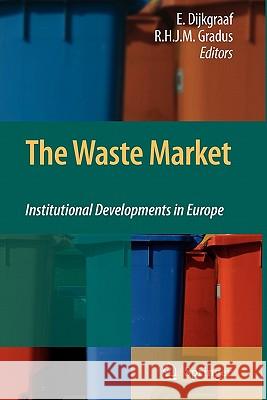
Elbert Dijkgraaf;Raymond H. J. M. Gradus
The Waste Market: Institutional Developments in Europe Elbert Dijkgraaf, Raymond H. J. M. Gradus 9789048179633 Springer - książkaWidoczna okładka, to zdjęcie poglądowe, a rzeczywista szata graficzna może różnić się od prezentowanej.

The Waste Market: Institutional Developments in Europe

ISBN-13: 9789048179633 / Angielski / Miękka / 2010 / 160 str.

Elbert Dijkgraaf;Raymond H. J. M. Gradus
cena 403,47
(netto: 384,26 VAT:  5%)

Najniższa cena z 30 dni: 385,52
Termin realizacji zamówienia:
ok. 22 dni roboczych
Bez gwarancji dostawy przed świętami

Darmowa dostawa!

E. Dijkgraaf and R. H. J. M. Gradus 1. 1 Introduction In 2004 Elbert Dijkgraaf nished a PhD-thesis Regulating the Dutch waste market at the Erasmus University Rotterdam. It was interesting that not much is published about the waste market, although it is a very important sector from an economic and environmental viewpoint. In 2006 we were participants at a very interesting conf- ence on Local Government Reform: privatization and public-private collaboration in Barcelona organized by Germa Bel. It was interesting to notice that researchers from Spain, Scandinavian countries, the UK and the USA were studying this issue as well. From this we brought forward the idea to publish a book about the waste market. Because of its legal framework we want to focus on Europe. In this chapter we give an introduction to this book. In the next paragraph we present a short overview of the waste collection market. Since 1960 the importance of the waste sector has increased substantially both in the waste streams and the costs of waste collection and treatment. Furthermore, we discuss policy measures to deal with these increases and give an overview of the different measures in - countries. In the last paragraph we present different chapters of our book. 1. 2 Empirical Update of the Waste Collection Market The Dutch case provides a nice example why studying the waste market is int- esting from an economic point of view."


Kategorie:
Nauka, Ekonomia i biznes
Kategorie BISAC:
Business & Economics > Industrial Management
Business & Economics > Economics - General
Science > Environmental Science (see also Chemistry - Environmental)
Wydawca:
Springer
Język:
Angielski
ISBN-13:
9789048179633
Rok wydania:
2010
Dostępne języki:
Angielski
Ilość stron:
160
Waga:
0.45 kg
Wymiary:
23.523.5 x 15.5
Oprawa:
Miękka
Wolumenów:
01

From the reviews:

"This specialized work on the topic of solid waste collection management in five European countries consists of eight substantive chapters: four on Holland and one each on Sweden, Norway, Spain, and Belgium. ... for those concerned with the efficiency of municipal operations ... this work, edited by academicians from the Netherlands, is a valuable resource containing much food for thought. Summing Up: Recommended. Comprehensive graduate, research, and professional collections." (J. Prager, Choice, Vol. 46 (11), July, 2009)

1. Introduction.- 1.1 Empirical update of the waste collection market.- 1.2 Description and purpose of the book.- Reference list.- 2. Cost saving of contracting out refuse collection in the Netherlands.- 2.1 Introduction.- 2.2 Effects of tendering: Estimations for the Netherlands.- 2.2.1 Method.- 2.2.2 Data.- 2.2.3 Fiscal aspects.- 2.2.4 Results.- 2.3 Robustness of results.- 2.4 Conclusions.- Reference list.- 3. Contracting out refuse collection in the Netherlands.- 3.1 Introduction.- 3.2 Theoretical issues.- 3.3 Data.- 3.3.1 Institutional forms.- 3.3.2 Output variables.- 3.3.3 Wealth variables.- 3.3.4 Interest group variables.- 3.3.5 Political variables.- 3.4 Estimation results: logit.- 3.5 Robustness of results.- 3.6 Conclusions.- Reference list.- 4. Contracting out in Sweden: Ownership and production costs.- 4.1 Introduction.- 4.2 Data and the decision-making process.- 4.3 Models and estimation strategy.- 4.3.1 How it has usually been done.- 4.3.2 Why it may be wrong.- 4.3.3 How it could be done.- 4.4 Theoretical framework.- 4.5 Evidence: costs and producer choice.- 4.5.1 Representative sample.- 4.5.2 Producer choice.- 4.5.3 Cost functions.- 4.5.4 Producer choice taking costs into account.- 4.5.5 Model selection.- 4.6 Concluding remarks.- Reference list.- Appendix A: The data.- Appendix B: Maximum likelihood estimations.- 5. Does public ownership impair efficiency in Norwegian refuse collection?- 5.1 Introduction.- 5.2 Corporate governance versus political economy.- 5.2.1 Corporate governance theory.- 5.2.2 Political economy theory.- 5.2.3 Empirical studies on public ownership.- 5.3 Refuse collectio in Norwegian local government.- 5.4 The impact of dispersed ownership on costs and user charges.- 5.5. Conclusions.- Reference list.- 6. Refuse collection in Spain: Privatization, intermunicipal cooperation, and concentration.- 6.1 Introduction.- 6.2 The structureof the solid waste service production in Spain.- 6.3 Intermunicipal cooperation.- 6.4 Concentration and competition in the private market for concessions.- 6.5 Conclusions.- Reference list.- Appendix A.- 7. How to get increasing competition in the Dutch refuse collection market?- 7.1 Introduction.- 7.2 Development of the Dutch Refuse Collection Market over time.- 7.3 Methodology and data.- 7.4 Results.- 7.5 Conclusions.- Reference list.- 8. Dutch cost savings in unit-based pricing of household waste.- 8.1 Introduction.- 8.2 Effects of unit-based pricing.- 8.2.1 Method and data.- 8.2.2 Results.- 8.2.3 The price elasticities of the pricing systems.- 8.3 The importance of environmental activism.- 8.4 The effect on surrounding municipalities.- 8.5 Administrative costs and illegal dumping.- 8.6 Conclusions.- Reference list.- Appendix A: Definition of variables.- 9. Assessing instruments for mixed household solid waste collection services in Flanders.- 9.1 Introduction.- 9.2 Waste management instruments.- 9.2.1 Pecuniary incentives.- 9.2.2 Service level.- 9.2.3 Municipality specific characteristics.- 9.2.4 Waste reduction and prevention.- 9.2.5 Objective.- 9.3 Conceptual framework.- 9.4 Methodology and data collection.- 9.5 Results and discussion.- 9.6 Conclusions and future research topics.- Reference list.- 10. Final comments and future research.- 10.1 Final comments.- 10.2 Future reseach.- References list.- Index.

Since 1960, the importance of the waste sector has increased substantially in many EU countries from an economic and environmental viewpoint, yet not much literature is readily available on the topic. Key questions answered in this book are whether the use of market oriented methods and organization forms can diminish the increasing costs and stimulate waste reduction and sorting.

The Waste Market undertakes the interesting task of examining the creative ways in which a handful of European countries, namely Belgium, the Netherlands, Norway, Spain, and Sweden, have managed their waste collection market. For instance, the Netherlands experimented a lot with competition and different types of ownership. It shows that competition is more important than ownership. The use of public firms, exceptional in other European countries, seems to be a powerful instrument to enhance competition. The lack of these firms might explain why private production is not always cheaper than own collection by municipalities in Sweden. Instead of public firms, cooperation is much more used in Spain and Norway to exploit economies of scale.

This insightful work also discusses variable charging that motivates customers to reduce waste. Different forms of variable charging are becoming more widespread in Belgium and the Netherlands and are very effective in reducing the amount of waste and help motivate customers to recycle their waste better. In the Netherlands different systems based on weight, bag, volume or frequency are used, which differ in effectiveness and implementation costs. The Flemish experience shows that variable charging can be even more effective, if it is combined with other policy instruments.


Udostępnij

Facebook - konto krainaksiazek.pl


Opinie o Krainaksiazek.pl na Opineo.pl

Partner Mybenefit

Krainaksiazek.pl w programie rzetelna firma Krainaksiaze.pl - płatności przez paypal

Czytaj nas na:

Facebook - krainaksiazek.pl
  • książki na zamówienie
  • granty
  • książka na prezent
  • kontakt
  • pomoc
  • opinie
  • regulamin
  • polityka prywatności

Zobacz:

  • Księgarnia czeska

  • Wydawnictwo Książkowe Klimaty

1997-2025 DolnySlask.com Agencja Internetowa

© 1997-2022 krainaksiazek.pl
     
KONTAKT | REGULAMIN | POLITYKA PRYWATNOŚCI | USTAWIENIA PRYWATNOŚCI
Zobacz: Księgarnia Czeska | Wydawnictwo Książkowe Klimaty | Mapa strony | Lista autorów
KrainaKsiazek.PL - Księgarnia Internetowa

Polityka prywatnosci - link
Krainaksiazek.pl - płatnośc Przelewy24
Przechowalnia Przechowalnia





